Why professionals dislike RADS?

My brain hurts.
That can be an expansion thang...
.
If you're talking about the amount of rope to pull to move one foot, it's a 3:1.
If you're talking about mechanical advantage, it's a 2:1. Pull 100 lbs to raise your 200 lbs body.
We would look for no free ride ;thus a 1 to 1 trade off of distance/power.


Every pulley position gets 2 legs of pull: dual pull on load or anchor or dividing input, but always 2.
.
A static pulley on anchor is a re-direct 1:1 just changes direction
Moving pulley as jig output on load adds extra leg of pull /power against loaded point/but slower in trade.2/1 power traded for 1/2 speed
Moving pulley on jig input as gives extra input length to pull reduces power/increases speed in trade 1/2 power traded for 2/1 speed(double distance in same amount of time)
.
Compound systems are more complicated, but just confidentally follow same rules, re-confirming them even around questionable turns, just keep the faith and carefully follow.
olde_compound_rig_styles.png


the 2 handing systems i try to show i look at as such a compounding. bodyweight + 2xEffort as inputs to maximize.
.
i think should stretch understanding to see compounds, then easier to see 2 handing. But then most assuredly, simpler systems will be well within mental powerband at a glance..
.
old long link: mytreelessons.com/images/Force Patterns of Pulley Systems.GIF
.
edit:
i found this moldy oldie i made to show how consistent the forces play out
>>even around counter-intuitive corners, just keep to the plan
>> with mind open
to perhaps wrap all the way around this more,from viewing this facet of the gem...
(weightless ropes and pulleys on 100# load)
mayhem%20what%20is%20loading.jpg


ANSWER:


G)400; has 100# pulling 'ripcord' /support setting line tensions @100
>>bottom strap simply has 4x100 pulling upward (answer G)
>>top pulley and rope termination pull 200+ 100 downwards respectively
+ 100# device weight downwards
= 400# upward/400# downward on same device so no movement, all forces accounted for
 
Last edited:
When climbing RADS, do you guys really pull youselves up? I step up in my foot loop and pull only to keep slack out of (tend) the system. So even if there is a 2:1 MA on the "pulling end," the vast majority of my weight is raised using my leg.
 
The way I understand the concept of RADS and use this technique is exactly like Hoowasat does.
This is a 'leg' technique not an 'arm' one. The body position should be very similar to the rope walking technique one: strictly vertical with the heel under the butt and the nose touching the rope...
The arms are used lightly. The one holding the ascender is to keep balance and slightly help the leg for lifting the body. The other arm's role is primarily to tend the slack and help in keeping balance. While tending the slack, this arm could pull a bit stronger and therefore bring a contribution to the effort but it is not essential.
And what about the second leg? Some use it to secure their position, if they are close enough to the trunk of the tree. I don't like it, as it is likely that it will affect the vertical position of the body and therefore the efficiency of this technique. If concerned about feeding a leg and get nothing in return, I would use a double foot loop to profit from its power. Then... Heels under the butt and push up!
 
Last edited:

And what about the second leg? Some use it to secure their position, if they are close enough to the trunk of the tree. I don't like it, as it is likely that it will affect the vertical position of the body and therefore the efficiency of this technique. If concerned about feeding a leg and get nothing in return, I would use a double foot loop to profit from its power. Then... Heels under the butt and push up!
In lieu of a double foot loop, I've often donned a foot ascender to use on the "free" end so both my legs do all the work.
 
I climb RADS only, and was not quiet sure how it worked, until now.
After thinking about this whole thing for what seem like an eternity, I think I finally understood how the system works (mainly the 3:1/2:1 thing), and it seems so painfully obvious now. Heres my explanation of the different phases in a RADS climb. I am going to go over the forces involved, hopefully in an easier to understand manner than *useless info*, in order to hopefully make it easy to understand for everybody(keep in mind I am only 15 years old and English is not my first language):

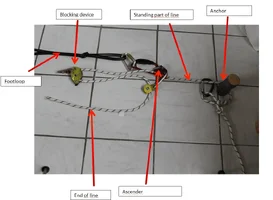
first of, I am going to define some terms here:
Terms.webp

Here is a normal RADS cycle. Forces of 0Kg are not mentioned. The climber only uses the pulley to pull slag out of the rope! All the climbing is done with the legs.

1. phase: climber hangs in blocking device
The weight of the climber, in this case 100kg, hangs in the blocking device. All load is on the standing part of the line.

Climber hanging in grigri.webp

2. Phase: the climber shift up ascender. The load is the same. The end of the line is pulled upwards by the pulley on the ascender.

ascender shifted up.webp


3. Phase: the climber stands up on the footloop.

All weight is on the ascender.

The tension above the ascender is 100kg, the standing line between the blocking device and the ascender is unweighted and slag builds up due to the blocking device being pulled up by the harness of the climber.

standing on footloop.webp

4. Phase: Climber pulls slag through pulley and sits back into his harness and blocking device. The forces and the position of the end of the line are now the same as in phase 1.

sit back in grigri.webp


This is the normal cycle of a RADS system, if the climber only uses the pulley system to pull out slag. But thats not what most climbers do: almost all of them use the pulley system to a certain extend in order to share the load between their arms and legs. This is hard to illustrate, so I am going to assume the climber is not using his legs at all.

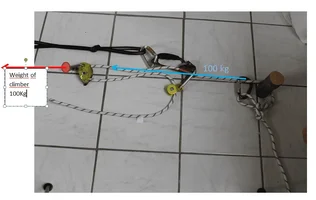
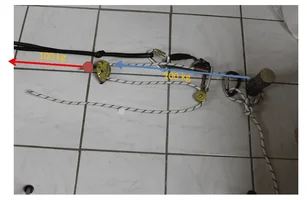
The climber starts off hanging in the braking device and not pulling on the line end with his hand. There is no load on the pulley system, all of the load is on the standing line.
not pulling.webp

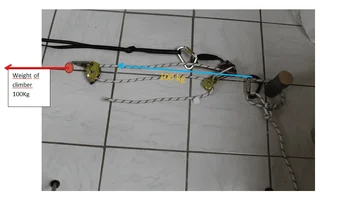
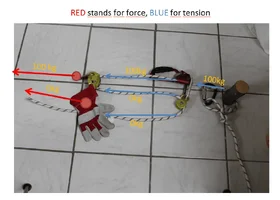
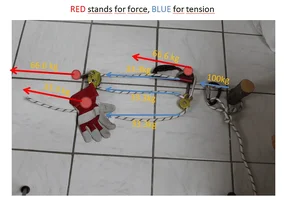
Now the Climber pulls on the end of the line to pull himself up.

While he does this, he distributes the force pulling on the braking device evenly between the standing part of the line and the part of the line between the braking device and the pulley.

Due to him pulling on the end of the line, he pulls less on the braking device, effectively making himself lighter.

When the force on all 3 legs of rope is equal, he starts moving up.

This makes a 3:1 system, where the climber has to pull on the end of the line with a third of his body weight in order to move up.

pulling.webp

The Ascender is pulled down with a force off 66.6kg because the pulley is attached to it!
The forces total 100kg pulling on the Anchor (because the climber still hangs in the rope)


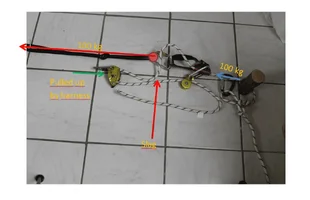
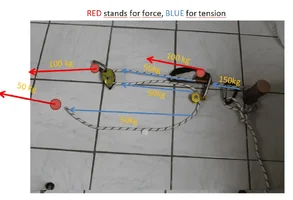
Now we can explain why the RADS system only makes a 2:1 if a groundie pulls on the end of the line:

If the climber is not pulling on it, he hangs in the blocking device with his full body weight, therefore the force is only evenly distributet when the end of the line is pulled at half the weight of the climber (50Kg)Groundie pulling.webp

I hope you understood this, if not, just sit back, look at the pictures again, think about the problem and you will understand it.
 
Jan - WELCOME to TreeBuzz. Considering that you are only 15 years old, and English is your second language, you posted a very good explanation. Good job!
 
Jan - WELCOME to TreeBuzz. Considering that you are only 15 years old, and English is your second language, you posted a very good explanation. Good job!

No kidding.

I’d like to sum up a few of my experiences with RADS for newbie work or rec climbers. (TimBR, I await your follow-up questions with great anticipation.

1) RADS requires an impressively small amount of gear to get going. Less amount, less faffing, less adjusting than with hitch cords and other ascender.

2) It provides a 2:1 mechanical advantage on the GriGri / Rig. if you’re pulling solely with your arm, it’s possible albeit inefficient. As someone else mentioned, the greatest combination in efficiency is an attached footloop while using the hand to tend slack in your main belay device.

3) It is a 1:1 system as far as how much rope you “use” going up. If you start with 10’ of rope flaked out in the ground and climb up 10’, there will still be only 10’ on the ground (+ a tiny bit of stretch depending on rope).

4) it’s easy to configure, easy to use for novices and a fairly safe system. In order to switch over to descent once needs only to take off their hand ascender and remove the tail from the pulley.

There are two main drawbacks that make it non-desirable for production climbers as an ascent system.
A) I can only productively use 1 of my legs. Someone mentioned you could put a foot ascender on the tail exiting the pulley but that sounds pretty awkward to me.
B) you have to manually raise up the hand ascender to provide a future MA anchor point every step you take. Although it’s 1:1 for rope use, you’re actually mking twice the amount of movements for every 1’ of ascent. (upward push of hand ascender, downward pull of MA tail).

I can rip through a tree on a rope walker system with both hands available to steady myself, pass branches, move suckers out of the way or system to assist both my legs which are pushing me up. No need to tend rope, my chest harness does that.

Ps Jan don’t make a habit of anchoring by cross-loading carabiners. There are many other, better and safer solutions.
 
Depends how you implement your RADS, if you set up a quick RADS for a hook traverse or returning from a downhill limbwalk, you're probably simply pulling on the tail, it's a 3:1. If you're using a RADS as a primary climbing system (probably a rec climber) left side of the body (traditional RADS setup) left hand on the ascender, left foot on a footlooop hanging from the ascender, is 1:1, right arm is pulling 3:1. That's why a foot ascender is useless for a RADS unless you're very physically challenged, pulling 3:1 with your right leg is one a of the greater wastes of time and energy in the trees.
-AJ
 
Ps Jan don’t make a habit of anchoring by cross-loading carabiners. There are many other, better and safer solutions.

I always try not to cross-load them, and this works almost always. Usually the carabiner "floats" under the branch with a small gap between. If I would have to cross-load because of a branches shape I use a base anchor or loop the rope through itself.
I have not found any other method for anchoring that avoids rope on rope friction and at the same time allows for quick and easy advancing of my TIP. I have tried rings on the end of my rope, but you have to thread through your entire rope in order to remove them. Do you know any method that could solve my problems?

if you set up a quick RADS for a hook traverse or returning from a downhill limbwalk, you're probably simply pulling on the tail

Are there other methods for setting up RADS than the one I show above?
 
I always try not to cross-load them, and this works almost always. Usually the carabiner "floats" under the branch with a small gap between. If I would have to cross-load because of a branches shape I use a base anchor or loop the rope through itself.
I have not found any other method for anchoring that avoids rope on rope friction and at the same time allows for quick and easy advancing of my TIP. I have tried rings on the end of my rope, but you have to thread through your entire rope in order to remove them. Do you know any method that could solve my problems?

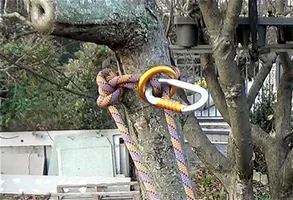
I have a friend who uses a system where he puts his spliced end through a ring then clips into the splice with a carabiner. It’s a better solution

Alternatively just advance up DdRT instead of SRT

Picture for clarity, splice instead of knot
DAF2D33B-2C8F-4BEA-BA66-80B1E93BFC7C.webp

Edit : a screw link maillon (“rapide”) or Quickie are both rated for this configuration but not as quick as a carabiner.

Check out this post by Giorgio Fiori on Facebook, it’s in a group entitled “i love SRT”. It has a vast repertoire of SRT canopy anchor options
https://m.facebook.com/media/set/?set=oa.625692357477900&type=1
 
Last edited:

Depends how you implement your RADS, if you set up a quick RADS for a hook traverse or returning from a downhill limbwalk, you're probably simply pulling on the tail, it's a 3:1. If you're using a RADS as a primary climbing system (probably a rec climber) left side of the body (traditional RADS setup) left hand on the ascender, left foot on a footlooop hanging from the ascender, is 1:1, right arm is pulling 3:1. That's why a foot ascender is useless for a RADS unless you're very physically challenged, pulling 3:1 with your right leg is one a of the greater wastes of time and energy in the trees.
-AJ

Definitely a fantastic progress capture tool for traverses or lateral displacements within a canopy. But I would relegate its usefulness as an ascent technique to beginners or rec climbers. RADS originated in the rope access world and even those guys are climbing on knee ascenders now :)
 
Depends how you implement your RADS, if you set up a quick RADS for a hook traverse or returning from a downhill limbwalk, you're probably simply pulling on the tail, it's a 3:1. If you're using a RADS as a primary climbing system (probably a rec climber) left side of the body (traditional RADS setup) left hand on the ascender, left foot on a footlooop hanging from the ascender, is 1:1, right arm is pulling 3:1. That's why a foot ascender is useless for a RADS unless you're very physically challenged, pulling 3:1 with your right leg is one a of the greater wastes of time and energy in the trees.
-AJ
Sooo, wouldn't that be a 4:1? operating a 1:1 in conjunction with a 3:1? That's the way I figured it.. @*useless info*
Now off to go smoke a blunt.. (don't really smoke weed, even though I should)
 
..all this has happened before, and all will happen again..

Anyone who can help translate Spydeyspeak is welcome here, keep up the good work
 
Very nice pics/guide thanx!

A 3:1 and a 1:1 dont make a 4:1. A 1:1 is simply a redirect and does not change MA at all
.
YES,
Evo: Would cumulatively MULTIPLY across in series for 3x rather than add across in parallel to 4x.
>>Also please note a 1:1 would be re-direct on ANCHOR /pivot.
>>Not a secondary pull multiplying pulls OUTPUT on load
>>Nor a secondary pull dividing INPUT
Only pulley on input or output moving points adjust the distance/power ratio
>>Pulley on anchor/pivot just re-directs around as stated
>>possibly for another leg of pull of input or output.
.
A 3x1 into 5x1 is 15x not 8x as a POTENTIAL
.
BUT, the inefficiencies(frictions resulting in heat) mount rapidly too; to decrease that potential.
>>knudeNoggin(very possibly the wiseset knot head on this planet) quotes out something like that a tarp pulled down over truck bed with trucker's hitch, with base of jig on hook below and feeds backup to butterfly knot and laces thru.
>>Has a 3x potential,but typically delivers 1.65x do to frictions/losses from x potential.
.
Pulleys definitely less friction , but MUST have some, and these inefficiencies are compounded when chained. Even from static/redirect pulleys that don't add to power, just pay friction tax on usage.
85% pulleys are cheapest, usually bushing that is also more shock worthy.
but essentially daisy chaining 15% losses as a multiplier 'adds' up quickly!
Same bushing with bigger sheave is more efficient, as larger sheave gives more leverage over same frictions.
Smaller axle/bushing can widen ratio favorably, but has strength loss.
Bearings are more costly, more delicate, but less friction.
Chasing efficiency into high end/much over 90% can co$t 2-3X as much money!
But if stacking inefficiencies against efforts, might be necessary.
.
The 2handing input on a 5:1 (typically for 5xEffort return)
>>gets 8xEffort + 5xBodyWeight instead(at full body hang)
>>i see less friction as the 2nd hand is lifting some frictions off some pulleys.
.
All lengths and forces are finite.
Always find potential range of force 0-X pounds, then degrade loses from those potentials.
Similarly in rope and leverage of lean. Calc potentail force in rope tension or rigid leverage, than cos/sin are just % pieces of that potential.
 
Last edited:
New threads New posts

Kask Stihl NORTHEASTERN Arborists Wesspur TreeStuff.com Teufelberger Westminster X-Rigging Teufelberger
Back
Top Bottom