Why 1/3 notch depth?

You make the below statement which basically is slander. I simply ask you to back it up with one example. I've got hundreds of videos up since 2009. Please point out one unsafe work practice per your allegation. If you can't or won't back up your allegations, then STFU. You start getting personal calling it hubris, when it is simply telling the truth. The thread is about notch depth. I put up one video showing a notch depth that barely breaks the cambium and another that shows multiple cuts from 1/2 to 3/4 depth.In the pm I just asked how your wife was doing with Lyme, and offered to help out with a rife generator? We got our differences. You talk $hit (lipstick and such), but I still care about you and your family... You just haven't crossed the line to make it otherwise.

All I ask is that if your are going to make accusations, please provide specific examples so we may carry on an intelligent conversation about tree work. Too much to ask?
one can point out many unsafe work practices in @Daniel ‘s videos. Hubris is one of the many….
 
Many of the answers here are partially correct, but many also are repeating commonly held fallacies, and other contributors simply don't know what they're talking about.
Tony is not going to be teaching this type of "hinge" anytime soon.
Maybe it’s just your delivery, but certainly sounds hubristic to me.
These are your opening sentences, and your introduction into this conversation. Who’s slinging monkey poo?

On a personal note, I totally appreciate you checking in on us. No matter the mud slinging, we are tree family, but I also truly can’t understand why you come here and post such. It feels like you just jump in wherever you please and pick a fight.
I remember the early days of the buzz, when these conversations of ‘salami’ cut first started. That included the silly but safe tongue and groove methods..
you present as if you have invented slicing hung trees down. And while it’s plausible you discovered such methods only though your personal experimentation the door closes when others mentioned that it’s a tried and true method, or a dangerous one.
I can tell you around here unequivocally sap wood is more elastic than heart wood, and much stronger hinge material. Who the F am I to say this is the same for all tree in all regions.
Back to the original post and one major failure of the question is the context. Are we talking about making deep notches while chunking down a spar, taking a 6” top or felling? Lean? Moisture content? Diameter? Height? Targets?

You might forget that we constantly drop 150’ +/- trees on road cones for target practice.

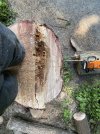
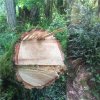
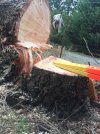
Here is a Doug fir with laminated root rot, a 10’ hemlock stump, and another Douglas fir with laminated.. photos got a little mixed up.

E0EA038F-7F49-44A1-ACFD-C03912395E37.jpegDA7DDB2C-F01F-459D-BA52-AF92CA2EA89D.jpeg92023521-B1D0-44B5-A0F8-04BE4A90FD3E.jpegE0EA038F-7F49-44A1-ACFD-C03912395E37.jpegDA7DDB2C-F01F-459D-BA52-AF92CA2EA89D.jpeg92023521-B1D0-44B5-A0F8-04BE4A90FD3E.jpegB95962B7-ED6F-424A-8D91-38FB7C086E7B.jpeg5517F399-8BFC-4130-B674-B182765CB0B7.jpeg
 
Last edited:
A61E27B7-661E-4069-8F8E-BA3BD5B69742.jpegA9233148-9290-45EF-A088-74ACC44FB9CB.jpeg1C515FEF-2CB2-4911-A41E-83ECD7700E95.jpeg
I don’t have many photos of the target practice. The first photo, was a crazy weird leaning noodle, the rope was a 3:1 side pull TOWARDS the house! If you zoom in you can see that I ever so slightly clipped the over hang of the gate trellis. The fence was wavered but the hose bib and ornamentals were not. Not to mention the power meter or phone pedestal. The only reason I place the cone on this one was because I was cutting blind, the lawn dropped off and I couldn’t see the fence opening from the stump.
But here I am talking outta my ass and spreading lies.
 
Last edited:
Here’s a few more. My point is stick to the rules until you know different. Look at the fibers, look at the tapered hinges. And know when you can’t just slice and dice and get on the fucken ropeDCBFAC90-E531-43CC-B176-8AE30168EE85.jpeg95EF7155-3B39-4B23-95AB-64AAFD3D3279.jpeg656F6469-A767-4AF2-95DA-1AC27AB23E59.jpeg
 
There's nothing magical about 1/3 that makes it a perfect number for felling trees, rather, its an easily described middle ground between extremes that should be avoided in most, but not all felling scenarios. Going deep makes a lot of sense when chunking wood, but doesn't make sense in full trees where the center of gravity make be several feet away from the trunk. Going shallow sometimes makes sense in skinny trees that require wedging, but the caveat is that you risk barber chairing and limited holding wood.

The 1/3 "rule" is really more of an anti-rule. That is, it represents the comfortable vacuum of ways to address extreme situations, and therefore defaults as representing the norm.
 
Phil,

As a long time trainer, I have found the more valuable question is “why not?” Understanding “why” certainly is important as it gives validity to the “how” of a task. However, ”why” questions really, in the end, only address methods.

Asking “why not” questions, forces one into examining the principles of a matter.

Example: When a climber is cutting aloft, she/he should tie in twice. If we ask “why” The answer: if you cut one system, then another is in place to prevent a fall. Cutting system is always a possibility. Therefore, redundancy is a method. Why the redundancy? So we don’t create a greater hazard by exposing the climber to a fall.

Now as production arborists, we all know there are times, not uncommon, when tying in twice might not be the best idea.

Here is one, fairly common. T. I. P in another tree. The tree you are working is dead, dead, dead. Should the dead tree fail beneath you and you are secured to it with your lanyard….you become rigging…

Is it possible in this scenario to cut your line? Yes. But the method, redundancy violates the principle of creating a greater hazard.

So in the above scenario, the better question to ask is “why not?” If you have a valid answer for “why not“ you are addressing a principle. Here the principle is not to create a greater hazard, ie. exposure to fall.

“As to methods there may be a million and then some, but principles are few. The man who grasps principles can successfully select his own methods. The man who tries methods, ignoring principles, is sure to have trouble.”
― Harrington Emerson


Respectfuly,

Tony
This reminds me of the tools and gear we employ, and the questions people often ask about them. These things are advertised for what they “can do”.

I always want to know the limitations of things. In there is the “why not”. If you know all the limitations involved, then you also have the answers to your “why not” questions.
 
This reminds me of the tools and gear we employ, and the questions people often ask about them. These things are advertised for what they “can do”.

I always want to know the limitations of things. In there is the “why not”. If you know all the limitations involved, then you also have the answers to your “why not” questions.
“Why not” is often of the same ilk as “yeah, sure that should work” and “I think it will fit”
 
Maybe it’s just your delivery, but certainly sounds hubristic to me.
These are your opening sentences, and your introduction into this conversation. Who’s slinging monkey poo?

On a personal note, I totally appreciate you checking in on us. No matter the mud slinging, we are tree family, but I also truly can’t understand why you come here and post such. It feels like you just jump in wherever you please and pick a fight.
I remember the early days of the buzz, when these conversations of ‘salami’ cut first started. That included the silly but safe tongue and groove methods..
you present as if you have invented slicing hung trees down. And while it’s plausible you discovered such methods only though your personal experimentation the door closes when others mentioned that it’s a tried and true method, or a dangerous one.
You don't have to prove anything to me bro. We've been around the block enough to make it clear you know how to put a tree on the ground. You are very good at what you do. And you've done some hairy work that many others wouldn't even think about attempting. Me too! That doesn't mean we are going to agree on everything. We just have a difference of opinion.

I actually went and looked up the meaning of hubris: excessive confidence and self-pride...
that's very subjective... the excessive part... You need confidence to do tree work at a high level. When you're life is on the line or there is a 3 million dollar house at risk, YOU NEED CONFIDENCE! Without it, you're better off raking leaves or cutting grass.

They called Ali "full of hubris"... until he backed his "excessive" pride by beating Liston's A$$.... Was it hubris or was he just good and didn't mind telling you so?

You guys don't like being told that you don't know what you're talking about, but that doesn't mean its not true.. It's not excessive pride to say that if it's true... And it is true.. not just about you.. it's true about the whole industry... With very few exceptions there is an entire industry of tree workers that have been taught to cut the notch 1/3 deep or 80% the width, BUT NO ONE KNOWS WHY... not the complete why at least... Being the guy that gets in your face and tells you how ignorant you are doesn't win any popularity contests, but that doesn't mean it's not true.

A very controversial subject. I seem to attract cotroversy for whatever reason. I'm used to it and don't much care about the shit talkers.

When I wrote the tapered hinge article in 2004, someone on the forums said... "you might as well write an article about where to put the gas and oil in a saw, I learned that at 12 years old the first time I walked into the woods with my father." On the other hand, Ken Palmer told me to my face that the tapered hinge doesn't work and his colleagues in Germany had proved it. That was almost 20 years ago and the industry is no closer to a consensus on the subject.

The cover photo of that TCI Mag (july 2004) showed me in the back cut, where there was a letterbox center plunge to gut the hinge... Now, this was 2004 and to be honest, that was the first time I had ever used the technique, and didn't understand the pros and cons. My mentor told me to do it on that back-leaning oak and I did it. That just happened to be the picture used for the cover. Well sure enough the editor got some complaints that the hinge had been damaged or whatever. Some people freaked out because they had never seen the cut before. Now it's much better understood and accepted practice, but not then.

When I first showed the plunged vertical snap cut around 2010, the uninformed thought that was crazy, reckless, dangerous, etc.. I had been using that cut since 1989. Tom says he was using it in the 70s. I didn't invent the cut.. but I did modify it by using the staggered plunge... That was the first video published showing the "salami cut" on whole trees. The cut was criticized by people that lacked skill and experience. I defended it because I know better. I know what if can do and what to watch out for. It was controversial at the time, at least in some circles.

Same thing for taking large treetops. Again the FIRST video on youtube showing taking multiple large tree tops. Again, people freaked out, calling me a wreckless maniac. "why don't you just take the top out first" etc... Now everyone and their grandmother are taking big tops out on Youtube... But that wasn't the case then.

So I've been criticized for being some wreckless maniac tree cutter for what is everyday work to me. It's no big deal to me. Truth is the real hairy stuff never made it to the camera. I didn't want the distraction. I've done lots of things that were the first to ever be shown on Youtube. And many things that have never been repeated. There is a long list... I've had to correct and educate people that consider themselves experts on these forums for years.

And Ya.. my style rubs people the wrong way. people don't like being told "I'm better than you.... I know more than you". But if it's true, it's not hubris.. So call me an a$$hole instead.... When it comes to the why of the 1/3 rule...Some of you are clueless. At best your knowledge is incomplete. That's everybody here.. If you want to debate that, let's go... Since you can't, there is nothing left to do but start the personal insults and name calling... HAHA... bring it on. I speak the truth.

 
Last edited:
“Why not” is often of the same ilk as “yeah, sure that should work” and “I think it will fit”
Evo,

You missed my point. Saying “why not” is entirely different than asking “why not” of a tool/technique.

As Oceans implied, it makes one look to limitations as well as capabilities.

Tony
 
@Flying~Squirrel

How does a shallow facecut increase barberchair potential?
If a tree has a head lean and you use a shallow face, you'll be cutting through more tension wood before you get to the point where its easier for the fibers to bend at the hinge than split up the trunk. It's easier to visualize if you think of extreme examples. Maybe 1/4 depth doesn't seem like it would make a difference, but how about 1/10? How about 1/10000? At that point you're basically cutting without any face at all, which at we all know is prone to barber chair.


So to bring it back to the thread topic, 1/3 is an arbitrary depth which keeps you out of trouble in front without getting you into trouble out back. Usually. Sometimes.
 
@Flying~Squirrel

How does a shallow facecut increase barberchair potential?
I think it is less a matter of increased barbers’ chair possibly and more a matter of shallow face cuts allow for less hinge length (all things being equal) and thus inhibit the face cut and back cut from working together to form a reliable hinge.

The tree diameter does not change, but a shallower face makes for a shorter hinge. I admit not all trees are round so exceptions do exist!

Tony
 
If a tree has a head lean and you use a shallow face, you'll be cutting through more tension wood before you get to the point where its easier for the fibers to bend at the hinge than split up the trunk. It's easier to visualize if you think of extreme examples. Maybe 1/4 depth doesn't seem like it would make a difference, but how about 1/10? How about 1/10000? At that point you're basically cutting without any face at all, which at we all know is prone to barber chair.


So to bring it back to the thread topic, 1/3 is an arbitrary depth which keeps you out of trouble in front without getting you into trouble out back. Usually. Sometimes.
This seems like an idea, not a proven truth.

I definitely cut a shallow face on heavy head- leaners of BC prone species. As well, I use anti- bc cutting and/ or binding techniques, or just avoid a hinge altogether.


It seems BCs happen when internal stress overcomes internal strength.

Letting a headleaner move to the lay before the hinge is set at the correct size and depth facilitates BCing.

Getting the pith in the hinge seems to exacerbate it.


I would like more evidence.
 
  • Like
Reactions: ATH
“Why not” is often of the same ilk as “yeah, sure that should work” and “I think it will fit”
For some people, yes. You’re making me wanna quote the Dr. in Airplane II, “The first step to recovery is admitting that you’re sick (you’re sick) ((you’re sick)).”

It’s like, after everything goes wrong, and saying “I didn’t think that would happen”. So, you thought about it beforehand thought??? How much did you think about it? Did you “think” it wouldn’t happen only because you didn’t want to take any additional time to ensure success? Admit that you’re sick, and figure out how to get better!
 
Last edited:
I think it is less a matter of increased barbers’ chair possibly and more a matter of shallow face cuts allow for less hinge length (all things being equal) and thus inhibit the face cut and back cut from working together to form a reliable hinge.
Tony
WRONG.... You only need to see this happen once to get an idea of just how much more prone Barber chair is in a shallow face cut tree. Likely you've never seen it happen or you wouldn't make such a ridiculous statement... Here's a perfect example of an "instructor" that has no clue what he's talking about.
@Flying~Squirrel

How does a shallow facecut increase barberchair potential?
Are you seriously asking that question? And you talk shit about me... you're not even close. That's tree falling 101. Surprised to hear that coming from a west coast faller with your experience...

In order to demonstrate to EVO that the above writing is not hubris, but rather just me acting like an a$$hole by getting in people's faces and calling them out for their true ignorance, I will be happy to explain the physics involved. It doesn't sound like Flying Squirrel has a clear understanding of the physics, but if he does, he did a terrible job of explaining it. If anyone else can answer the question: How does a shallow facecut increase barberchair potential? Here's your chance. I'll write it up and post it in another day or two and we'll see who knows what they're talking about.
 
Last edited:
Evo,

You missed my point. Saying “why not” is entirely different than asking “why not” of a tool/technique.

As Oceans implied, it makes one look to limitations as well as capabilities.

Tony
No, I got your point and understood it.

I’m just impulsive, and used the ‘why not’ phrase to justify free climbing up and down a 300’ talus slope in a wildfire site with a bum shoulder. All cause I wanted to see the fire origin tree (set on fire by timber poachers that lit a ground hive of hornets on fire, 7/5/2018. Everything on that ‘talus’ slope is unstable as fuck. But you only live once, so why in the hell not.
Phots are looking up from the tree by the river, and then down from the top of the rock face3CD66D80-6607-4045-A7D3-86461CE46293.jpegE718EB62-EC24-4CB8-A617-A0EF4BF8D9DD.jpeg
 
No, I got your point and understood it.

I’m just impulsive, and used the ‘why not’ phrase to justify free climbing up and down a 300’ talus slope in a wildfire site with a bum shoulder. All cause I wanted to see the fire origin tree (set on fire by timber poachers that lit a ground hive of hornets on fire, 7/5/2018. Everything on that ‘talus’ slope is unstable as fuck. But you only live once, so why in the hell not.
Phots are looking up from the tree by the river, and then down from the top of the rock faceView attachment 81444View attachment 81445
I am glad you understand the concept well enough to realize when you choose to ignore it!

We always called that testosterone poisoing and many years ago it led me to fall out of planes, train to be hard to find and harder to kill, walk towards fights that were not mine, and try to save the world, in a manner of speaking. This testosterone poisoning ultimately led me back to a career in tree work. All worthy endeavors at the time and I regret none of the major decisions. But it was so much easier to risk when there was not as much to conserve and the world seemed more black and white.

Tony
 
Being the guy that gets in your face and tells you how ignorant you are doesn't win any popularity contests, but that doesn't mean it's not true.

A very controversial subject. I seem to attract controversy for whatever reason.
Wow, and I thought that I had a way of insulting others while forcing my opinions on them--or so I've been told. As my father once told me, people who disagree with you are not ignorant a$$holes, they just disagree with you and have their own reasons for doing so. All you can do is state your opinion and let the consensus of facts win out.

Likewise, one should not assume that everyone else is stupid, illiterate, unenlightened, poorly trained, or incompetent. I'm certain there are innumerable professionals on this forum who have comparable or greater experience and knowledge to you. I am always impressed and amazed by the knowledge base expressed here. You are one of those people, and that is admirable--but you are not the only one.

If you wish for us all to focus on the scientific, practical, proven reasons for your claims, you might want to stop insulting us readers every five seconds. I know from firsthand experience that that method is not fruitful, and it is never satisfying to anyone. But that's just my opinion. . . .
 
Last edited:

New threads New posts

Kask Stihl NORTHEASTERN Arborists Wesspur TreeStuff.com Teufelberger Westminster X-Rigging Teufelberger
Back
Top Bottom