
Where I'm at & request for any advice...

123Craig

Participating member
Started removing slightly bigger (generally single stem) trees recently (when I say bigger, it's nearer 100' compared with 80'). After limbing the trunk as far as the bucket can reach - I climb from the bucket to work on the remaining tops. I've been doing these tops spurless as the boss preferred I do it that way (and I do too right now), so I generally leave enough stubs to make a ladder of the top. My question specifically is this; if you look at the picture below - is it safe to rappel in this way to reach the ground? - ie, I think it would be extremely hard for me to flick my friction saver off 1' length stubs on the opposing side that I am descending on. Thoughts?
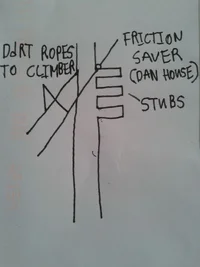
20160428_185639.webp

One more question; say for instance I was descending in this (DdRT) and I realised that I was going to run out of rope. Would it be a viable option to stop rappelling just before my stopper knot in my climb line, choke my lanyard around the trunk (while probably bracing myself against the trunk by trying to wrap my knees/legs around it in a manner - if I had no spurs). Pull down/out my DdRT line, then choke it SRT with the tail long enough to reach the ground - then just descend on it again? - I realise longer ropes (and spurs) would lessen the need for this option - I was just wondering if it still could be done fairly easily?


All the time (and money) I've spent on gear, research and testing is really beginning to make much more sense (and work easier/faster) as I climb higher. The views up at the top get better, I'm more stringent with checking my gear/work practices the higher I climb (I think that's a normal thing for any climber) - it's a mixture of 'Fuck sake, I must be out of my fucking mind to do this job...' to 'This is amazing - not many people will ever get to experience the intimacy with the trees at this height in this way...'. I'm discovering how easy and fast it is to bomb out the tree with the Bulldog Bone in DdRT - the boss is pretty impressed, even though he complained once that I almost landed on him - nonsense, I had it all under control - he's just not used to seeing me rappel so fast. ; ) I never thought I'd be able to bomb out the trees like others can on youtube, but now I can. I know that many are interested in the peak forces when you bomb (or shock load) in this way DdRT and SRT - I too would like to know more...

Thanks
 
If there is any doubt...tie a stopper in the end of your rope right away.

You could make the transfer down low. Plan your work and do the transfer where you have a good stance.

If you use the setup in your sketch be very careful. Climbers have had the false crotch or bite of rope slip off the stub=disaster!
 
Buy a longer rope and wear spurs. If you need to get down quick you can lower straight down. I assume a groundie lowers the bucket out of the way when you are bombing the upper branches which means without spurs or longer rope you cant lower to the ground or even climb down in case of emergency. Leave that " bombing out of the tree " for the amusement park that's asking for trouble and is hard on your gear. I don't want to revisit the no spurs and leave stubs on a removal conversation most of us see that as inexperience. I agree tree climbing can be a real beautiful experience and I still love what I do but always think of all the possibilities before you act.
 
Why spurless? Honestly, doing large tree removals spurless is a terrible idea and you are putting yourself at risk unnecessarily.
Man, have you ever worn spurs all day? I only do it when there is no alternative, which is usually (but not always) just stomp up a lead until it fits and fell it.
There aren't many green trees that really require them. It's almost like they're made to climb.


This might all change when I buy a set of kiwiklimbers.


Started removing slightly bigger (generally single stem) trees recently (when I say bigger, it's nearer 100' compared with 80'). After limbing the trunk as far as the bucket can reach - I climb from the bucket to work on the remaining tops. I've been doing these tops spurless as the boss preferred I do it that way (and I do too right now), so I generally leave enough stubs to make a ladder of the top. My question specifically is this; if you look at the picture below - is it safe to rappel in this way to reach the ground? - ie, I think it would be extremely hard for me to flick my friction saver off 1' length stubs on the opposing side that I am descending on. Thoughts?

View attachment 37487

One more question; say for instance I was descending in this (DdRT) and I realised that I was going to run out of rope. Would it be a viable option to stop rappelling just before my stopper knot in my climb line, choke my lanyard around the trunk (while probably bracing myself against the trunk by trying to wrap my knees/legs around it in a manner - if I had no spurs). Pull down/out my DdRT line, then choke it SRT with the tail long enough to reach the ground - then just descend on it again? - I realise longer ropes (and spurs) would lessen the need for this option - I was just wondering if it still could be done fairly easily?


All the time (and money) I've spent on gear, research and testing is really beginning to make much more sense (and work easier/faster) as I climb higher. The views up at the top get better, I'm more stringent with checking my gear/work practices the higher I climb (I think that's a normal thing for any climber) - it's a mixture of 'Fuck sake, I must be out of my fucking mind to do this job...' to 'This is amazing - not many people will ever get to experience the intimacy with the trees at this height in this way...'. I'm discovering how easy and fast it is to bomb out the tree with the Bulldog Bone in DdRT - the boss is pretty impressed, even though he complained once that I almost landed on him - nonsense, I had it all under control - he's just not used to seeing me rappel so fast. ; ) I never thought I'd be able to bomb out the trees like others can on youtube, but now I can. I know that many are interested in the peak forces when you bomb (or shock load) in this way DdRT and SRT - I too would like to know more...

Thanks

Use a ring and ring or leave a stub that will not drop you because of the angle (those are the ones that snag your limbs and rigging and the tail of your lanyard and make life hard.)
 
Man, have you ever worn spurs all day?...

Seriously! LOL! Sorry buy that just hit my funny bone. Yes I have indeed worn spurs all day, 10 to 12 hour days, day after day, week after week. It is a part of what we as climbers need to know how to do and be proficient at. Pain or discomfort when using spurs can largely be eliminated with proper setup and technique.
 
OwScott nailed it with needing a longer rope. Always have a quick means to the ground. And you would also do well to listen to the veterans about spurs. Buy a cheap pair of steel shanked boots for these removals and ask how people wear their spurs for max comfort.

If you or your boss has a bull dog bone, then you should be able to buy cheap boots and a 200' rope. If not, sell the bone and buy both. I might even buy it from you.
 
Seriously! LOL! Sorry buy that just hit my funny bone. Yes I have indeed worn spurs all day, 10 to 12 hour days, day after day, week after week. It is a part of what we as climbers need to know how to do and be proficient at. Pain or discomfort when using spurs can largely be eliminated with proper setup and technique.

Thank you. I thought it was funny.
I do hate the things though.
 
Do you not wear the spurs so you don't have em on in the bucket?
It's tough working with/for someone that requests/expects you to do things that they over time learned is what works for them. Doing something just one person's way with out making it work for you can potentially make things more difficult for you. Sounds kinda like that, as far as going no spurs out of the bucket on a 80' stem to finish the remaining parts.
If this is the case, maybe have that convo with the boss. You're not him, learn what works for you, blend what others suggest with what's comfortable and easiest for you.
Climb high Craig, climb high.
 
Ok - better step back in here; good advice from all sides - I appreciate it all - though I will qualify my reasoning of how I thought I approached this particular climbing task before me (4 Spruce Tops in 2 days) in the right way for me.

Of course - I understand that my 150' climb line can be choked at any time, and providing I am no higher than 150' - I'll be able to reach the ground in one descent without having to change my tie-in. Even if I had a 200' rope - I'd still need to make sure I'm within 100' of the ground to rappel to the ground DdRT without having to change my tie-in. As it is, I have to make sure I am within 75' to reach the ground DdRT in one descent - and as I am piecing the top down to within Bucket Reach (65'ish) - I still have around 15'-20' of rope spare in that descent mode. Until I start climbing regularly higher than 150' - I don't see the need for a longer rope, though am willing to hear reasoning to differ.

I've been using spurs for all large removals for around 3 years now - I have them set up perfectly as possible for me. Removals is what we mostly do - so mostly when I'm climbing - I'm in spurs.

Here's some of the reasons why if I had the same climb before me again - I'd go spurless again;

Spurs in a bucket (and climbing from a bucket in them) is not that great.

Spurs are bulky and heavy (until I get the carbon fibers) - I jumped at the chance not to wear them and the time it takes to put them on and off.

As I was just piecing down the tops of these 80'-100' trees to around 65' (where the bucket could reach) - the diameter of the Spruce at this height is thin enough (1', 1/2' or thinner) that it can be a problem spurring such a thin stem; I have found this a problem many times. Many times I have accidentally spurred one gaff into the other, ect - it is very hard to avoid this on skinny stems. Even if I had spurs on - I probably would have been leaving stubs on that diameter of stem to stand on, as I still think it would have given me greater stability, and to stand in branch unions with spurs brings it's own instability, as the bottom of the spur shank rests in the union as opposed to the bare sole of your boot. I found the lightness, and freedom of movement without spurs to be liberating and safer - especially as the sole of my boot could sit right in branch unions - I felt more at one with the tree.

Every time you spur - you send a shock wave through the tree. That shock wave might be comparatively small for the tree as a whole - but it can magnify any flex in the stem the nearer the top you get. You also might think it insignificant - but every time you spur - you are damaging the stem at the base of where you are standing - again, it might not matter so much on a thicker part of the stem - but it gives you pause for thought as you are near the top. Spurring sends shock waves through your legs - this is worth thinking about in the long run - anything I can do to minimise this shock to my legs - I'll do.

Almost all of the tops (stubs or no stubs) can/would have gone through the chipper anyway. I realise why stubs can be a pain - though would be willing to listen to more reasons why from those way more experienced than I. One of the things I did realise when I was back on the ground was that these thin stubby blocks at the base of the tree are a hazard for further falling blocks to 'flick up' as they are hit - once I realised this - I entered the drop zone at at safe time to move them from the base of the tree.

Almost all of the removals we do are done in what I view is the 'conventional' way; conventional meaning - spurs on, clean limbing all the way to the top, remove the top, clean blocking down. How something is 'seen' by others rarely matters to me as much as doing something the way that I think is the 'best' way for me; sometimes I will leave the branches on, climb through them, top the tree, then limb and block on the way down - sometimes in strong winds, this can lend the tree a greater stability (as it is less of a bean pole, with more branches to balance it). Of course - this can lead to branches getting caught up in each other as they fall - sometimes the drop zone you have is adequate for it though. I'm not worried about changing my technique for changing situations. Spurs aren't that great for climbing through many branches.

I wanted to practice climbing just using the tree and rope - I do find that for this particular situation it liberated me in a good way.

All in all - I felt going spurless for me in this situation was safer. I found that if I had used spurs for this task I would have been less safe and my ergonomics would have suffered.


I haven't heard much of the spur, spurless debate (I haven't been here that long). Willing to listen to all reasoning.


Thanks for the heads up on using a Ring & Ring Friction Saver - I haven't used one for 3 years though will consider it, and I have one.

Yes - Bucket is removed remotely once I'm in the tree.

I'm not too concerned about the 'bombing out of the tree' just now - as I have seen what the Bone is capable of in SRT - DdRT is a breeze for it. Two slight concerns though are the tail end of my rope getting caught up in branch on the ground (or knotting itself) as it quickly runs up towards the tree, and getting too much friction on my gloved hand tending the tail (heat). That said - I think I will slow it down though - as there is simply no need for it; it's nicer on the body to descend at a more moderate pace, and of course - the less shock load, the better (for many reasons).

I worked the trees SRT, descended DdRT. I won't be parting with the Bone. :)

Thanks for all the input!
 
Last edited:
I'm slightly alarmed and very confused as why a guy who has any climbing experience is asking how to get out of a tree that's taller Then his rope. Also I don't get the comment that spikes are bulky and get in the way in the bucket while working. Why not do all your bucket work then come down (takes less then a min) then strap on the spikes and go back up and climb out.... then the comment about it taking too long to put the spikes on, come on now what's it take like 15 seconds a leg?? Idk man sounds like u need a new job

Sent from my SM-G900T using Tapatalk
 
why a guy who has any climbing experience is asking how to get out of a tree that's taller Then his rope.

Never asked such a thing.

chris - I was doing just the tops. Of course - if I was doing the whole thing - I'd have the spurs on. As it was - I'd do a top or two, then I'd be back on the ground, hauling brush, bucking/moving logs - you must be quite a bit faster than me, as it takes me a few minutes to get the spurs on and off (velcro - good but requires the perfect tension) - not to mention the hassle of tippy toeing around a clustered worksite - in, then out of the bucket - then a tree that I have to get to the 'tippy top' of anyway - and it being in the wind (with a small patch or two of drop zone). I'd be wanting to climb through the branch anyway to limb and block from the top down - to keep the stabilising balance of the lower branch (less bean pole effect).

PS I'm really cool and I like doing sh#t the hard way!

Not really that cool, like to think I take the easy way as much as possible (providing it is safe).

Check out Reg. No branches. Spurs. 10" diameter.
To descend - cinch a running bowline with a really long tail. Rappel down to the end of the tail. Lanyard in. Pull down on tail to bring rope down to you. Re cinch bowline and repeat. This is how I block down a spar. I learned it on Treebuzz.


Thanks Oroboros - Of course I have spurred 1', 1/2" and much smaller - of course it can be done - though the small diameter is only a small part of my reasoning to go spurless in this particular situation.

Spar choke with long tail is how I do it most of the time - it works great.

I was going to stay, I've spurred up conifer tops MUCH smaller than 1' in diameter ... I often go high enough to cut and hold a top for the fun of it...

Thanks Stan - that is exactly as I had to do for at least one of the spruce tops - but for this particular tree it made more sense with no spurs. I had to hand saw and hold/throw every branch and piece as there was wind, a house, power lines, flower garden and bucket truck around me. It was around 85' - double stem from 10' up - then a double leader on one stem 15' from the top. It would have been harder to spur these skinny stems close to each other. It made absolute sense for me to go spurless in it.


Different courses for different horses.
 

New threads New posts

Back
Top Bottom