Reg,
I would be interested to hear the positives and any negatives you have observed working conifers with srt. I'm mostly on my own as far as I can tell in my area as far as srt used for tree work. Mainly redwoods and fir trees.
Theres only 2 real negatives that come to mind, if you can call them that. One is the fact that most conifers being single stem, if youre using a base tie on the same tree, its so easy to lose site of it and forget its dead opposite you on the back side of the tree. In the moment, when things are just flowing, its so easy to just reach around with the saw to make a cut without looking, forgetting that the base tie is right there in the zone.
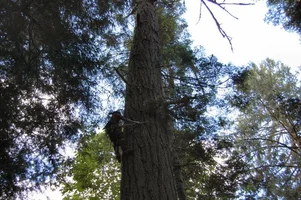
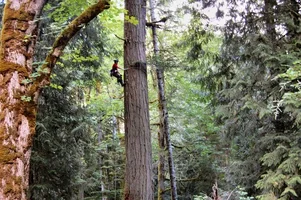
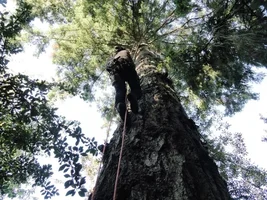
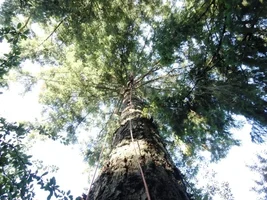
The other is retrieving a line that isnt base tied....should you choose to do so. It can be an inconvenience to plan that last descent free of and obstructing branches that might create friction on a pruning job. I generally go back up and untie the TIP if Im not using a base anchor. As an example, the fir in the pics was 150, end weight reduction on some of the heavy limbs. I used 2 lines. One base tied and set at 90 feet or where ever I can safely bigshot to, mainly for access....the other fixed at the top to work most of the canopy. With SRT its no big thing to go back up to undo your fixed TIP at the top of the tree when your finished....because of the ergonomics and speed. So when I was done I Ddrt down to the 90ft base tie, then continue down on that one to abandon the tree altogether.
Obviously accessing trees using SRT is a huge time and labor savor. Big shot, no need to isolate a limb, just fire it straight through the canopy. You reap the same benefits through working the tree also i.e. if your pruning and say split your routes into 4 quarters of the tree, its no big effort to climb back up to the TIP to redirect your climb line down the next quarter. Ideally climbers prefer to have a direct route from TIP to whichever limb they have to access and work on....especially so if they're having climb out on it. But on big conifers as you know its rarely possible to get that direct route as you move lower down because theres so many obstructing branches, because of its form. With Ddrt you can only afford so much friction or line redirect before your hitch just becomes impractical or redundant all together....but with SRT (non moving line), your hitch fluid and consistent no matter where you are in a tree.
Coming back from limbwalks can prove difficult for some climbers to keep their weight in the line, if they big heavy guys or struggle to hold their own weight. Never been an issue with me because I only weigh about 155, and Im always in shape. But for those who aren't its not a big hurdle either with convenient MA accessories that can be added on and off at any point and part of the line.
Pitch on the line is much lesser problem too....because its not constantly running back and forth i.e. DdRT spreading it all over itself.
On removals, then the advantages are not as many, depending on how you work the tree. Mainly because you're generally positioned on the trunk the whole time, you can cut off anything thats in the way, and you have spurs. On wide old growth type conifers, if you can set a line from the ground, its gonna be easier than flipline and spurs too. Much less energy and time spent trying to whip your line around stubs and shit. Just a direct route to an easier part of the tree. The pic bellow show one such messy dead fir. Had to access it the old fashioned way. PITA