Evo
Been here much more than a while
- Location
- My Island, WA
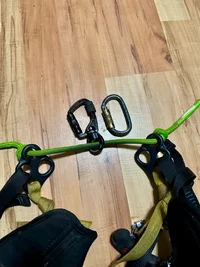
Yesevo, is it a swivel?

Follow along with the video below to see how to install our site as a web app on your home screen.
Note: This feature may not be available in some browsers.
Yesevo, is it a swivel?

I never had it happen with my double locking snap. It had thicker metal where it needed to.Those isc snaps both double and triple have been plagued with problems. Just use a binerand keep up with the graphite lube.

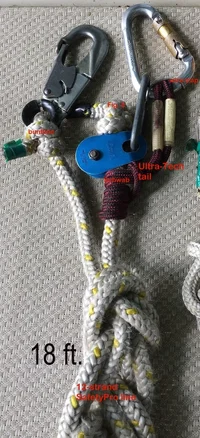
The way you 'taped' or banded down the excess on your claw... is that easily removable? Cause there's LOTS of times where I need to untie the rope from my snap, otherwise if I tried to pull it thru a narrow crotch far away from me, I'd B fk'd. I do that kind of securing for my split tail, and all my false crotches made from Lg & small alum rings, w/8mm line.

That tech cord looks painful
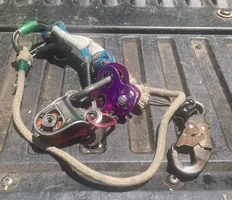
Off OP topic, but on my rope bridge I switched out my RE SwivaEye (length = 137mm) for a DMM Director Swivel Eye (length = 116mm) with the locksafe gate and (importantly) the rhino horn at the spine. It keeps my Akimbo tended off the corner as it is designed to. The Akimbo and SwivaEye did not play well together on my bridge; the Akimbo drifts over to the corner and spine and would kink up and I had to watch it every time I sat back into my climbing system after unweighting it. I waited a while to buy the DMM kit because of the 2022 recall. Seems like there have not been any further issues. I took out the black plastic that arrives pre-installed in the swivel eye. The swivel eye barely permits free travel of my 10.5mm Teufelberger Platinum rope bridge, so it is fine, but for y'all that use large diameter 16-strand I would look into a swivabiner with a larger interior eye diameter.rock exotica swivaeye with standard CT steel carabiner for size reference. very compact.
I don't know if we're talking about the same thing, but that seems incomprehensible to me. So many times I havta whip my lanyard into a higher or more distant crotch ... but I don't always havta climb in close proximity to it. I just need to position and balance myself to make some cuts. then i'm headed elsewhere and I need the lanyard back.The only. Time I remember untying the Tech Chord was to replace it
That's crazy. I can't imagine untying my lanyard while in the tree. Well, all my lanyards have sewn or spliced eyes. Maybe that's your problem - you need to be more selective of your crotches if you're using a bulky knot.I don't know if we're talking about the same thing, but that seems incomprehensible to me. So many times I havta whip my lanyard into a higher or more distant crotch ... but I don't always havta climb in close proximity to it. I just need to position and balance myself to make some cuts. then i'm headed elsewhere and I need the lanyard back.
If I were to NOT untie that claw snap before I pulled the rope back thru, maybe 50% of the time it would get hopelessly wedged in a narrow Y, 10' away. And climbing up to retrieve it may not B an option. Maybe the angle from my main TIP wouldn't allow it?
I also carry a 'mini lanyard' that's maybe 9' long, that I use to momentarily stabilize while I work my other lines. Or to double up if I'm blocking down.
I know most of you guys could climb circles around me, but I just don't see how you can avoid having to make your line bare to retrieve it sometimes.

Same here, I have never used a hand tied lanyard, every lanyard I've ever owned had a spliced eye with a rope snap of some variety or other spliced into it. I've never had issues getting it hung up in a tree and being unable to get it out.That's crazy. I can't imagine untying my lanyard while in the tree. Well, all my lanyards have sewn or spliced eyes. Maybe that's your problem - you need to be more selective of your crotches if you're using a bulky knot.
seems like to me the sweet spot is 12', anything shorter is constantly too short and 15'+ gets annoying. Also, use the lower D'sI don't know if we're talking about the same thing, but that seems incomprehensible to me. So many times I havta whip my lanyard into a higher or more distant crotch ... but I don't always havta climb in close proximity to it. I just need to position and balance myself to make some cuts. then i'm headed elsewhere and I need the lanyard back.
If I were to NOT untie that claw snap before I pulled the rope back thru, maybe 50% of the time it would get hopelessly wedged in a narrow Y, 10' away. And climbing up to retrieve it may not B an option. Maybe the angle from my main TIP wouldn't allow it?
I also carry a 'mini lanyard' that's maybe 9' long, that I use to momentarily stabilize while I work my other lines. Or to double up if I'm blocking down.
I know most of you guys could climb circles around me, but I just don't see how you can avoid having to make your line bare to retrieve it sometimes.
firstly, your real world climber experience is what I came for and you delivered. Thank you. I had searched the device name and this thread came up which is why. anyhow, The rubber bits pictured are from an old big shot. i've not had any alignment problems like you describe so seems like they are helping. The swivel function is important to me.Off OP topic, but on my rope bridge I switched out my RE SwivaEye (length = 137mm) for a DMM Director Swivel Eye (length = 116mm) with the locksafe gate and (importantly) the rhino horn at the spine. It keeps my Akimbo tended off the corner as it is designed to. The Akimbo and SwivaEye did not play well together on my bridge; the Akimbo drifts over to the corner and spine and would kink up and I had to watch it every time I sat back into my climbing system after unweighting it. I waited a while to buy the DMM kit because of the 2022 recall. Seems like there have not been any further issues. I took out the black plastic that arrives pre-installed in the swivel eye. The swivel eye barely permits free travel of my 10.5mm Teufelberger Platinum rope bridge, so it is fine, but for y'all that use large diameter 16-strand I would look into a swivabiner with a larger interior eye diameter.
Mildly curious about why you posted the rope bridge picture with the Swivaeye and biner size comparison to this thread. Do you suggest using the Swivaeye at the lanyard termination instead of a snap? I'll read up a few more posts to see if the answer lies there.
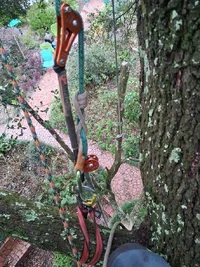
I did not originally see the rubber bits - that is practical and makes sense. I climbed regularly for a decade from 2014 - 2022, but climb only occasionally now. I suited up to help Ed Gilman earlier this year with some pruning CEUs and really enjoyed that, and late last year I chased some <10" diameter dead wood around the understory of a live oak and rigged it down solo with this rope wrench in-tree setup:firstly, your real world climber experience is what I came for and you delivered. Thank you. I had searched the device name and this thread came up which is why. anyhow, The rubber bits pictured are from an old big shot. i've not had any alignment problems like you describe so seems like they are helping. The swivel function is important to me.

I rotate gear more frequently maybe. All my lanyards are hand tied, but also taped up., no untying ever.Same here, I have never used a hand tied lanyard, every lanyard I've ever owned had a spliced eye with a rope snap of some variety or other spliced into it. I've never had issues getting it hung up in a tree and being unable to get it out.
nice solo rigging idea you got there. it "locks off" by default and you can move your friction around the canopy wherever you need for your positioning. my buddy uses a mini-portawrap+sling in a similar work flow, which is kinda cool because it's tiny and midline attachable.I did not originally see the rubber bits - that is practical and makes sense. I climbed regularly for a decade from 2014 - 2022, but climb only occasionally now. I suited up to help Ed Gilman earlier this year with some pruning CEUs and really enjoyed that, and late last year I chased some <10" diameter dead wood around the understory of a live oak and rigged it down solo with this rope wrench in-tree setup:
View attachment 103275
You're at the point of the spear now and I respect that. It's always cool to share a similar kit setup with someone and geek out for a second.
I have previously affirmed that the ISC triple action snap failed (stuck open) on me. I did notice it happen and was able to troubleshoot it, but it was a bit of a wtf moment to be sitting up in a tree trying to get my gate unstuck - from a basic design standpoint there just shouldn't be any possibility of such a thing happening but those thin plates definitely can slide past each other and the friction of that holds them frozen and the gate open. The triangle piece added to make the triple action is the same thin sheet gage as the backbone "dead man's trigger", and one or both of the sheet metal pieces need to depart from the paired conditions where they interface of 1.) approximating two dimensionality and 2.) being oriented in parallel. 3.) having any play in the way they are assembled to the unit as a whole (both have play, with the dead man's trigger having much more play on mine. My Petzl Eashook 2x action snap dead man's trigger has about half as much play. Not sure if this would hold if several ISC and Petzl snaps were looked at, and if differential wear were accounted for since the ISC has much more use).
Stay safe, stay salty.