
what do you think?

Rem Wizz, well done on getting that beast to ground level.

The Fell - If you've got a pulling rope why were you frantically hitting in wedges with a tiny hammer?

Why not just put some pressure on the pulling rope to lift the back slightly so you can continue cutting and the saw wont get jammed?

Your front notch was bizarre looking, I read your explanation for it above but still dont understand why the 2 different angles on the bottom face of the notch?

Anyway......... well done
 
I've never been around a tree that has cracked that was as big as this one. When I have worked on split trunks I add support to keep it in place with some tension.

Here's the way that I've looked at the setup. The tree has split but not failed. That tells me that the tree has enough strength left to stand in that position. If I 'freeze-frame' the tree it will stand. Now...if I use gear that has "X-thousand" pound strength to brace the tree but in tightening the tree I put one half/X thousand pounds load on the gear all that I'm left with as a safety factor is one half/X thousand. I'd rather have a higher safety factor in my rigging, not use it up pulling the tree back into place.

Realize though that all of my comments are made as a 'sidewalk engineer' :) Since the tree and rigging didn't fail, your system did work. Great to see that such a large 'bomb' was defused successfully.
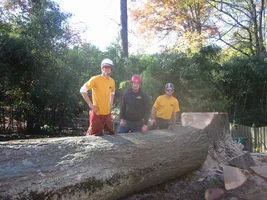
 
Scary. Hope you got paid well for risking your life. Did you draw staws to see who the hero/victim was gonna be? Good job, next time hopefully there will be crane access. Maybe a 200ton from the road?
 
it was a crazy scary tree, and it could not have been done with out "the dream team" : Odis Sisk and Josh Prophett were there for all but the first 2 hours of the job. Odis and i took turns climbing, but most of the time we just stood there looked at it and cussed.

I guess "the dream team" is going to miss their daddy, my last day was friday..... I am moving to TN... i heard that the trees were not cracked up there
 

Attachments

  • 64817-November312006152.webp
    64817-November312006152.webp
    190.7 KB · Views: 114
[ QUOTE ]
Tom Dunlop wrote:
Here's the way that I've looked at the setup. The tree has split but not failed. <font color="red">That tells me that the tree has enough strength left to stand in that position.</font> If I 'freeze-frame' the tree it will stand.


[/ QUOTE ]


Tom it looks like you missed a most important point in Removal Wizards' first post. The tree was 'failing' even as the rigging was being placed.

"One of my customers called last week with this tree problem, when i arrived the crack was about 14" wide.... by the time that i had ropes set to tention, the crack was about 18" wide and i was hearing cracking and popping "

Awesome job fellows.
 
ya rob i heard you going west. great job i would work with you guys any day and yes tom IMO i think they did right with pulling it togeather if it was still opening up as they were working. great job guys and rob good luck in Tn green. odis i thought that was you up there in the first photo.
be safe scotty
 
On the final cut the pull rope you see is being placed through a block on the poplar, then into the GRCS. The GRCS was used to pull the tree over. The tree had a side lead toward the house and the only area to place the GRCS was also near the deck of the house. The wedges were used to prevent the side lean to compress onto the bar of the saw.

The rigging consisted of multiple blocks strategically placed from on side of the splitting canopy to the other side. The generous amount of blocks helps distribute the weight throughout the canopy. Never was only one side of the stem loaded alone. In most cases we used two systems as mentioned above. To tip and butt tie pieces, some branches were 6 feet off the neighbors roof. A total of 5 to 6 blocks a time just for rigging. The placement depended on the landing area which consisted of a 30x30 back yard.

A crane would have been great. We would have had to use all the same stabilization gear and systems to hold this beast together. Two hours later than arrival and we could have just cleaned it off the houses. Seems easier now! 3 other companies arrived before we did and turned the job down. One of the other companies had referred us to the homeowner. Loyal customers are obtained through extraordinary efforts.
 
I might miss working with ya a little. I’ll miss that nice hard hat more. “Go long”. "Removal Wizard" that says it all. To bad you wouldn’t get to see the poplar you sold come down.
 
I like using the cinch straps as well for pulling trees together.
They use chains alot out west on the large trees.
I'm thinking on something like this tree a 5/8 bull line placed higher in the tree with a 5:1MA tensioned from the ground using the GRCS would assist greatly in pulling the tree back together and allow you to secure it in two or three different locations below the tension point.
Nice work, well done.
 
[ QUOTE ]
it was a crazy scary tree, and it could not have been done with out "the dream team" : Odis Sisk and Josh Prophett

[/ QUOTE ]

Odis Sisk - that is one cool name!
 
[ QUOTE ]
[ QUOTE ]
it was a crazy scary tree, and it could not have been done with out "the dream team" : Odis Sisk and Josh Prophett

[/ QUOTE ]

Odis Sisk - that is one cool name!

[/ QUOTE ]0
Also one cool cat
 
Kevin, we had two of fiddle block sets, attached to 2 port-a-wraps, pulling two 3/4 inch pieces of double braid. The double braid ropes were placed approx. 3/4 higher than the crotch.Each rope was through a block on one lead and tied static on the opposing lead. The two system were used in conjunction with the binding staps and chain. The groundmen would tension those two systems. Needless to say we had to borrow a few blocks from other crews.
 

New threads New posts

Back
Top Bottom