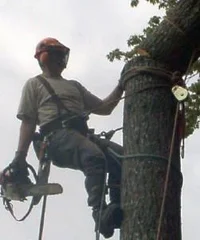
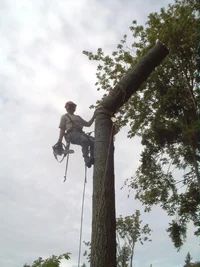
Wesspur catalog cover

[ QUOTE ]
I think its time for a group hug

[/ QUOTE ]

Yeeeeaaaahh,....I'm out.
tongue.gif
 
[ QUOTE ]
I was biting my lip as long as possible with this...

Notice that the Wesspur photo was photoshoped to cover up the poor notch and back cut? See page 13 to see how it really came off the spar.


[/ QUOTE ]

I'm not seeing what you are. The left shot is a different cut as the right is the cover according to the knots (rope and tree both). Only thing that I see interesting (without bringing up the rope placement) is a small and deep face cut and the piece taking a leap. Seems to work and it is nice to have options in a tree.
 
Here's a larger view of the previous pic.

Preventing the climbing lines from coming up over the top of the stem is one benefit of staying under the block.
 

Attachments

  • 278252-3-05Oxman002(1).webp
    278252-3-05Oxman002(1).webp
    200.4 KB · Views: 94
Lots of this discussion is how to do it 'the right way'.

Part of Daves expertise means being able to pull it off with any of a hundred variations.

Video of fancy rigging by our coverboy of the month.

STARRS zipline
 
I also work with my flip line and climbing line below the sling. I would be dead or seriously injured now if I didn't.

One time I was topping out a pine close to a house using false crotch rigging. Well, the guy on the rope was afraid that the top would hit the house so he grabbed the rope. As soon as he did so, it launched me up in the air so my feet were above my head. I came back down with my chest on top of the spar. I had some bruising and scrapes but nothing serious.
trytofly.gif


Having your flip line or climbing line pinched by the block is not the end of the world.
 
I think that there is a higher likelihood of my RP or rigging rope breaking than a 5/8" steel core flip line backed up with my climbing line being pinched in half by the block.
 
[ QUOTE ]
Having your flip line or climbing line pinched by the block is not the end of the world.

[/ QUOTE ]

Not in your scenario, but in others it might not be so great. If your climbing line is choked around the spar in your scenario then there is no problem either way. The steel core lanyards too stiff to keep above the block in my opinion that I would put below.

Glad that you weren't seriously injured!
 
One thing I didn't like about both your pic Ox and the wes spur cover is that you both have "saw in hand" as the piece is falling into the rigging. If you set up your hinge well, its fairly easy to set the saw on your saddle, so you can be ready to brace yourself with both hands. You know there is going to be a little (at best) ride coming. I guess on a front leaner some will just keep cutting til it goes, but I don't see the need or sense in that. I;ve seen guys that do a lot of rigging down a spar, just drop their saws onto a long lanyard, which seems very effective, especially for those situations where a quick transition is required.

Also on the cover shot, as mentioned it seems like he is mighty low relative to the cut, and the hinge looks questionable.. as far as the lanyard placement, I like to tuck mine up right under the sling, so there is no way the block is going to touch it. Keep the climbing line below as well, usually well below the low point the block can reach.. rarely if ever work off a choked climbing line, but will use a FS tucked under the sling. I usually set the sling before I make my cut, and cut down pretty close to the sling, so I don't want my life lines anywhere near the cut..

 
Thanks for the comment about jettisoning the saw prior to tipping the work. I never have been able to stow the saw one-handed. It is also difficult for me to put it away without seeing the clip visually.

My first climbing saw in 1970 was the Homelite Super EZ Automatic 250. This was before I knew about a saw lanyard.

The exposed muffler on the EZ caused a lot of painful burns. Finally, after 5 saws had accidentally hit the dirt, the boss changed company policy to require a saw lanyard. Voila! No more dropped saws.

What was even better was the introduction of the McCulloch Mac 6. That baby was light! I rember when the first chain brake came out.

I was up in the tree when a new Mac 6 chainsaw was tied on my rope. I pulled it up and made a few cuts. The cast magnesium brake was in the way of nestling the bar in the crotches, so I ripped it right off.
 
There's no doubt about it, you guys who came up through the ranks in the early days have seen a whole lot of improvements in climbing saws.

I have an older friend who is 75 years old and his first climbing saw was a 1954 McCulloch 47 A chainsaw to remove 100's of Dutch Elm Deseased trees.
 
Man had grit lugging that thing up a tree, for sure.

I don't get all the hubbub; if you're tying the sling right, it isn't going anywhere. If sling slippage is a problem, you need to learn to tie the darn thing right.
 

New threads New posts

Back
Top Bottom