Wedgin' n jackin'

Just bullshit how people who experiment with some cutting techniques get called frauds and others pioneers. Alright treebuzz figure a forum for open ideas that don’t need any backstory of conventional thought
 
These threads are to debate techniques that are unconventional and when one of the “bros” says something outside the box it’s experimental but when someone outside the clique wants to talk about an unorthodox technique it’s a dangerous scandal.
Nothing we have discussed here so far has been terribly unconventional, revolutionary, unorthodox, or out of the box Jem, and even the latest & greatest, never before thought of, mind altering, industry changing technique is only as good as its execution.
 
Nothing we have discussed here so far has been terribly unconventional, revolutionary, unorthodox, or out of the box Jem, and even the latest & greatest, never before thought of, mind altering, industry changing technique is only as good as its execution.
Yea whatever keep making your backcut first and notch last. We’re all impressed and astounded by the ingenuity. Surely no one could come up with anything that experiments with base cuts better.
 
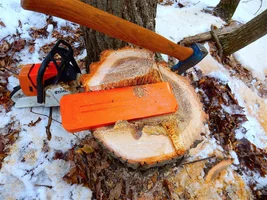
I think one important aspect of wedging that gets overlooked sometimes is the axe. I’ve seen a lot of people spanking wedges with little bitty axes or hammers and not getting much for their effort. Up in the tree yeah, a hatchet or a hammer is fine, but on the ground if you want to pound a good size tree over a good 5 or 6 pound axe is nice.
 
I think one important aspect of wedging that gets overlooked sometimes is the axe. I’ve seen a lot of people spanking wedges with little bitty axes or hammers and not getting much for their effort. Up in the tree yeah, a hatchet or a hammer is fine, but on the ground if you want to pound a good size tree over a good 5 or 6 pound axe is nice.
Very true, but as you pound the wedge you send a wave up the tree. If you time this right it can save a lot of work. Some trees or dead trees you have to be extra cautious because of this same effect.
 
Good topic

Tim Ard showed an expanded version of the back cut wedge.

His method is to bore cut several slots on the back side towards the face side...seperate them about an inch or so. Insert wedges in each slot and pound them in. Each wedge adds a little lift and stretches the wood on the backlean side. make the face and keep tapping the back wedges in to lift. It was an impressive tip on a tree that would have needed a lot of pull
If using this method and the wedges don't some out cleanly from the lower slots, usually a good sharp rap to the top of the stump above the wedges will split the fibers down along the wedges allowing them to come out effortlessly.
 
Here's a problem I never solved...must be a solution.

I would buy a stack of basic wedges in various lengths. Sometimes the solution was to stack one on top of another. No space to cross them. Some wedges have slots that correspond to rails on the other side to keep them aligned. Others have a coarse surface molded in. Too often stacked wedges would spit out...scary!

Solutions???
Nylon stacking plates with one wedge.


Keep your wedge heads de-mushroomed.


Have a variety of sizes to match the taper of the back cut.
 
Yea whatever keep making your backcut first and notch last. We’re all impressed and astounded by the ingenuity. Surely no one could come up with anything that experiments with base cuts better.
I realize your knickers are all knotted up Jem, but I really can't take credit for the invention of the "making the back-cut first" method when using tree-jacks, or pounding over a hard learner. I myself was taught this technique when I was 16-17 yrs old, and folks had been doing it for a very very long time before that.

A video of Bucking Billy (love this dude) starting with a back-cut on a hard leaner. Again just as important as the method is the execution of said method. You can clearly hear and see when his wedges are maxed out, and no longer moving the tree. He adds another wedge and gets a little more movement. He then he adds his undercut which gives the movement that he has already created a place to go. Back to the wedges, and through thoughtful hard work he slowly continues banging over this tree and letting his wedges tell him when they are maxed out, and when he can begin double stacking. I got tired just watching this, but Billy persevered and got it done! I think I am gonna buy that fella a Salt Creek Hi-Jacker for christmas!!!

This is why always trying to use at least 2 wedges is so important. It is exponentially more effective, and if you spit a wedge your tree will not sit back on you, and possibly go backwards on you.

 
Last edited:
I realize your knickers are all knotted up Jem, but I really can't take credit for the invention of the "making the back-cut first" method when using tree-jacks, or pounding over a hard learner. I myself was taught this technique when I was 16-17 yrs old, and folks had been doing it for a very very long time before that.

A video of Bucking Billy (love this dude) starting with a back-cut on a hard leaner. Again just as important as the method is the execution of said method. You can clearly hear and see when his wedges are maxed out, and no longer moving the tree. He adds another wedge and gets a little more movement. He then he adds his undercut which gives the movement that he has already created a place go. Back to the wedges, and through thoughtful hard work he slowly continues banging over this tree and letting his wedges tell him when they are maxed out, and when he can begin double stacking. I got tired just watching this, but Billy persevered and got it done! I think I am gonna buy that fella a Salt Creek Hi-Jacker for christmas!!!

This is why always trying to use at least 2 wedges is so important. It is exponentially more effective, and if you spit a wedge your tree will not sit back on you, and possibly go backwards on you.


He did great job, shouldn’t have taken Tin lid off though even if it was tempting to do so...
 
Lots of trees go easy with wedges and accurate blows (flat ax-to-wedge head contact, inline with length of wedge, no upward or downward angle, with speed). No tricks. 1,2,3 cuts, bang bang bang, tip.


Fundamentally, the wedges are rotating the tree on the hinge with a lever that is the length from the hinge to the back of the wedge. If the tree cannot move the wedge will lift upward on the hinge fibers possibly more than desired. The closer the wedges are to the hinge the more upward Force they're exerting compared to rotational Force.

The hinge is lot of wood fiber to bend. If you added up in cross-sectional area it can be quite substantial. Gutting the hinge reduces the cross-sectional area while retaining strong corners for steering.

Your wedging must rotate the tree's center of gravity to the layout plus overcome the resistance to bending of the hinge fibers.

EDIT: this is not really what I meant to say. Sorry:
To a degree you can store energy in the hinge by pounding your wedges tight. If you gut the hinge in the middle, with the tip of your saw, what we would call "tickling the face", you can reduce the cross-sectional area of the hinge and get it to fall once you have it 'on the run'.

Not really storing energy in the hinge. Wrong wording.


One-trick I saw from a guy was when he was stacking wedges to not line them up rather the bottom row went slightly toward the right and the top row went slightly toward the left so that the mushroom heads we're not fighting each other.


If you have a tree sit back and close the back cut you can carefully bore in from the back, perpendicular to the hinge to establish space/ kerf to put a wedge in and beat the whole back-cut kerf back open. If you can't open it up you can drive the wedge tight and bore-in again and insert a second wedge.


If you want to clean the mushrooms up on your wedges you can make a kerf in a log and bang the wedge in tight then back-chain off the mushrooms, being careful not to fling the wedge.


Where there's room... More wedges, especially, if there is decay, particularly sapwood decay.
2 for sure.


Easy tippers... I'll sometimes bang small wedges with a large wedge, rather than carry a bigger, heavier ax.

Tree have various weights of mallets, built right in... The mallet head is trunk wood, with a branch handle.


If the double ram Silvey feels light, strapped to the backpack frame, it's maybe not that you're such a machine, as much as you've had an oil leak... discovered when the 5' dead fir was ready, and the pump handle was soft, gauge not showing what it should.
A great time to have lots of big wedges.


Cutting the bark off, let's your see how wedges are interacting with the wood.
Is the wood staying intact, or mushing? You can sink wedges deeper. Stacked wedges, sunk beyond flush are easier to see, so easier to hit, accurately, with thick bark gone.
 
Last edited:
I like my steel splitting wedge the most for felling. Keep a fat maul head for big tiping.
Never hear or see any one use steel. Like it mostly cause you can pound it right through the hinge
 
How about the Ali wedges? Are they worth their mettle;)
I have had to grind the steel mushroom off, that is what has kept me from buying the Ali.
The steel has lasted longer than dozens of plastic wedges, nicked it a few times-not good. Only comes out for big drops,
@rico What wedge is your favourite, long lasting, doesn't break, crack, can drill small hole for throwline tether,
 
How about the Ali wedges? Are they worth their mettle;)
I have had to grind the steel mushroom off, that is what has kept me from buying the Ali.
The steel has lasted longer than dozens of plastic wedges, nicked it a few times-not good. Only comes out for big drops,
@rico What wedge is your favourite, long lasting, doesn't break, crack, can drill small hole for throwline tether,
If Im feeling rich I grab some K&H red head wedges, if not I will grab the yellow/orange wedges from baileys. I am very rough on wedges, and am constantly hitting them with my saws, mushrooming them, or missing badly during a big swing and busting them. A very expendable tool for me so spending too much money on them is pointless.
 

New threads New posts

Kask Stihl NORTHEASTERN Arborists Wesspur TreeStuff.com Teufelberger Westminster X-Rigging Teufelberger
Back
Top Bottom