southsoundtree
Been here much more than a while
- Location
- Olympia, WA
Thanks for the elaboration.

Follow along with the video below to see how to install our site as a web app on your home screen.
Note: This feature may not be available in some browsers.


I’d say it has many more variables, the forces can certainly be very violent. I think if it like letting a negative rigged piece run and get snubbed off.Vertical speedlining has the potential to generate very high forces. I've broken a rope, a carabiner, and a fence attempting it before. Not at the same time. (Granted, the fence was my fault and the other two were rigging big wood). I've also gotten absolutely paddled from shock loading the spar.
A cut piece has a long time in freefall before it encounters any tension in the rope, which can come on all at once as it gets closer to the ground. The force vector may have more of a horizontal component than you expect.
I'm very much an amateur at the technique and don't fully understand how to use it effectively. From that perspective I advise that VSL can be surprising and can generate huge forces, and for those reasons I'm hesitant to pull it out of the bag of tricks, and so I remain an amateur.


thank you, this is what i came for. I was off for a long 4th w/e and another climber spent the day limbing up to 100' or so. fought it the whole day and went home exhausted. I'm on it tomorrow and get this thing all down on the ground. I appreciate the insight esp the vectors clarification. very helpful.Vertical speedlining has the potential to generate very high forces. I've broken a rope, a carabiner, and a fence attempting it before. Not at the same time. (Granted, the fence was my fault and the other two were rigging big wood). I've also gotten absolutely paddled from shock loading the spar.
A cut piece has a long time in freefall before it encounters any tension in the rope, which can come on all at once as it gets closer to the ground. The force vector may have more of a horizontal component than you expect.
I'm very much an amateur at the technique and don't fully understand how to use it effectively. From that perspective I advise that VSL can be surprising and can generate huge forces, and for those reasons I'm hesitant to pull it out of the bag of tricks, and so I remain an amateur.
we can block the road indefinitely.If you limb off the front falling lane and backweight, can you undercut the COG with snap cut or facecuts to dump chunks with the side limbs?
Pulling from that height seems like a line angle issue?
What else is beneath the tree?
For how long can you block the road?
I appreciate that. sometimes overthinking it wastes so much time and if you'd just got to it, it'd be done by now. that is an option for sure.I’d say it has many more variables, the forces can certainly be very violent. I think if it like letting a negative rigged piece run and get snubbed off.
Having just the right amount of slack in the system seemed to be the key when I played around with it. This was very hard to achieve without smashing the shit out of the rigging.
That and EVERY piece bounced off the trunk of the root flair, requiring the rigging to catch it again adding to forces and wear and tear.
IMO with trees I deal with is it’s better to just negative rig with the groundie barely slowing it, until ground contact is made just limiting the piece from flopping.
i like what you got brotherI remember when I first saw Matt's cart up an incline groundie that I wondered about the creation of the big, largest(?) first load spike at the initial tensioning of the rig rope. In snubbed off the groundie is just an immovable boulder for practical purposes. In a run and catch the groundie starts near zero rope grip force and ramps the grip force up with some sort of profile until he makes the stop. The cart with mass onboard tries to start into motion upon rope tension spiking and acts as an inertial anchor, enhancing or affecting the size of the rope tension spike. In essence its a mass (log) to spring(s)/damper(s) (rigging rope, block, block sling, rig rope down leg, porty, porty sling, horizontal rig rope leg, mass (groundie cart). Later on the cart going up the slope provides groundie grip force profile, but also affected by car m x a force contribution.
Always nagged at the back of my mind.
But I like Matt's work.
Slack unless loads a light. Remember the vector chart of rope angles. The tighter it is the more load on the anchors.for smoothness and less shockload, slack or no slack on the speedline? should we get it banjo tight or leave loose slack in it?
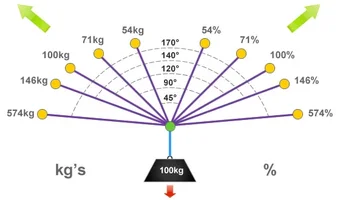
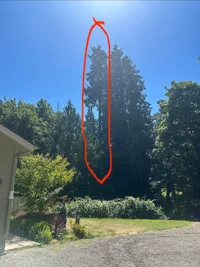
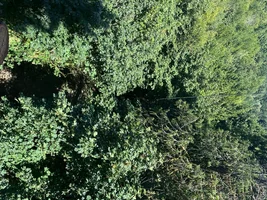
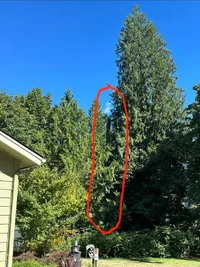
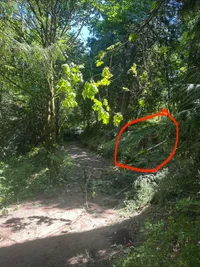
finished the job today. i was too stressed out about the vsl at this scale and with the twisted trunk angles. just decided to send it. had the pull line choked at 200 because that is how long my climb line is. descended down to customer indications guessing about 70', and made the one cut, about 26" dbh because my 25" bar didn't reach. very narrow face cut. it started sitting down on my chain. everything went well. Just all the setup ate up the morning. had a couple redirects starting with 60' up a big leaf maple stem and over to a fat cedar, and then to the chipper winch. used coms. also luckily completely unintentional hooked a stump and the tree didn't roll. nothing fell in the creek. snip snip and everything on the road. drove right up to it. and bonus, we chipped into the forest.Slack unless loads a light. Remember the vector chart of rope angles. The tighter it is the more load on the anchors.
The balance is the load runs smoother with tighter lines, yet the anchors see more force.
View attachment 102516
thank you for such an amazing response.A couple thoughts. If you're worried about putting too much force on the tree while going big, counteract the resultant vector force on the stem downwards to keep forces in compression on the stem by having a guy line tensioned and tied off to the base of one of the cedars behind it if possible.
Sometimes jobs like that are just a pain the arse no matter how you choose to do it. One climber clearing out a good speed line route from the maples in front towards the gravel road could be the best use of time while another is getting setup to speed line out the entire tree. Having a good setup and pre-slung branches is going to be time consuming yes, but it's also way more predictable/manageable than a chunk of stem wood with brush on it. I don't have any concept of how close to the road and how deep the ravine/intertwined the trees are for the path of material, but if the tree is really that tall you'll be able to get a lot of material out smoothly before the maples become a huge issue (that is if you have a longer distance of travel in the speed line vs a steep angle getting past the maple canopies).
Another thought, getting all the limbs/brush down to the ground and stacked/oriented for winching up the ravine vs trying to get through a big tangled mess, find a way to set a high redirect in a maple for the winching piles to move freely uphill without getting snagged repeatedly, unhook redirect when they are uphill enough for a direct route to the chipper.
Big cuts big results, but sometimes dropping conifer pieces with wood and brush can be a total PITA with challenging terrain in the mix. My two cents.

absolutely, glad the project went well for you! Chipping into the forest is such a great move when you're in a rural area.thank you for such an amazing response.