Using trunk to make table tops

YOu want to make table tops out of round slabs right?

Choose your thickness then add at least an inch to give you half inch on each side to plane out

If you want to make one slab you need to cut three

Have your sealer right with you ready to go immediately. Waiting reduces the effectiveness. Have your drying are ready to go and stickers too

Make your slabs

Now...the trick...look at the lab and see if you can find some weakness or pattern that might lead you to be a place where a crack might form. Use a crayon or marker to run a straight line from the bark to the center. Do the same on the slabs above and below it. Offset your lines 40* at least. If you can cut with a bandsaw or thin kerf its best.make the cut following your line. paint on the seal and sticker/stack

What you've done is give the slab a place to let off the drying stresses. Wood dries at different rates in a radial fashion. That's why most rounds crack.

After the slabs are dry your crack will have opened up like a pie piece. Now, take one of the slabs and match the grain to the crack section. Cut out the pie piece, smooth all edges and glue it in. By off setting the relief cut you should be able to grain match the pie

When I read this years ago the writer had pics of several thick large slabs that he had 'pied'. YOu could hardly see the patch

Using PEG...poly ethylene glycol has some merit but also some shortcomings. read up on its use for large wood pieces
 
Thanks for all the input.

Just to be clear;
1. recut it oversized.

2. Seal all services immediately

3.)Store in a cool dry place not in contact with any moisture holding substance

4. Wait as long as 3 to 5 years for it to properly dry out and plain and sand from there

There are two problems I'm noting.

First, you will need to finish drying in a kiln for two reasons - to kill the bugs and to get it down to 6-8% mc. You'll probably get it down to 20% mc in a garage. Since the grain is cut end on, drying will be a lot faster than 1 year/inch.

Second, live oak is bendy, porous, and fibrous, so it is not valued for woodworking. That said, you can get a pretty penny for large wooden objects if you do it well, so don't be afraid to work a rarely used species.

Hth
 
For Pentracryl, from what I've SEEN not done, I'd probably make a slightly strong, rectangular form around the cookie, then keep boxing in with 2x's to take out as much space as reasonable to reduce excess volume in the form, then line with the appropriate plastic, some spacers that won't press into the wood from below, but also not prevent pentracryl from soaking in.
 
Last edited:
There are two problems I'm noting.

First, you will need to finish drying in a kiln for two reasons - to kill the bugs and to get it down to 6-8% mc. You'll probably get it down to 20% mc in a garage. Since the grain is cut end on, drying will be a lot faster than 1 year/inch.

Second, live oak is bendy, porous, and fibrous, so it is not valued for woodworking. That said, you can get a pretty penny for large wooden objects if you do it well, so don't be afraid to work a rarely used species.

Hth
A wood working buddy of mine from church told me today to buy a moisture meter for it. Said they were under a hundred bucks. Guess I’ll be getting one to accomplish what your saying.
 
A wood working buddy of mine from church told me today to buy a moisture meter for it. Said they were under a hundred bucks. Guess I’ll be getting one to accomplish what your saying.

Moisture meters are a rabbit hole, beware. Cheaper ones have limitations. Expensive ones fall into a couple categories that are better than the other category at taking readings. You can also monitor moisture content directly using a sacrificial round of similar stature, and not buy a moisture meter, but who does that?... Good luck, jump in and do it.
 
I’ve always wanted to try soaking the wood for a few days in water then wrapping a 1/4 x2 (or 1.5”) steel band around the cookie with square head lags every 6” or so. Kind of like a wagon wheel, as the steel cools it shrinks and constricts thus limiting movement. It would also be incorporated into the finished piece.
 
Aside from killing PP beetles and the like, I've never seen the point of kiln-drying wood down to some crazy-low MC level, because once you bring the piece into your house, no matter how many coats of finish you put onto it, it's gonna reach equilibrium somewhere around 8-12% MC, depending on the season (higher MC in summer, lower in winter).

I've always used air-dried wood with no problems. Boat builders talk about KD wood as being "dead" FWIW...
 
Timber Kings rout out the bottom side and replace it with glue and plywood.
I placed a couple of large cookies on my sawmill to get them even and that works really well.
Wood will take one inch per year to dry.
 
There are many ways to skin this cat... but, for a heirloom piece simply hoping the cookie doesn't check is overly optimistic. Even using epoxy resin to stabilize the slab usually requires some more advanced woodworking techniques, if you want the finished piece to last a hundred years, not a couple of decades.

Once I've got the wood stabilized and the moisture content down below 20% the real fun starts. I want the slab reinforced with materials that stay flat, so I make a template (usually out of 1/2" MDF) and use a template following bit in a router to cut two or three layers of Baltic Birch plywood in either a circle or the shape of the cookie (only smaller) to laminate up a thick core for the table. These pieces are cut out on the bandsaw to about 1/8" oversize, then finish cut with the router and template. Then, they're glued up to a thickness suitable for the slab size/thickness. With the router mounted to a planing sled, I mortise out the slab to a suitable depth... again, the thickness of the slab determines this. For example, on a cookie slab that is 2" thick, I'll cut the mortise to a depth of 1" (very time consuming, as this takes multiple passes over a large area) and build the plywood core up to 2" thick using two pieces of 3/4" BB plywood and a piece of 1/2" BB plywood sandwiched between them. This keeps any glue joints from being in the same plane as the bottom of the slab. The core gets glued into the mortise and I either clamp it with lots of weights, or it can be screwed to the slab for clamping.

After the glue is set, you have two choices... the plywood core protrudes 1" out from the bottom of the table top... but this will be underneath the table. If you want the piece to look like it's entirely made from solid pieces of the slab wood, then you can cut two cookies (from adjacent locations on the log) and mortise them both out, so the second cookie can now be glued onto the bottom of the first one, and the core. Obviously, you need to get this right in order for it to look like just one cookie. You might not be able to keep the live edge if you get it wrong, but if you get it right the glue line won't be noticeable after finishing.

There is a reason heirloom furniture is so expensive. It's a LOT of work.
 
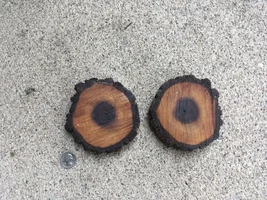
As a total nube and borderline idiot 10 years ago I decided to make some "beverage" coasters out of a walnut we took down. Found a nice limb with consistent diameter and simply cut 6 slices out of it with the chainsaw. Got them home, drove a nail into the center of each, strung them up and coated each with a few coats of spray polyurethane. No sanding, no waiting to let the wood dry. I wanted a very rough look since much of the basement is unfinished wood. Here are 2 of them (stains and all):

fullsizeoutput_37c6.webp

Question: why didn't they crack/check? Is it just because they are so much smaller than Canary's table?
 
image.webp
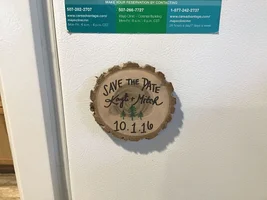
We did the same for our wedding invitations, the smaller diameter walnut didn’t check. Probably has to do with lumin density and lumin size for the species. We did some out of Ash, and they checked. Definite correlation when you consider species mass.
 
Question: why didn't they crack/check? Is it just because they are so much smaller than Canary's table?

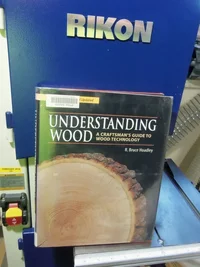
THis is explained in Hoadley's book. Thickness, diameter, species are figure into the formulas. Pi is a big influence in this just like in anything round.

An understanding or inter and intra cellular water comes into the discussion too.
 
  • Like
Reactions: ATH
I've had good luck with fine, straight grained woods with cookies up to about 15" for clock faces, etc. Especially the soft to medium density ones... walnut, boxelder, aspen, etc... they usually have minimal checking.
 
I've got a nice cookie out of a WO maybe 20" diameter. I cut it from a tree that had been downed two or three years earlier, so it didn't check almost at all. The sapwood had started to rot, but the heartwood was like cast iron. Will probably make a clock out of it, eventually. I love the smell of WO...smells like WHISKEY (or vice versa)...
 
I've got a nice cookie out of a WO maybe 20" diameter. I cut it from a tree that had been downed two or three years earlier, so it didn't check almost at all. The sapwood had started to rot, but the heartwood was like cast iron. Will probably make a clock out of it, eventually. I love the smell of WO...smells like WHISKEY (or vice versa)...
Willow oak
Water oak
White oak

I dunno. I had trouble with this. Whiskey gave it away, but for some reason it was not my first guess.
 

New threads New posts

Back
Top Bottom