Up a stick without a crotch

When you are cutting also? Or just when you walk down the spar?

One reason I started using an AFS was because it was easier to rapell down rather than walking down the spar on spikes, particularly if the spar was tall, fat, stubby, or covered with ivy. It does take a little time to learn the routine, but it is simply throw the ring around the spar, feed the eye through the ring, and clip the eye to the saddle. If you use two attachments when you make your cuts then the AFS is already on the spar and all you have to do is unclip your lanyard and rapell.
 
It's true, Petzl has this pictured in previous catalogs It can be difficult to retrieve for us (with bark and limbs), but on metal poles or concrete it works well.

On thing to remember is to make sure you rappel on the right side!
wink.gif
 
It's definitely easier to rapel down a stem that has large crotches and such. In such a case, I do rapel. Say, however, on a loblolly pine removal- I'll just walk down the stem in spikes and chunk wood.
 
[ QUOTE ]
It's definitely easier to rapel down a stem that has large crotches and such. In such a case, I do rapel. Say, however, on a loblolly pine removal- I'll just walk down the stem in spikes and chunk wood.

[/ QUOTE ]

Do you use a back up system?
 
i think if both ends of the krab are pulled with tension and any sideways force is more intensly on any individual part of the krab; the krab is leveraged some. If the whole krab is pushed to the side evenly, then jsut lines are leveraged. But if there is any other 3 part but not inline force pattern we are trying to arc that which resists bending(non-flexable device); thereby leveraging?

i also kinda think system mounted horizontally on a vertical spar/mount/host; and pulled vertically would give 2 axises of potential arc/bend; 1) around spar as arc/bend and 2)down vertical from horizontal rope as bend.


i favour same setup, and a running bowline in the bight; made by bight of the Sheetbend; made from a doubled over bight of line; that leaves an extra eye; then you place krab in it as a keeper/stopper; and the larger/normal eye around Standing Part that you ride down. But ususally; i have a rigging line up with me; and jsut place running bowline in end of lifeline to choke itself; then riggin line to eye of Running Bowline to make it retieveable.

Similarily, can set line at 60' for SRT ascend, with rigging line in eye of Running Bowline; then climb up to work area at 40', safety off with lanyard and retreive Running Bowline with rigging line to switch over to DdRT, and have rigging line with you.

This places only flexible line and not metal at potential arcs of horizontal to vertical line pull or curve around spar. Also, i'd think could snug tighter. i think straight metal should only be pulled iniline on long axis for most predictable and minimal forces; so it is best if it only 'floats' unrestricted between 2 points of pull; or is evenly/ flatly against something like flat agaisnt middle of plywood as it ran by it(both neutral variances in sidewards force on krab).
 
Mangoes- No, I don't use a back-up system. Of course I have a lanyard on. I suppose you mean a line hitched to the stem attached to a friction hitch, attached to me. Do you use a back-up system in such cases? Did you learn that way, or did you switch later?
 
" ... can be made with only a climbing rope "

One could stop here, w/o the 'biner!
A variant the treacherous Highwayman's Hitch could be used,
and pulling on the release end drops the entire line free of the spar.

[ QUOTE ]
The drawbacks are 1) if you are on a tall spar, having to feed the end of your line to the ground, and 2) retrieving the line if there are a lot of stubs, ivy, or flaky bark on the spar.

[/ QUOTE ]
Maybe a prudent step to take, at least in some cases, is to
re-attach oneself mid-descent and release & re-rig the descent
line at that lower point--the thought being: easier to tie twice short
than wrestle releasing one long
?

Nick, why favor a "Slip Knot", as that would tend to confuse re orientation
of the slipping part (under rapell loading, you'd want it to be working
qua Overhand Noose!). Just an Overhand loopknot is quickest.

"on a bite" !! Tom, is this a Spyderian slip?

*knudeNoggin*
 
[ QUOTE ]
"

Nick, why favor a "Slip Knot", as that would tend to confuse re orientation
of the slipping part (under rapell loading, you'd want it to be working
qua Overhand Noose!). Just an Overhand loopknot is quickest.


[/ QUOTE ]

What do you mean by overhand loop knot? Isn't that a slip-knot? If so, couldn't the 'biner catch both the tail and the bight for a marlin spike?
 
The knot I was talking about can best be seen here http://www.iwillknot.com/slip_knot/ I consider this such a powerful and valuable knot because it is so fast to tie (a kid can tie it in less than a second) and can be used in a lot of applications. There is a catch, however. If I was using this to send a polesaw, I would pull the loop up from the top. If I was using the same knot as a stopper to pull on a tagline, the loop would have to be formed from pulling the bight through BELOW the loop.

The same applies here. If I'm standing atop a spar, the I'd make the loop, then insert a bight from the running end of the rope (the side heading around the spar) rather than from the side immediately heading to the ground. The way the loop would tighten down on the 'biner.

All that said, I've have to try it out, first. I don't know just sitting here if the thing would slip or not.

love
nick
 
[ QUOTE ]
Surely a clove hitch is the answer? Or am I wrong?

Butterfly/Alpine?

[/ QUOTE ]

I think the only right answer is that in this case there are many right answers.

love
nick
 
[ QUOTE ]


I think the only right answer is that in this case there are many right answers.

love
nick

[/ QUOTE ]

There seems to be many wrong answers, too. I think your slip knot is one of them.

I think the butterfly is great and the figure eight even better. This is no place to be messing up on tying a knot so my vote is for the figure eight.

69908-Figureeight.jpg
 

Attachments

  • 69908-Figureeight.webp
    69908-Figureeight.webp
    46 KB · Views: 61
When its like that the figure 8 looks rock solid.

Also looks like the only carabiner you'd want to using is the Petzl Ball Lock, Other 3 way twist locking biners may open when downward force is applied to the rope.

Maybe a Maillon Rapide instead of a biner?

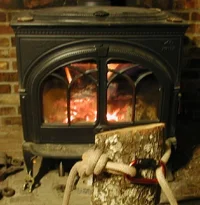
Nice stove TreeCo, shame about the goddam mess round the fireplace! man, tidy it up and give that place a sweep!

Better look shipshape in the next photo!

Request; can you do the same photo but with a clove hitch as the midline knot?
Use climbing line instead of the bullrope please.

Yours hopefully

axeknot
 
[ QUOTE ]
The knot I was talking about can best be seen here http://www.iwillknot.com/slip_knot/ I consider this such a powerful and valuable knot because it is so fast to tie (a kid can tie it in less than a second) and can be used in a lot of applications. There is a catch, however. If I was using this to send a polesaw, I would pull the loop up from the top. If I was using the same knot as a stopper to pull on a tagline, the loop would have to be formed from pulling the bight through BELOW the loop.

The same applies here. If I'm standing atop a spar, the I'd make the loop, then insert a bight from the running end of the rope (the side heading around the spar) rather than from the side immediately heading to the ground. The way the loop would tighten down on the 'biner.

All that said, I've have to try it out, first. I don't know just sitting here if the thing would slip or not.

love
nick

[/ QUOTE ]

Nick I have always called this knot a Marlin Spike.

I use it for sending chainsaws etc up trees. And for sending the workin end of the rigging line back up(acts as stopper knot in the block, only when it is tied the right way)

I certainly would not be promoting this as a suitable midline knot for cinching your climbing line, precisly for the reason you stated. If you tie this knot the wrong way round it does not work properly.

A clove hitch can only be tied one way so is far better than a slipknot(marlinspike). Or you could use a figure8, butterfly, bowline on bight etc.
 
[ QUOTE ]
Nick I have always called this knot a Marlin Spike.

I use it for sending chainsaws etc up trees. And for sending the workin end of the rigging line back up(acts as stopper knot in the block, only when it is tied the right way)


[/ QUOTE ]

In the marline spike the biner tail end of the rope passes through the carabiner. At least thats how I recognize it. The knot Nick showed did not do this. The overhand loop I think.

A marline spike is accepted as a midline knot worthy of personal support.
 
A marline spike hitch is a slip knot with a marlin spike put into the loop. There are 3,854 knots referred to in Ashley's book of knots, and the Marlingspike Hitch is the seventh one he mentions. See ABOK # 7. ABOK 43 and 44 show this knot, identical, except without anything inserted into the loop. In this instance it is referred to as a Slip Knot.

So if we consider the 'biner as serving the same purpose as the spike, then...we're both right. If we say the spike is different than the biner, then we're both wrong.

love
nick
 
[ QUOTE ]
[ QUOTE ]


I think the only right answer is that in this case there are many right answers.

love
nick

[/ QUOTE ]

There seems to be many wrong answers, too. I think your slip knot is one of them.

I think the butterfly is great and the figure eight even better. This is no place to be messing up on tying a knot so my vote is for the figure eight.

69908-Figureeight.jpg


[/ QUOTE ]

In that photo, better to slide the karabiner to the left, so the pull comes in line with the major axis.

Always make sure the gate faces up (it is shown correctly here).

Make sure you're tied in to the correct leg of rope before taking off the lanyard. I normally spike down on the lanyard until my weight is on the system. I give it a check before unclipping the lanyard.

As for the marlin spike, just ensure the slip loop is pulled through the half hitch from above, not below. If pulled from below, it can run! It aslo needs to be cinched correctly so it doesn't collapse. It wouldn't be my choice here. The clove hitch seems a good idea - but I'll have to try it.

I miss my log burner
frown.gif
 
I tried it today. I was only up a 40ft ash. Stripped all the branches off, took some logs off the top, then wanted to come down and fell the stick, about 20-25 feet.

I wanted to use what was on my harness, I hadn't pre planned to use this technique. I had a spare krab as usual but no figure 8. I lanyarded onto the stem. Unclipped end of climbing rope and removed rope guide. (of course I could have come down on the rope guide but I wanted to try this out).

Leaving my friction hitch in place I pulled the rope through so enough spare was on the ground, then tied it off using the spare krab and a clove hitch. Clove hitch must be the easiest to tie in the tree.

So I only had my friction hitch on the rope and now I'm srt. I was using the ascender hitch as shown on here somewhere, so the was enough space between the pulley and the krab (the one one my front attachment) to tie an italian hitch (munter) on the front attachment krab. Came down using italian hitch backed up by the ascender hitch. Really easy and quick.

Ropeguide would be better but I guess if I'd gone passed the poin twhere the RG was not big enough then it would be ideal. I'll keep that in mind for the future.
 

New threads New posts

Back
Top Bottom