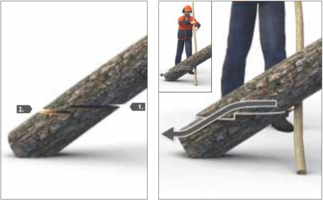
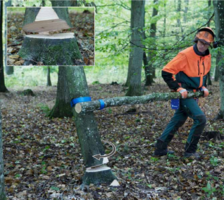
Undercutting hung up trees

tomstrees

Participating member
A guy from the Bible study wanted me to come up to his property to help try to get a hung up tree broken away from the tree it was on. Against my better judgment, I got a couple of my big saws, and he had a come along, etc., so we cut a few sections. My experience is that this can be dangerous, especially if there is a lot of spring in the wood. It had been hung up for a while, I didn't want to disappoint him. We cut a number of sections away, and the hung up tree sometimes doesn't come down much. This is not recommended right? Probably the right way to handle this would be to get a line high up in the leaner and have a sufficiently strong machine to pull it out.
 
Try cutting so that it moves sideways a little each time, rather than dropping straight at the tree. The top will sometimes roll out of the other tree.
Have also wrapped rope around the stem, lower down and (provided the thing isn't still attached at the stump) pulled on the line with the truck and clevis a bit to roll it along on the branches it was stuck on. Worked like a charm in that case. Suppose depends on if it's stuck up in some deep V unions or something. Good luck.
 
I wouldn't do it on huge trees...and I don't think that a small tree won't kill me. But I do undercut 10-12" diameter trees. I'm not going to say on a "reguy" basis - but when cutting a few hundred trees for timber stand improvement work, one is gonna hang every now and again.

Always make sure you have a clear path to get out. Start getting out as soon as it starts to move.

Sometimes doing a bore cut in the middle then moving up the stem to bypass it with a top cut and bottom cut and then pulling it sideways with a rope.

Also, usually you need to undercut. Sometimes that will pinch so you need a top cut. Just gotta read the situation.

Like @Brocky said, trying to get some roll is ideal.

Best way to do it is pull with a winch on a skidder or grapple. Or leave it. I've told a lot of people "yeah, that's ugly, but there's nothing in the woods worth dying over. It'll come on it's own in time. Gravity always wins!"
 
Goodness gracious folks, do we not know how to clear a hung up tree with a properly executed slice cut? A mandatory skill set around here which I frequently use. Hell, I‘ve cleared hung up trees well over 4 ft diameter with the old slice/salami cut.
 
Last edited:
Slice cut, bore snap slice variant, hooking it for a roll, face cut back cut to help control the direction of the butt, lots of options and tricks depending on the situation.
Setting a line can be a good idea in some cases.
Wasn’t someone here promoting a tounge and groove with a controlled side pull many years ago?
 
Goodness gracious folks, do we not know how to clear a hung up tree with a properly executed slice cut? A mandatory skill set around here which I frequently use. Hell, I‘ve cleared hung up trees well over 4 ft diameter with the old slice/salami cut.
Take it easy Uncle Rico I’m sure if coach would’ve put you in fourth quarter you would’ve won state, no doubt in your mind.
 
couple options to get movement:
1. Roll the tree with a cant hook or a strap/pry pole
2. Bypass cut at he base and break it free with a pry pole or manipulate the break with a rope/comealong from a distance.
3. Salami cut as Rico suggested. Others might have pictures of this. There is nuance to it that is hard to describe in text but I do use this most often in hung situations.
4. Bypass cut at 3-4' height and break it with a rope pulling from a distance.

Picks and tree size details would help. Attached pics are from Husqvarna's felling publications.
 

Attachments

  • bypass break.png
    bypass break.png
    85.3 KB · Views: 27
  • roll tree.png
    roll tree.png
    369 KB · Views: 25
Salami cut was our bread and butter when I was working fires. Lots of other ways to get fancy but often KISS is the best approach when you don’t have targets to worry about. Make sure to have a good escape route (ideally multiple), especially if the angle of the hang up is steep (generally ok to have it come back towards you if you’re expecting it because the tree it’s hung up in can become a safety tree to step back around). Cut the offside, then the top until it starts to close, and have as little of the bar exposed as necessary on the under cut so you can pull out and move away quick when it goes.
 
Where were you doing wildland work @Treemuel ? Always been interested in it, seems cool but hard on the body.
Spent a couple years as a wilderness ranger, then another six on a hotshot crew in AZ, working all over the west. Rewarding work in many ways, but definitely hard on the body; not to mention inhaling smoke and ash. Doesn't allow for much of a life in the summer, usually working at least 14 on with 2 off.
 
Goodness gracious folks, do we not know how to clear a hung up tree with a properly executed slice cut? A mandatory skill set around here which I frequently use. Hell, I‘ve cleared hung up trees well over 4 ft diameter with the old slice/salami cut.
Never did anything close to 4ft diameter though. That’s a beast of a hang up
 
Salami cut was our bread and butter when I was working fires. Lots of other ways to get fancy but often KISS is the best approach when you don’t have targets to worry about. Make sure to have a good escape route (ideally multiple), especially if the angle of the hang up is steep (generally ok to have it come back towards you if you’re expecting it because the tree it’s hung up in can become a safety tree to step back around). Cut the offside, then the top until it starts to close, and have as little of the bar exposed as necessary on the under cut so you can pull out and move away quick when it goes.
Nice description of a slice cut (especially the part of getting your far side first). I would also remind folks that it can take multiple slice cuts to completely clear your hanger, and as each slice cut slides off of the cut the butt will generally swings towards the tree it is hung in. This means your hung up tree will get more vertical with every slice cut, so please be aware that it can and will come back at you as it finally clears...

Never did anything close to 4ft diameter though.
We get some big nasty hung up firs around here and many times a series of slice cut is you best and/or only option.
As I said, I consider the slice cut to be a mandatory skill, and one I was fortunate to learn at an early age.
 
Watched a dumbass smash his foot with a slice cut. Entirety inappropriate situation cutting one handed overhead while on a bank without anywhere to go. Small piece only about 6/8” diameter bigleaf maple sprout.

They can certainly come down violently. Depending on the situation you can get some directional INFLUENCE depending on how you make the slice cut.

Also depending on the situation there can be enough back pressure where a well placed face cut can move it quite a distance left or right. Occasionally even backwards in conifer land.
Imagine a 30’ uprooted stem 150’ leaning into a like size tree. The loaded tree wants to snap back, a well placed face/back cut can get the butt to shoot backwards. Not a time for a step cut, and even one for a low back cut. It might need a pull to get things moving.

Others say the top dead center of the diameter is 12 o clock, you can make a face/backcut between 3 and 6 or 6 and 9 (face) and control the direction left or right. Opposite face back cut if walking it in and steering it left or right, is a possibility too.

90% it’s a slice for me. Sucks when they don’t slip out and either flip backwards or get so hung they are suspended
 
pics plz, every shituation different; the hooks, unhooks and passers by are in different locations and directions. Where CoG is, how much Clarence to ground/ or if touching.
.
As Brocky lends falling into direct lean is more pressure, thus slide to side less or distributed forces to lean direction, and if that is to the un-hook part of the hook/pass by/unhook choices, usually good move on chess board. This even goes if top compression, where are undercutting too; it is more intense forces fight vertically w/the empowering gravity directional axis, but some relief of forces if steer to the side. So might face to 1;30 , even small Dutch pivot change on close of top side to serve towards 1:30, fat of Tapered Hinge preserved to down side to fight on the vertical dimension. Dutch more powerful w/speed tho..
And this can be much more like chess, than checkers; 3 layer chess that is like on Star Trek; including where CoG is; especially if twisted somehow. If can perhaps more instinctively read very well to dance around and relieve into the compressions/not cut into them can read back to it the Rico Act..
.


i always picture tree as weightless frame whose members are of varying rigidities. All the weight concentrated densely into a cannonball called CoG as the only active force, that expresses thru the passive but responding framework of the tree.
Counter-intuitively the CoG cannon ball may be even in empty space (within framework), but can only express, communicate with rest of world thru the framework. This is to a simple model formulated of a metal donut; where CoG would not be on framework, but framework is the only way to react with or against CoG, and it back to world.

 
Last edited:

New threads New posts

Kask Stihl NORTHEASTERN Arborists Wesspur TreeStuff.com Teufelberger Westminster X-Rigging Teufelberger
Back
Top Bottom