Trying a new SRT setup

Fairfield

Participating member
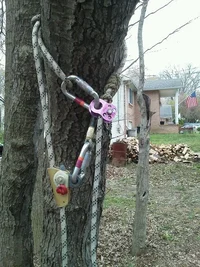
This past winter I had taken a SPRAT class (mainly for idustrial work), but I have always been one for safety and also if I say I am a member of something I try my best to follow the organizations practices (ISA, SPRAT, NFPA). I have fully made the switch to SRT while doing tree work and have been playing with the setup in the picture as my high anchor point. I start on the ground with the line going through the micro pulley ( directional eight clipped to the biener. Then I pull the line up. Once I have ascended to that point I attach the hitch above the micro pulley, in turn that is connected to the gibbs on the other side of the line. This allows for both ends of the rope to be locked off. The thing I like about this setup is I am able to use both ends independent of each other. Also I place a Petzl ASAP to one end of the line as a backup. I am trying to work on a way that this can all be setup from the ground to save the time of having to climb the whole way up first. Although most the time I am setting up a high rigging point so it doesnt matter anyway.

I know this is way out of the norm for tree work as of now (climbing), but if you would have said 10 years ago that guys would all be moving to SRT it would have been odd as well. Any thoughts on this to try and tweek it is more then welcome. Stay safe.
 

Attachments

  • 318180-IMG_20120401_160827_resized.webp
    318180-IMG_20120401_160827_resized.webp
    111.2 KB · Views: 417
An advantage of having both ends available would be: First would be having a backup device on one end reducing the chances of having a dinamic fall. The plus side to this is being touched on in another thread right now about rope elongation with SRT. If there was to be a fall the backup is going to stop and reduce the distance. Now there is no real need for a rope with longer elongation (like we have been using). Another good point is having two lines is the ability to move around a trees canopy while still having a line that is not wrapping around multiple branches. What I mean by this is when moving past one branch you can stay attached to one line while moving the other to a more direct postion inline with where you are getting to. Granted this may not always be possibilty.

When it comes to tieing off at the base of the tree im not such a big fan. One reason is due to that is where the lowering station is setup at and the other is I dont need limbs or anything else getting near my one thing holding my butt up in the air (too much could go wrong, plus I hate looking down to check on it all the time).

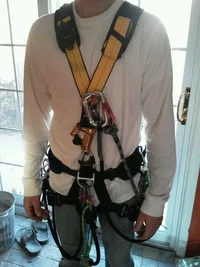
Im not saying that this is the best or only way of climbing by any means but when it comes to backing your system up (a topic that is always talked about, this is a great way of doing it). Even if you are to do the unthinkable by cutting one line the other will be there to stop a fall. This is a pic of my rig setup. I know it is more then a arborist climbs with but I have found it becoming more and more climber friendly then when I had been using a dbrt and a single lanyard. The two upper lines are my backups and one of the lowers is my upper ascender while the other is a extra lanyard for positioning. I do have a normal lanyard as well that goes to the side Ds.
 

Attachments

  • 318236-IMG_20120205_160506_resized.webp
    318236-IMG_20120205_160506_resized.webp
    44.4 KB · Views: 187
This is another solution for good SRT tree climbing.

Like a lot of practices that arbo work has incorporated a system, gear or technique is brought from another rope access discipline and modified for trees.

Keep it going!
 
Yes, this will work. But there is a point of no return. To much clutter! Be it ropes or other items. Haveing two independent ropes will give you more freedom of movement. Still tied into two ropes or rope and lanyard. Advancing around the wide spread canopy with two TIP as you go. Or two base anchored as you go. OR one base anchored and one TIP at current work station. Advancing one line ahead of ya. This can zipeline you around the tree canopy. 15 to 30ft jump at a time. The easy of getting to the next limb is very quick and effecient. The wide spread Oaks and Cottonwoods are much easy to work by doing this. Hope that didnt confuse ya.
 
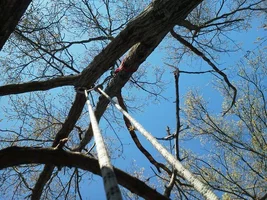
Sawdust, Compleatly agree with you. SRT with a backup line can cause more of a problem then any good in some trees. I have been trying it out in large open trees. The thing I had a problem with in the setup I have showed is there is no real point (seeing how I am saying it is a back up). I really had showed no true backup saying that my main line fails or the TIP breaks out. I tryed a diffrent way today when I was playing around with the idea. In this pic you can see that I have two independent TIPs, and also this gives you an idea of how I go about having a second TIP in other parts of the tree when I need that balance while staying still to make a cut or place a rigging point.

The other thing I did notice about having a high TIP setup like shown in this pic is that saying you only work off the one end of the rope (most often). Before descending down to start your cutting you can place the other end of the line on the other side of the tree where you will be working. This will take away from zig zaging one line through the whole tree. Once you are done prunning one half just transfer over to the other line and continue. Once you are finished there is no need to retrace a line all around the tree.

Well, at best its a work in progress for me but I am seeing good points to it.
 

Attachments

  • 318389-SRTtreehighpoint.webp
    318389-SRTtreehighpoint.webp
    132.1 KB · Views: 155
I see your point. This is what works for me. With a single 120ft line cinched at midline. You have either loose end to use another SRT or DRT for a short distance. Lot of my second ty points are just a quick blakes for the controlled swing\lowering over to next work station\rigging point. This is a quick way for two ty in point. For large trees with bigger jumps between work station. Second climb line works great. With the top TIP (ty in point) you choose your spot. Not confined to just the natural tree fork! For working large pin oaks this works great. I'll try and get some pics up for ya by wkend.
 
With your picture of your ty in. If your concerned of breaking ty in out? Just include or rope around more limbs at tip. If in doubt have a double ty going from start. Or pick safer ty in points.
To use one rope set in middle. With one end for each side? Getting weight loaded bothways? The pull out at end will be difficult from ground. Going back to tip to loose one side would be effort and time killer! Is there a way around this? One rope v's two seperate climb lines?
 
I have not had much time to work on the system in the past few days. The line does come out of the tree with not much problem (using the system in the last pic). I was at first just passing the climbing end of the rope through a butterfly knot or directional eight, but I have found that it can be alot more tuff to pull out of a tree at times. Plus the unneeded wear on one point of the rope from rope to rope friction.

As for the TIP failing, I used to just place my line around more branches as well. The only issue I have with this is there may only be one other TIP close enough to be practicle. Saying this is the case and I place my climbing line around that as well and back to the SRT (with a tracer eight or some other knot), all I have really done is given a bad TIP a chance to be worse. Going along with a Death Triangle. The last pic I put up shows the use of one climbing line as two independent lines at two independent TIPs. For picture sake they are closer then normal but imagine both points on two diffrent leads. Again this is not the perfect system but it does allow for a independent exit route and also give you options for moving around the tree using one line or both at the same time.
 

New threads New posts

Back
Top Bottom