
Navigation
Install the app
How to install the app on iOS
Follow along with the video below to see how to install our site as a web app on your home screen.
Note: This feature may not be available in some browsers.
More options
You are using an out of date browser. It may not display this or other websites correctly.
You should upgrade or use an alternative browser.
You should upgrade or use an alternative browser.
Trees from a distance
- Thread starter TC
- Start date

- Location
- North of Boston
Redwood
BB - the trees behind it are redwood but not this one

- Location
- balancing on the edge . . . .
Cedrus deodara
OK - i take that back
i just saw the new photo
OK - i take that back
i just saw the new photo
- Location
- balancing on the edge . . . .
western hemlock
JZ- Western Hemlock lives in the same forest as Tree #1.
To clarify:
I have posted 2 separate trees -
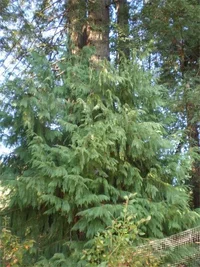
Tree #1 is a forest tree from the western N.American continent
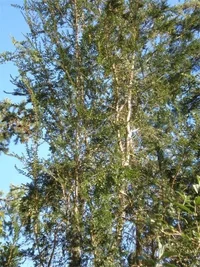
Tree #2 is the 'Bonus' tree from the S.American continent
-Diane-
To clarify:
I have posted 2 separate trees -
Tree #1 is a forest tree from the western N.American continent
Tree #2 is the 'Bonus' tree from the S.American continent
-Diane-

- Location
- Olympia, WA
Tree 1: Western red cedar
Tree 2:?
First pic looks to be deciduous the second evergreen... Dawn redwood?
Tree 2:?
First pic looks to be deciduous the second evergreen... Dawn redwood?
- Location
- North of Boston
This is how the game gets confusing. Too many trees........

- Location
- balancing on the edge . . . .
YA - i got confused also - thinking the second photo was a grown up version.
anyway
no rules - but one tree at a time would be nice
jz - time for work
anyway
no rules - but one tree at a time would be nice
jz - time for work

easyphloem
Branched out member
- Location
- Louisville, KY
[ QUOTE ]
And the 'Bonus' tree from a different continent
[/ QUOTE ]
Is that a Gingko?
SZ
And the 'Bonus' tree from a different continent
[/ QUOTE ]
Is that a Gingko?
SZ
Sorry for the confusion everyone.
I thought my first tree would be too easy so that's why I posted a 'bonus' tree.
Anyway, LTP- guessed right on Tree #1. It is a Western Red Cedar (Thuja plicata). Native Americans used the tree for their canoes and totem poles. The fibrous bark was used for making ropes, blankets and clothing.
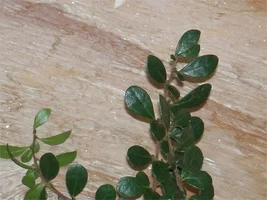
Here's a close -up of the leaves on the 'bonus' tree and another hint: this tree has yellow flowers that smell like vanilla to some people and chocolate to others (don't ask me why???) It makes a wonderful evergreen tree for a small yard.
-Diane-
I thought my first tree would be too easy so that's why I posted a 'bonus' tree.
Anyway, LTP- guessed right on Tree #1. It is a Western Red Cedar (Thuja plicata). Native Americans used the tree for their canoes and totem poles. The fibrous bark was used for making ropes, blankets and clothing.
Here's a close -up of the leaves on the 'bonus' tree and another hint: this tree has yellow flowers that smell like vanilla to some people and chocolate to others (don't ask me why???) It makes a wonderful evergreen tree for a small yard.
-Diane-
Attachments
- Location
- North of Boston
Diane
Great references! I love hearing/reading stuff like this, it really helps me remember the species I dont see often, and gives a background on the species. Especially useful w/customers!
Great references! I love hearing/reading stuff like this, it really helps me remember the species I dont see often, and gives a background on the species. Especially useful w/customers!
- Location
- balancing on the edge . . . .
while in Colorado in 07 - we were asked to smell a tree and my though was butterscotch - that was a Pinus ponderosa.
I agree BB. The more information about a tree the better.
So.....
the bonus tree is a Boxleaf Azara (Azara microphylla) It is native to Chile and Argentina. Grows in zones 5-9 & 14-24. Give it a protective area in colder climates. It's a great evergreen tree for small yards. It can be shaped or espaliered. (Plus the flowers as mentioned before.)
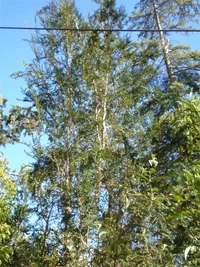
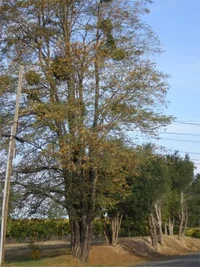
The attached photo is an escapee from the east coast that has naturalized in the west. The settlers brought seeds/seedlings of this tree along with them since it grows fast and the wood was good for fence posts.
Any guesses...?
*The round clumps in the tree are some mistletoe infestation
-Diane-
So.....
the bonus tree is a Boxleaf Azara (Azara microphylla) It is native to Chile and Argentina. Grows in zones 5-9 & 14-24. Give it a protective area in colder climates. It's a great evergreen tree for small yards. It can be shaped or espaliered. (Plus the flowers as mentioned before.)
The attached photo is an escapee from the east coast that has naturalized in the west. The settlers brought seeds/seedlings of this tree along with them since it grows fast and the wood was good for fence posts.
Any guesses...?
*The round clumps in the tree are some mistletoe infestation
-Diane-
Attachments

- Location
- Missouri USA
looks like robinia
[ QUOTE ]
looks like robinia
[/ QUOTE ]
Robinia it is. Black Locust (Robinia pseudoacacia).
Native Americans used to make their bows from the wood since it was flexible yet strong.
-Diane-
looks like robinia
[/ QUOTE ]
Robinia it is. Black Locust (Robinia pseudoacacia).
Native Americans used to make their bows from the wood since it was flexible yet strong.
-Diane-
- Location
- Missouri USA
- Location
- Decatur, Georgia
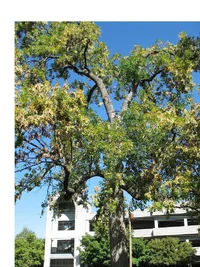
Fraxinus penn.
New threads New posts
-
test
-

-
 Alternatives to standard asphalt around roots
- Started by southsoundtree
- Replies: 12
-
-

-

-


