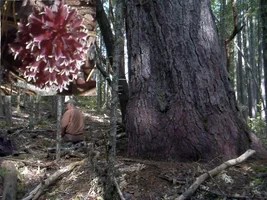
Another shot of this Sugar Pine with the ground cone next to it. Tried to superimpose a closeup, lets see if it works.
When asked what is the key to understanding old growth forests, Forest Ecology Professor Jerry Franklin said, "Forget the trees. Look at the mushrooms."
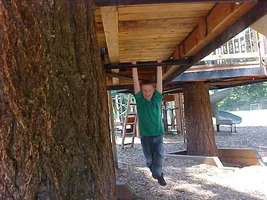
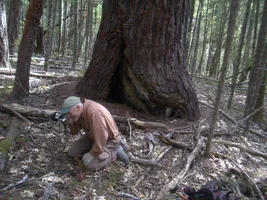
Scott may seem to be missing the boat by facing away from this very significant tree. The incredibly complex relationship among the small & large occupants of the forest is the predominant factor, however.
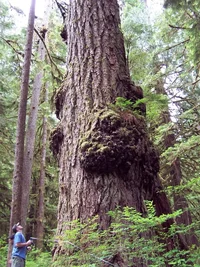
This pine has a trunk that has changed its shape in response to the wound it received way back in the past. From this angle, it can be seen that the trunk is much wider. The section with the wound is on the left in this shot.
Students of bio-mechanics know from reading Claus Matthecks books that the tree is tying itself down with the long trunk/root buttress hanging off the back of the stress load, to the right. This buttress is just like a tent stake trying to hold down the circus tent when 3 elephants are trying to run away with it to the left.
At the far right hand side of this shot, the trunk has grown a long 'ear', where it enters the ground. Notice this buttress is very light colored and has no bark seams or texture. Why is this? Mattheck teaches that careful observation of this ear will show tension wood, and much new growth. This active growth is piling on so fast, that the bark is expanding, and does not have time to develop 'character'.
The patterns of gnarley bark & smooth texture bark are what the wood directly underneath the bark looks like, mechanically.
This "window" into the structure beneath the bark is a tremendous key to unlock conceptual understanding to tree growth response to physical loads exerted by the upper portion of trees.
Click here for "Stupsi" book description:
Stupsi