
Treeflex bridge sheath

Tom Dunlap

Here from the beginning
Administrator
The webbing bridge on the Treeflex comes from the factory with a tubular webbing sheath. This sheath fits a bit loose on the bridge. The biners or shackle shove the webbing over to one end and it reduces the position of the biner on the bridge. This bunching also keeps the bridge biner from sliding smoothly.

The sheath that I made is from a piece of sheath from some 11mm semi-static climbing rope that I had laying around.

Milking the sheath onto the bridge is a challenge. To open the sheath for hot cutting I jammed in a tapered punch that was in my toolbox. Then I rolled the end on my rope cutter to fuse the edge. Now the fun begins...milking the sheath took some hard work. The first attempt failed. Then I got a piece of throwline and made a doubled loop through the eye of the bridge. Next I threaded the throwline through the sheath. The throwline was tied off to my workbench and I started to milk the sheath and pull it through. After getting all of the sheath over the bridge I found that it was too short. fighting the sheath off the bridge was hardly any easier.

I guessed how long to add and made up a second sheath. Sorry...I didn't measure the sheath. From what I remember it was about 3" longer than the bridge. If the sheath is made too long it's going to be really hard to hot cut the end after it's slipped onto the bridge.
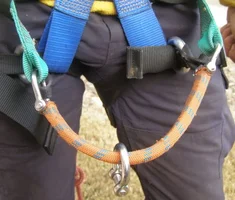
 

Attachments

  • 114640-CRbridgewithkernmantlecover.webp
    114640-CRbridgewithkernmantlecover.webp
    47.2 KB · Views: 228
By some 1/2" KMIII.

Take out the core.

The sheath will milk over perfectly.

1/2" doublebraid sheath might also work (go on, chop a short length off your rigging rope and try it!
grin.gif
).

I'm going to try a longer length and milk it over the shackles as well. Then poke the pin through the sheath and seize it with a wrap of (pretty) cord round the shackle and through the pin head.
 
[ QUOTE ]
By some 1/2" KMIII.

Take out the core.

The sheath will milk over perfectly.

1/2" doublebraid sheath might also work (go on, chop a short length off your rigging rope and try it!
grin.gif
).

[/ QUOTE ]

Hey Paolo, was this the setup that you had on your saddle at the TCIA Expo? I'm still using the bridge that came with the TFX from the factory but I like Tom and your ideas too.

How many of you guys out there have tried the TFX? If you have, I'm sure that you either now own one or will very shortly.
 
[ QUOTE ]

I'm going to try a longer length and milk it over the shackles as well. Then poke the pin through the sheath and seize it with a wrap of (pretty) cord round the shackle and through the pin head.

[/ QUOTE ]

In my opinion, with the advent of Petzl's (sequia) opening rings, this type of modification will become outdated.
 
i talked to the guys at the petzl booth at TCIA about getting those rings by themselves and what i was told was that they are not available individually and they were not planning to but who knows
 
Nope, they're smooth rings that open. They look pretty much like the round rings you'd use for a friction saver. I didn't get a close look at TCIA but they use some kind of trick opening/closing configuration with allen screws. It's pretty cool.

Wait... <u>looky here, page two.</u>

I was posted in the thread named 'sequoia'.
 
[ QUOTE ]
[ QUOTE ]

I'm going to try a longer length and milk it over the shackles as well. Then poke the pin through the sheath and seize it with a wrap of (pretty) cord round the shackle and through the pin head.

[/ QUOTE ]

In my opinion, with the advent of Petzl's (sequia) opening rings, this type of modification will become outdated.

[/ QUOTE ]

Regardless of how the bridge is attached, the sliding bridge stitching still needs protecting. The choice is a fixed sheath like the butterfly that gets replaced with the bridge but covers the stitching from inspection, or a seperate bridge cover that allows inspection and can be replaced seperately. Seems the Petzl option is not to protect the load bearing stitching??? (I didn't get a close look at how the webbing is secured there) and replace the bridge sooner??? We decided against this option, because of a potentially quick wear rate, that might not be recognisable.

Maybe the fixed bridge sheath is best - replace the lot when the cover wears through.

The opening rings are a nice feature, but they seem too large to get the effect for TFX - smaller ones might be perfect. We tried large shackles and maillons and rings, but this affected the pull on the waist and leg risers. Judge suggested at a trade fair to just use a large maillon instead of the ring and shackle - in practice the support to the pelvis was lost, causing climber inversion.

Like I've said before, what is gained in one area is lost in another.

I'm thinking a bridge sheath stitched in place is the right option. But it has to be pretty tough.
 
[ QUOTE ]


The opening rings are a nice feature, but they seem too large to get the effect for TFX - smaller ones might be perfect.

[/ QUOTE ]

There may, or may not, be a reason they didn't make smaller opening rings. I'm gonna check it out personally.
 
I'm not sure I understand your meaning Nick???

Do you mean if we fix the sheath, how can the bridge stitching be inspected?

If so, the answer is the stitching cannot be inspected with a stitched sheath. I think I may have a solution though.

Another alternative is the knotted rope bridge, but this has drawbacks too.

This is what I mean when I say something is lost when something is gained.

Lucky there are so many options for climbers to choose there poison I guess.

I'm just thankful of the TFX ergonomic mobility while I ponder mine
cool.gif
 
[ QUOTE ]
[ QUOTE ]


The opening rings are a nice feature, but they seem too large to get the effect for TFX - smaller ones might be perfect.

[/ QUOTE ]

There may, or may not, be a reason they didn't make smaller opening rings. I'm gonna check it out personally.

[/ QUOTE ]

Be sure to let us know what you find Frans.
cool.gif
 
"Another alternative is the knotted rope bridge, but this has drawbacks too."

I used a length of Fly for my knotted rope bridge but for some reason the adjuster on the back of the TFX loosens, not considerably but enough to throw the balance on to my thighs. No big deal for me I cinch the strap every couple of hours is all... but I wondered why?
 
The webbing cannot slip when the buckles are loaded - pull it as hard and long as you can and you'll see.

What happens, is when the load comes off, the buckles can oscillate, which helps them loosen. The solution is to stop the oscillation.

I do this by pulling the elastic sock back over the buckles, and tuck the remaining webbing behind the ice clipper elastic. Adjustments can still be made without moving the sock each time. I'll take a pic and post it tomorrow.

I hope that helps.
 
Thanks for that but I meant something else. It seemed that the different movement from a slightly longer bridge and the way it attaches to the shackles changed the dynamic of the harness and you are definitely right about something gained is something lost or vice versa. I realise now that aside from the ground breaking back pad you worked hard on all of these combinations Paolo. I will tinker cautiously.
 

New threads New posts

Back
Top Bottom