Tree of Heaven

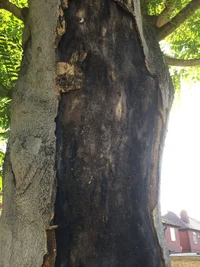
IMG_2586.webp We have a large tree of heaven in our garden. Recently the bark has begun to flake away - see picture. We estimate the tree to be 40 years + in age. Is the tree dying or is this some sort of infestation?
Can anyone help/advise please?
 
Hi Sarah, Tree of Heaven, or Ailanthus, are fast growing, weak wooded species that can achieve large stature in little time. While it is difficult to give you a complete assessment of the tree with so little information, it appears that the tree is located close to a building and could pose a risk if it were to fail. Given the amount of bark missing on the tree, there is a good chance that it will display symptoms of decline, including dead branches or trunk and root decay. You should consult an ISA certified arborist in your area, and you may be faced with removal of the tree. Look for a certified arborist on the International Society of Arboriculture web site: http://www.treesaregood.org/
Perhaps someone on treebuzz is in your area?
Good luck!

 
Hi Sarah, Tree of Heaven, or Ailanthus, are fast growing, weak wooded species that can achieve large stature in little time. While it is difficult to give you a complete assessment of the tree with so little information, it appears that the tree is located close to a building and could pose a risk if it were to fail. Given the amount of bark missing on the tree, there is a good chance that it will display symptoms of decline, including dead branches or trunk and root decay. You should consult an ISA certified arborist in your area, and you may be faced with removal of the tree. Look for a certified arborist on the International Society of Arboriculture web site: http://www.treesaregood.org/
Perhaps someone on treebuzz is in your area?
Good luck!
Thanks for the reply & advice, we suspected as much, we are awaiting to hear back from the council to see if it has a TPO then will seek quotes for an arborist using the link. I appreciate it's an invasive tree but it's been here since we moved in and we will miss it.
Cheers
Sarah
 
The scar tissue on the right side of your image indicates that bark had been dead for some time. Maybe it just started to shed.

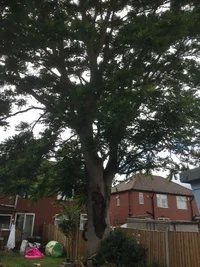
Invasiveness is regional. If no seedlings are popping up in South Yorkshire then it is not invasive there. If you want to keep the tree, there are ways to reduce the load, and there are ways to speed the scarring. Post a pic of the whole tree for more input.

"While it is difficult to give you a complete assessment of the tree with so little information, it appears that the tree is located close to a building and could pose a risk if it were to fail. Given the amount of bark missing on the tree, there is a good chance that it will display symptoms of decline, including dead branches or trunk and root decay. "

If you can't give a complete assessment, how do you know how good a chance there is for all those conditions? And is advice balanced when negative possibilities are mentioned, but positive possibilities are ignored?
 
The scar tissue on the right side of your image indicates that bark had been dead for some time. Maybe it just started to shed.

Invasiveness is regional. If no seedlings are popping up in South Yorkshire then it is not invasive there. If you want to keep the tree, there are ways to reduce the load, and there are ways to speed the scarring. Post a pic of the whole tree for more input.

"While it is difficult to give you a complete assessment of the tree with so little information, it appears that the tree is located close to a building and could pose a risk if it were to fail. Given the amount of bark missing on the tree, there is a good chance that it will display symptoms of decline, including dead branches or trunk and root decay. "

If you can't give a complete assessment, how do you know how good a chance there is for all those conditions? And is advice balanced when negative possibilities are mentioned, but positive possibilities are ignored?

True, I could have given a more balanced opinion and gone into more details regarding risk assessment and management, I figured a local arborist would be better suited to fill in the blanks with a site visit. And.....I have to admit the species probably biased my opinion a little!:aburrido:
 
Sarah, because this tree has a co-dominant structure, one of the biggest concerns i would have is whether there's any internal decay between the two stems? A close-up photo between the two stems would be helpful. Also, the necrosis extends far greater up the trunk, (possibly 2X's greater) than the exfoliated bark area. Just an observation.
 
This species doesn't have many advocates or supporters...as you've found

After spending some time with them I'm not much of a fan either. I'd be very cautious based on how much of the trunk is debarked
 

New threads New posts

Back
Top Bottom