Tree = Bullet in 1000 Chamber Revolver?

i think this conversation also has something to do with where we live. I never have to argue with someone about the hazards of trees. For the most part, around here, it seems that most people regard all trees as hazards. I cant remember or imagine a time where I had to convince a customer to let me remove a hazard. do you have any good analogies regarding convincing a customer that their tree is NOT a hazard? I find myself in that situation a lot. Oregon I take it is home to a lot of irrational tree huggers? good for you guys.
 
One of the most interesting threads for a long time. It’s so relevant to what the whole of what our jobs are about; advising clients / tree owners or simply assessing trees prior to climbing or work.

Here in the UK the Health and Safety Executive have just published new guidance for Managing risks from trees:- http://www.hse.gov.uk/foi/internalops/sectors/ag_food/1_07_05.pdf

“The risk, per tree, of causing fatality is of the order of one in 150 million for all trees in Britain or one in 10 million for those trees in, or adjacent to areas of high public use.”

From this you can conclude that the risk is very low: but unfortunately here in the UK we are increasingly not prepared to accept any risk. Persons want all the benefits of trees and a guarantee of safety, but the two are simply incongruent. In tandem with this mind set is a society increasingly driven by the threat of litigation as apposed to well thought out legislation. Consequently, precedents are set, based upon the minority rather than the majority e.g. the news paper headlines are quick to pick upon the one tree that falls in a storm and hits a car- but it does not make for interesting reading to have a headline “ car driver safely makes it home after passing 15000 trees”.

In 20 year+ career I’ve thought about this a great deal and tend to agree with the ‘we need to accept more risk’ school of thought. However, this is of no consolation to the family of the one person in 10 million whom is unlucky enough to be killed by a tree !
When you talk about this subject it inevitably gravitates to statistics, but it is part of the human condition that none of us want to be a statistic.


“ A single death is a tragedy; a million deaths is a statistic.” – Joseph Stalin (1879-1953)

“Statistics: The only science that enables different experts using the same figures to draw different conclusions” - Evan Esar (1899- 1995)

" trees have a habit of making liars out of us" - Frank1 (1965 -?)

Frank 1
 
[ QUOTE ]

Here in the UK the Health and Safety Executive have just published new guidance for Managing risks from trees:- http://www.hse.gov.uk/foi/internalops/sectors/ag_food/1_07_05.pdf

“The risk, per tree, of causing fatality is of the order of one in 150 million for all trees in Britain or one in 10 million for those trees in, or adjacent to areas of high public use.”


[/ QUOTE ]

That's interesting that they published that particular statistic. The example I used with a multi-chamber version of roulette, would pertain exclusively to just specific trees with a notable risk. Whereas that 1 in 10 million statistic is connected to "all" the trees.


On another note...

One other person replied about a certain number of deaths - I think in the UK - from trees. That got me to searching online, and one of the first pages I found was from a FULTON county. It didn't say which state in the USA, and it was written in a way that lead me to believe it was from the USA. It was like from the coroner's office or something.

Anyhow, it listed the number of deaths from trees or falling limbs in that county to be about 1 death per year. It listed - say - a seven to eight year period, with a near equal number of deaths. Those were separate deaths from tree / arborist related occupational work. So that was 1 per year in just that county.

I have no idea what the stats are across the US, but if other counties had 1 death per year from trees and branches, we would see a lot more in the USA, than the other person replied about the UK. Populations are not the same though.

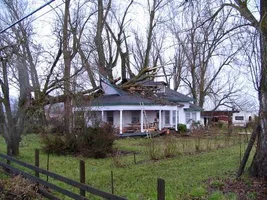
Did you see the attachment I posted earlier? ... here's the attachment, and the image too if it posts. The image does not illustrate arborist work - it illustrates intention...

IMAGE OF TREE CRUSHING ROOF / TWEAKED FRAME

Anyhow, there sits that house now - still - with the remaining trees, with various kinds of weakness and damage. That would be more of a worst-case situation.

The trees in the image remind me of a row of trees in Klamath Falls, Oregon. Three times more of them, all topped, weak, and breaking. And overhanging into a neighboring yard. The guy in the next yard is the one who hired me for consulting. He already knew there was a danger, but the city required a Ceritified Arborist to be involved. The man who hired me, had already been hit by a limb that fell while he was mowing his lawn.

Anyway, his neighbor was insistent on keeping these trees (as big and bigger than in the attached image) which were planted a few feet from the property line, and hanging over next door by about 20 feet, up overhead.
 

Attachments

  • 95934-smashed.webp
    95934-smashed.webp
    68.9 KB · Views: 37
Wow, you saw this hazard and you didnt do something about it? That means you are the one responsible. You know how to stop the trigger from being pulled and you didnt. Why is that? They were not going to pay you? So you left a hazard because someone didnt want to pay you the money to solve it.

This is like you noticeing a loaded revolver in the playground at your local elementary school. you wont go over and get the revolver out of the school yard until you get paid.

When you see a loaded revolver in a tree, its your civic duty to fix it. Even if the homeowner just doesnt see the hazard and doesnt want you to remove it.

They might not realize your really saving their life, a true hero. Im sure the police will understand, its their duty to serve and protect too.

Going by your analogy, you are putting all the responsiblity and "intention" squarely upon your own soldiers. It is not the homeowner, you cant expect them to recognize loaded guns even after you educate them or fail too. If you walk away from the job sight not having taken care of your loaded gun, regardless of pay, I would say that is equivalent to not listening to an S.O.S call out at sea.
 
I don't get it. One tree fell on a house, true. Does that mean that all the trees nearby need to be removed, because they are loaded guns? Huh? You need to be more detailed than "these trees are dangerous" to be credible.

Trees are innocent until proven guilty. If your client hired you to assess the risk of an individual tree(s) that had his property as a target, and when you assessed it you found a defect(s) that required action such as pruning cabling bracing or removal, he could send your report in a certified letter (copying the town attorney is good).

If the owner took no action for 30 days, then any damage from the failure of the assessed trees would be on him/her because their negligence would be documented. Dunlap and I assessed one like that, the owner sent the letter, and action was immediate.

"People may unreasonably expect that all arborists are experienced and knowledgeable enough to be experts in tree risk assessment, even if they are not. Knowledge gained from experience and from books will build your abilities, but that knowledge is a double-edged sword. As professionals we are expected to act reasonably and in the public interest if we see a very high-risk, life-threatening condition. Despite our disclaimers, and even if we were hired for other reasons and they are not part of our assignment, we may still be wrongly considered responsible for nearby trees. In extreme cases, it may be a good idea to document critical conditions with words and pictures, deliver that information to the property owners, and make copies for your files. Once you have lowered your personal and professional liability to a level that is acceptable to you, you are ready to assess tree risk." (reprinted from attached with permission from ISA)
 

Attachments

This is in response to treebing and Guymayor from the past two replies...

The tree service for the removal was a Certified Arborist. I stay out of affairs like that. As I wrote, if you followed the thread, I anticipate they already would have mentioned it. (knowing the company at this end).

That's probably one of the worst practices that Certified Arborists and Consulting Arborists could get into. If we know the nature of the other arborists is to do their work and communicate, but then whenever the other's customer does not follow-up, we knock on a door and stick out big nose in there and totally cut our throat.

Need to be more specific for credibility? I'm not sure about that. But if it makes you feel better; topping, weak crotches, wounds and decay are starters.

Did that make them safer? I'm not working for that homeowner, not working on the trees, and not networking with the other arborist.

But for the sake of conversation, if you would like more details in thread, just ask. I'll be more than glad to share observations since that will enable us to cover more facets or related subjects. (no offence taken on this end)

The photo is not to prove that the trees are dangerous. It could even be hypothetical "IF these trees were dangerous, this proximity would be hazardous". In this case, its not hypothetical.

Generally, when a Certified Arborist tells me that a tree is hazardous, I don't question them to prove it to maintain their credibility. At that point, I need to take them at their word. Otherwise, what are they certified for?

treebing...

There was only one company I stuck my nose into affairs of down here, but it was different. A landscape company - a bigger one - was putting tree root barrier in a fairly tight circle around street trees; by the dozens. Like planting trees in plastic pots. And putting 3" to 4" of river rock in the bottom of the hole.

The city code specified two parallel barrier - one along the curb and another along the sidewalk.

I handed the code and diagrams to the management in the company and discussed it. In fact, when hired, I was asked for input on how to save time, and this was losing time for them.

In response, they let me go over the tree care isssue. And I went to the developer of the neighborhood and asked him to talk to the landscaper so the homeowners wouldn't come back to the developer over the issue.

This was 100s of trees.

So the developer took action, the landscape finally went to the city arborist, and things got done right.

My nose in a way, already was in that ordeal.

Then, that's when I started in business for myself down here, so I would not be limited to do good tree care like that - especially since it was already being paid for.
 
One more whack at this horse, and if it still flinches after that, it's off to the glue factory.

[ QUOTE ]
That's probably one of the worst practices that Certified Arborists and Consulting Arborists could get into. If we know the nature of the other arborists is to do their work and communicate, but then whenever the other's customer does not follow-up, we knock on a door and stick out big nose in there and totally cut our throat.

[/ QUOTE ] Door-knocking is usually no good, but if we are called and hired for 2nd opinions, then our nose belongs right in there.[ QUOTE ]


Need to be more specific for credibility? I'm not sure about that. Generally, when a Certified Arborist tells me that a tree is hazardous, I don't question them to prove it to maintain their credibility. At that point, I need to take them at their word. Otherwise, what are they certified for?


[/ QUOTE ]They are certified as a first step to overall competence. If I told clients I was a fertilizer expert or a safety expert I would be lying, never mind the bcma and all that. Tree risk is 11% of the ca test; passing it does not make every ca a risk expert.
blush.gif
2 examples:

Town nearby pays $6k for an inventory by a ca, hears that 268 trees have to go, most of these big oaks. 2nd opinion is that 23 have to go.

Another town has a branch hit a car and starts whacking right and left. City arborist says 12 have to go but missed huge stem infections and big cracks while condemning a cedar due to the top 2' being dead. 2nd opinion, again following ISA/Matheny-Clark guidelines, 3 have to go.

No one should judge tree risk unless they inspect the trees and the site, designate the high risks or "hazards" and then systematically review all the management options. Only then can the owner or the arborist make an informed decision.


wink.gif
 
[ QUOTE ]
One more whack at this horse, and if it still flinches after that, it's off to the glue factory.


[/ QUOTE ]

Well, that's the benefit I had of being on the site before the work occured, and when the work was happening. Plenty of time to spare for those trees. Just because wasn't my job, doesn't mean I wasn't there.

I think the difference between us, is that when I whack the horse, I just swing and take the neccessary hit.

You get out the calculator and try to determine the most scientific speed, arc and angle at which to make the strike.

grin.gif
 
[ QUOTE ]
I think the difference between us, is that when I whack the horse, I just swing and take the neccessary hit.

You get out the calculator and try to determine the most scientific speed, arc and angle at which to make the strike.


[/ QUOTE ]Why thank you, Mario, that is a nice compliment.
laugh.gif
Without calculating and thinking a little, we can't know what whacks are necessary.

To continue misapplying the metaphor; if we see a horse limping, we can assume its leg is broken and say it's time to put it down. But upon close inspection, we see the horse only needs new shoes, so let's call in the farrior instead of the mortician. Or maybe it's a muscle pull, so we call the veterinarian.

If the assessor does not know about or think about these other options, (and many ca's do not)the horse gets put down before its time.

If you want a biblical metaphor, there's Daniel in the lion's den, threatened by the raging beast until a thorn was pulled from its paw.
 
[ QUOTE ]
[ QUOTE ]

If you want a biblical metaphor, there's Daniel in the lion's den, threatened by the raging beast until a thorn was pulled from its paw.

[/ QUOTE ]

Esop's fables, maybe? Not in the Bible.
Regards,
Phil
 
[ QUOTE ]
[ QUOTE ]
I think the difference between us, is that when I whack the horse, I just swing and take the neccessary hit.

You get out the calculator and try to determine the most scientific speed, arc and angle at which to make the strike.


[/ QUOTE ]Why thank you, Mario, that is a nice compliment.
laugh.gif
Without calculating and thinking a little, we can't know what whacks are necessary.

To continue misapplying the metaphor; if we see a horse limping, we can assume its leg is broken and say it's time to put it down. But upon close inspection, we see the horse only needs new shoes, so let's call in the farrior instead of the mortician. Or maybe it's a muscle pull, so we call the veterinarian.

If the assessor does not know about or think about these other options, (and many ca's do not)the horse gets put down before its time.

If you want a biblical metaphor, there's Daniel in the lion's den, threatened by the raging beast until a thorn was pulled from its paw.

[/ QUOTE ]

To a degree Guy...

I'd be stopping before taking its temperature
grin.gif


That's where I hand-off the consulting project.
smirk.gif


By the way, I think Daniel didn't do anything by "sit tight" figuratively speaking, in both furnace an den on two separate occassions.

Do you have a Biblical research software program on your computer?

If not, they are free.

I have one, and it's handy for doing my research and calculations for paragraphs.
grin.gif


But seriously though, there is either free biblical software, or, sites where you can just go in and enter a word, context or phrase, and do that stuff.

By the way, that was
grin.gif
a compliment
grin.gif
about the angle and arc part.
 
ok I confused the Bible and Aesop (or was it Disney?), my bad.

It takes a smart arborist to know when to hand off an assignment. I called in an engineer on my last support project, not so much out of smartness but fear.
 
[ QUOTE ]
It takes a smart arborist to know when to hand off an assignment. I called in an engineer on my last support project, not so much out of smartness but fear.

[/ QUOTE ]

Amen to that. We have been working on a project with plenty of bullets, but no engineer willing to sign off on anchor/guy ratings, and little cooperation from the neighbor who caused the problem in the first place.

The homeowner created this site: http://www.savebouldertrees.org/index.html
 
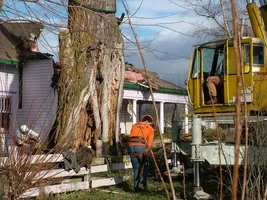
actually in this particular case the defects are obvious. i was on the crew 2 winters ago that did this removal. old topping cut with decay visable from the ground and very large sprouts growing from that point. heck theres a 40-50 foot hanger next to the parking strip. yes my former employer pointed out the hazards. the job was done and paid for by insurance, no more than was covered! in fact we refused to take that one off the house till we had another tree beside it removed.
 

Attachments

  • 96079-Picture098.webp
    96079-Picture098.webp
    151.5 KB · Views: 34
[ QUOTE ]
actually in this particular case the defects are obvious.

[/ QUOTE ]Maybe so, but does that mean that removal is the only option?


A “defect” has been defined as a visible sign that a tree has the potential to fail. However, since every tree has the potential to fail, the questions of how visible, and how much potential, remain. Any harmless feature of a tree that looks unfamiliar to the inexperienced observer can be called a defect that creates a “hazard tree”, defined as a tree with an unacceptable level of risk to a target. The question is, what can be done about it? All risks can be lowered (abated, mitigated, lessened), but when arboricultural options are not carefully considered and clearly communicated, the owners cannot make an informed decision. Quickly labeling “defects” and “hazards” can lead to the needless removal of valuable trees, when more conservative actions may have been more reasonable.
 
[ QUOTE ]
[ QUOTE ]
actually in this particular case the defects are obvious.

[/ QUOTE ]Maybe so, but does that mean that removal is the only option?


A “defect” has been defined as a visible sign that a tree has the potential to fail. However, since every tree has the potential to fail, the questions of how visible, and how much potential, remain. Any harmless feature of a tree that looks unfamiliar to the inexperienced observer can be called a defect that creates a “hazard tree”, defined as a tree with an unacceptable level of risk to a target. The question is, what can be done about it? All risks can be lowered (abated, mitigated, lessened), but when arboricultural options are not carefully considered and clearly communicated, the owners cannot make an informed decision. Quickly labeling “defects” and “hazards” can lead to the needless removal of valuable trees, when more conservative actions may have been more reasonable.

[/ QUOTE ]

Yesterday, I removed a 40' tall red maple, not because of an internal problem, but because more than half the tree ripped away, leaving an enormous wound.

Anyhow, after I got it on the ground and started to cut it apart, I discovered a narrow cavity in the center of the trunk. Have no idea what caused it - about 4' up from the ground, and no apparent pruning cut wound enclosure.

So, the first thing I thought when I saw it was "defect".

It was not visible, and whether it happened due to something man caused or not, it was not something normally found in a red maple - none that I've removed before.

"Defects" can be both visible and invisible.

Technicalities of definitions are inconsequential in many cases. The important part is, is it a defect?

A valve spring broke in my Hemi engine last winter. It was not visible. But there must have been a defect. There sure was for certain by the time it broke.

So what's the concensus from everybody?

If there is a crack, hole, included bark or decay inside a tree that you cannot visibly see, do you consider it a defect? Or do you exclude it as a defect?
 
"Maybe so, but does that mean that removal is the only option?"

guy, im biased against cottonwood trees near homes already, these particular trees have old, decaying (severly) topping cuts with large leads and history of major failure so in my opinion they should come out. sorry for the derail
 
[ QUOTE ]
cottoonwoods near homes, these particular trees have old, decaying (severely) topping cuts with large leads and history of major failure so in my opinion they should come out. sorry for the derail

[/ QUOTE ] ok, now you are assessing, having listed five risk factors. Information is a good thing to have before judging. Was the owner informed about the hazardous condition of the trees?
 
[ QUOTE ]
actually in this particular case the defects are obvious. i was on the crew 2 winters ago that did this removal. old topping cut with decay visable from the ground and very large sprouts growing from that point. heck theres a 40-50 foot hanger next to the parking strip. yes my former employer pointed out the hazards. the job was done and paid for by insurance, no more than was covered! in fact we refused to take that one off the house till we had another tree beside it removed.

[/ QUOTE ]

Your reply confirms my earlier post regarding my thoughts about a competent arborist and service having been on that job.

Didn't the crane service get stuck in the mud on that one?

I find that quite a few people with trees like that, often don't have the funds to take care of extra tree work.

Sure took them a while to get that house repaired, didn't it?

Haven't looked to see if they handled it in the repair, but a plumb line showed that the house frame was tweaked / tilted to the side a little after the impact.

[ QUOTE ]
heck theres a 40-50 foot hanger next to the parking strip. yes my former employer pointed out the hazards.

[/ QUOTE ]

That reply from earlier probably would cover Guy's question in the last post.

willie...

Whenever our house in Ruch sells, we're going back near Portland. If you want referrals, let me know. I'll probably make a Medford tree service web page after I move north, similar to the Portland page I have now, which refers work to a Portland arborist. Anyhow, calls will still trickle in after we move, and I need someone to send work to. (Just don't know when it will all happen).
 
pointed out is one (toothless) thing; informed in writing with verified receipt is another. I thought you were working for the neighbor.

Here it costs $2.32 to send a certified letter.
 

New threads New posts

Back
Top Bottom