Tips and Tricks

Also I found this video series very helpful. Well worth 50 bucks. You can stream them any time and watch over and over.


Sent from my iPhone using Tapatalk
 
Gotcha, thanks. Makes the most sense to me (now) thinking of it in terms of the climber unweighting him/herself by the amount of force he/she is pulling, plus getting double that on the harness pulley for a total 3X advantage.

But it's only a 2:1 if a groundie, squirrel or raccoon pulls it for you!
No,it depend what point moving.
1 SRT line with TIP in a tree.
2:1 MA
2 Horizontal set-up.Try to pull tree.TIP moving,second point -not
In result 3:1 MA
 
No,it depend what point moving.
1 SRT line with TIP in a tree.
2:1 MA
2 Horizontal set-up.Try to pull tree.TIP moving,second point -not
In result 3:1 MA
I think you fell into the same trap as I did initially.

In your scenario #1, the system is only generating 2:1 MA. However, if the (moving) climber is pulling the system, his/her effective weight is reduced by the amount of the pull force, resulting in an effective 3:1 system. Having the (moving) load exerting the pull force is unusual for a standard MA system.

A slightly different way to look at it is the climber essentially has 3 legs of rope attached to him/herself: the tail of the rope they're holding, plus 2 legs of rope in the harness attached pulley. Each leg will have the same tension, so the (hand held) tail of the rope only sees 1/3 of their weight - an effective 3:1.

If someone else pulls the system, the climber then only has 2 legs of rope attached and it's 2:1.

In scenario #2, you essentially have a classic 3:1 z-rig.
 
Tip: become good at, or friendly with someone who is, milling steel into replacement parts. I've met a guy who retired from his machine shop who still does some work at home who has built me several parts for my mini skid, saving me thousands of dollars and weeks of downtime waiting for the part to arrive.
 
Mongol folk medicine to keep your hand/body parts warm
Mustard and other herbs was spread on the body to keep body warm when riding on horse back in the freezing temps.
I have tried Mentholatum, seems to work better than just Vaseline(great lake swimmer).
Going to try Tiger Balm claims to be hottest effect
 
When climbing SRT on the Akimbo bring the CT quickroll hand ascender. Attach to your climbing line above the Akimbo and put the running end through the pulley for 3-1 anytime. This is also very convenient for lifting and lowering other lines, pulleys, saws etc...

View attachment 77102

So the reoccurring discussion continues. I remember doing a video and trying to explain hauling vs. climbing.
Try to see the difference, don't let moving pulleys and counting lines confuse you.
This little test can be done with your rope and some tape.
MA is simply a ratio, like a game of marbles, (just don't loose all of yours trying to figure it out) 2 marbles to 1 (2:1) or 3 marbles to 1 (3:1) You can see them and count them. We can do the same with the rope used to lift oneself or lift something else.
Hauling: Count how many feet the load has been lifted from the ground verses how many feet of rope the hauler has laid on the ground. (The ground is our point of reference here) Try it, mark the level of a load on the tree with tape, mark the rope with tape where it touches the ground, now lift the load 10' and mark the rope again where it touches the ground, measure the distance between the two marks on the rope, yep...20 feet. Seen another way, the load is pulled all the way up to the pulley, all of that length of rope that was above the load, is now laying on the ground, both legs of it. Our ratio is how much the load went up verses how much rope the hauler pulled down. (2;1)
Climbing: Now our reference is not ground to ground but the height of the climber verses how much rope passed the climber. (The elevation gain of the climber verses how many feet of rope passed the climber on his/her way up.) Starting at a point in space, how much rope did the CLIMBER have to pull thru his/her hands to go up 1'? Try it. Lets say the climber is looking at the tree (mark the tree with tape at eye level) and holding the rope, mark it with tape, again at that eye level. Now ascend the rope. When the climbers eye has ascender 1' up the tree that mark on the rope will now be 3' below the climbers eye level. 3:1
Try it, you will see it.
Seeing these ratios works with simple machines like pulleys, gears, belts, chains, inclined planes and the like. The trick is to see what you are comparing to know the ratio.
 
One more observation on Mechanical Advantage.
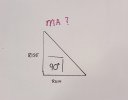
Look at the image below, imagine it is an inclined plane that has MA, like a flight of stairs. In this case you walk forward 1 foot for every one foot you go up. Rise over run building code kind of stuff.
What is the ideal MA? (Answer in the following post)

MA.jpg
 
Last edited:
It seems easy to see a ratio of forward movement to upward movement and think, 1:1 MA
Just like the difference between hauling and climbing we need to make sure we are comparing the correct numbers.
So the distance traveled in this case for a 45 degree angle is 1.41 and the distance elevated is 1.0. MA is 1.41:1
I find this very interesting that 1.41 is also that number to remember when we are looking at force vectors on redirects that are at 90 degrees. At 90 degrees we apply potentially 141% of the tension in the climbing lines. Like potential 200% for a base anchor.

Anyway, sorry to ramble, I just find it interesting.
 
To the splicing of stuffing the sausage, rubber bungee wraps as gripper can help greatly at some points; and always use NEW rope rather than all tightened and ruff i think.

Sure, force, but also distance or speed.
I add this because sometimes seeing force is like seeing the wind and "seeing is believing".
Wow, so much said here!
In my imagery, distance is a reciprocal of force;
so i try to always have view that naming one, names the other.
These antagonistic /displacing each other/ at the cost of each other reciprocals to same sum are shown in a moment measure of how much distance and power as total expression in that moment of the total sum whole.
More distance crammed denser into that moment gives speed, denser force is more power as choices of the sum total volume in moment. Can work funneling of total sum either way to concentrating or spreading depending on which end of funnel is input etc.
.
As like 10speed bike choose granny uphill or 10th gear once at racing speed type transmission of choice of power or speed from the same, finite power source volume input, just reapportioned (always at a co$t of conversion).
.
i also always look at the hypotenuse /slanted leg across from the 90degree in a right angle triangle as the actual,
then the legs of the 90 degree itself as the amounts expressed individually at each end of the 90degree geometric paradigm. i say paradigm so look at either end as a possible solution to capitalize on.
.
Trucker's Hitch therefore has 3 positions of 1,2,3 legs that can each be :input, machine pivot or output for 2 different ways each for 6 various effects from the simple tool; of the volume of forceXdistance input redistributions to not be greater than the original sum as output.
.
Dual treadwheel (for balanced force thru output shaft)/hamster cage winch/crane takes lots of outer distance funneled into smaller distance of output to center shaft wraps:
Medieval_crane_-_Brugge.jpg

As more European minds tackled problem they only saw make larger crank to spool ratio to get more power.
But Oriental mind, turned the model recursively inward on it's own self to go smaller for same target/more power in the Chinese windlass/differential (seems typical of their other philosophical etc. lendings /mind).Which seems confusing as starting to see the light enough to grasp that far; if lose sight of just watch the input /output ratio model, can end up back in the darkness of Plato's cave; banging head on wall again(as i remember it so).
L-differentialwinde.png

.
As we dilute a force over a larger distance we have more distance/less power in trade (just as diluting lemonade concentrate to same total pucker power, just less per mouthful).
.
Another twist tho:
Press/not impact common hammer on scale, is a 3rd class lever(like arm), losing power w/distance multiplier
>>Choke up to hammer head and just press on scale gives more power on scale than common extended grip press, as losing leverage in 3rd class mode w/more distance.
.
But in another paradigm on the other end of the rainbow extending from static to dynamic status :
By capitalizing on distance per moment(speed) when swing hammer/dynamic
>>we get the velocity squared of E=MC^2 and the lower leverage position now outruns the static leverage loss to deliver more power, not less via speed.
Now, extra distance from 3rd class lever is friend, not foe when seeking power return as gives more speed per moment to impact harder from the weaker (statically)power leveraged position. The static part M of formulae is of how much resistance to overcome static to dynamic is a simple multiplier; but the dynamic C^2 measure is an exponential multiplier.
.
Pattern repeats in even electronics forces:
Watts as total = Resistance of change from static to dynamic X Amps^2(speed, dynamic component squared).

 

New threads New posts

Kask Stihl NORTHEASTERN Arborists Wesspur TreeStuff.com Teufelberger Westminster X-Rigging Teufelberger

Back
Top Bottom