Tip on a spar

The video I'm about to provide a link to might not be the perfect answer to your question, because it still requires the full 100 feet of climbing rope for the base-tied system in order to set up the DdRT system that hangs off of it, but to me it is a really elegant and simple solution to your problem.

Daniel Holliday is the host of the Climbing Arborist website. I think he is just a brilliant guy, and I've sung his praises multiple times before. He's the only person on all of the internet who set out to deliberately make a comprehensive set of videos about climbing and working in the trees. On his own website he has the videos arranged by subject matter, so it makes it easy to focus on one area at a time, instead of having to grind through looking for an individual video that gets lost in a big pile of other topics that you don't want or need. His subject areas start at the most basic, of tying knots, and progress to climbing systems and rigging systems. All are worth watching.

Here is the link to the video that shows the most simple way to hang a DdRT system off of a single line, in my humble opinion.

http://www.climbingarborist.com/falsecrotch.php

Also, here is the link for the main page of his website.

http://www.climbingarborist.com/index.php

He also has a presence on YouTube, and I have already found at least one instance where he did have a video on YouTube that was not present on his own web site. So in spite of the fact that I prefer the organization of his own web site better, in some cases it might be worth looking on YouTube for other stuff. Here's the link to his YouTube home page.

https://www.youtube.com/channel/UC7jakWKUvZqiH7q7dNJau6w

I hope some of this is helpful. You can easily lose yourself in his videos for a few worthwhile hours, if you choose to. Best wishes.

Tim

Edit: I think he also has at least one video on how to do an effective base tie for the system, which you should also look for.
The video is spot with what I believe several others here have suggested. I don't think I was clear in the original thread that I'm at least as interested in using this semi permanent tip for Srt as Ddrt.
I saved your links and look very forward to looking at hours of video to add to the many I've already logged. Beats hell out of a tv with 400 channels of nothing on.
Thanks very much!
 
From everything I've ever read on the forums, it is a Cardinal sin to leave life safety rope in a tree overnight. It must be pulled out each and every time you finish climbing. The reason is the rodents that live in trees that love to chew on stuff. Over and over I've read tree guys say they would never trust a rope that had been left in a tree overnight. Having said all of that, I might do it if it was only for the purpose of work positioning, and I had one or two other ropes that I pulled out of the tree each time. If a squirrel did chew on it, I could still take a bad swing in this scenario, though. I'd inspect it closely before I put all of my weight on it in a dangerous fashion.

Edit: Read @chiselbit's post above; it is probably the best answer going. So hard they really can't hurt it.
Yes, I know the rodent risk. I may end up using chain in my originally proposed configuration. Be costly but super convenient for trying things out and quite safe.
 
Squirrels. Those little Bastards chew anything and everything. I’ve seen (more than once) where they’ve chewed through the insulated cover of electrical service lines. Down to the bare wires. I would never leave anything intended for life support in a tree overnight. If I really wanted a place to test out new methods and gear I’d install an appropriately rated eye lag, locking carabiner or delta link and a small pulley. Hang a throwline in it and pull my rope up when needed. Let those furry little f’ers break their teeth on the hardware when I’m not using it.
I didn't see your post before thinking I may go with chain. An eye lag would harm the tree and, make me a little squirrelly.
 
How much rope would be needed if the tree is 2' diameter, throw line limb 50', and floating tip at 30', Ddrt?
Not sure you read the whole thread. I'm looking to leave this in place for a while and use it for trying different techniques. A number of the replies have mentioned the floating tip for Ddrt. I will actually be trying more Srt.
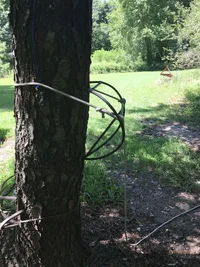
If it's not a safety issue , I'll probably try what I had in the picture and check it carefully with binoculars before use.
I was just answering your question.

Why are you going through all this needless effort? Just set a throw line and be done with it
 
I was just answering your question.

Why are you going through all this needless effort? Just set a throw line and be done with it
Sorry Evo, I'm using a phone to visit here so I can't easily see the string of replies or from whom they have come. Your input to my thread has been excellent, helpful and is appreciated. I didn't connect your above reply about "needless effort" with your others. It is needless effort I'm looking to avoid here. If I just leave a throw line at 50' (it may even be higher), I have to pull, retrieve and store twice the rope with every use. Pulling over a 50' tip vs a 30' is significantly more rope weight/effort and wear. There would be no friction saver for Ddrt at 50' unless installed each time, etc.
What I'm looking to create is a relatively low & slow permanent or semi permanent tip with friction saver qualities where I can easily change from Ddrt to Srt, to use a couple of times a week, for trying things out.
I've decided, with the feedback from you and others, to install a chain @ 25-30' in the configuration of my original picture, joined by a cord to keep it in position with quick links on each end. A throw line will be left through the links between uses. Thanks for your help. I need to make up an adjustable false crotch.
 
Should keep it simple to confident throw line use even to point of using lines to pull thowlines back into place overnight to then pull life and rig support lines back into place next visit. Next visit might be delayed risking lines to more various elements for longer and even further tempt especially bright pretty lines to grow legs and wander off.
.
Strength and security are separate rope targets. Round Turns ( multiple, continuous, uncrossed turns), Crossed Turns (Clove), Backhand Turns(Timber, Cow) all have more than 1 have more than 1 half circle pull of Single, Simple Turn so are much more secure.
.
Strength is potential strength of support legs(2 in first pic) that is only maintained on a pure inline column of rope, diminishing to virtual Zer0 the further deflected from straight line(s) between equal opposites of support and load. Cosine is the percentage of potential strength maintained at given deflection/deformation.
Not flatter than 120 lends more towards extruding the support column of rope, flatter than 120 extrudes more of a wrench leverage across , more towards sweat or swig line tighter against a support . Not the forces you want to invoke when extruding support from rope device.
.
Cosine is 50% @ 60 degrees deflection each leg. Thus until both support legs are spread 120 degrees (2x60 degree deflection s) the line tension is less than load. So we say line tension has LEVERAGE over load. But at 120 degrees line efficiency /cosine is .5000. So this is UNIQUE point that line tension is equal to load.
.
Past/ flatter than 120 degree spread we have 2 complications against support:
A) the line tension must be greater than the load on both legs, so now reversed so must say that load has LEVERAGE over line!!!
B)The continuing loss of support column strength accelerates and impacts against support efforts enormously!!! With even more leverage against line tension by load.
.
If original pic applies load to flatter than 120 I think of as past redline.
Also, if going that route would bury 'seams' /knots behind spar frictions as buffer or even back to this simple model:
image006.jpg

.
But all day every day not allowing spread flatter than 120degrees no matter how you go.
.
If MUST leave in place may prefer chain in leather tube? Or just take as challenge to l-earn throw line art to greater depth , polished by repetitions against same target!
 
Last edited:
Aragorn, you will be pulling 60’ of rope with a throwline with the setup you are designing. 40’ more will save you the headache of installing a chain setup that will cost more, rust, and potentially cause more wear on your ropes. Also, pulling a rope through links with throwline isn’t always painless. The srt base tie with a ddrt system built from the ground will eliminate those pains.

Ultimately, the argument of not wanting to pull 100’ of rope mystifies me. It takes a minute, tops. Count it as an arm warm up so you don’t start climbing cold. If pulling a rope is too much work, what does climbing count as?
 
Should keep it simple to confident throw line use even to point of using lines to pull thowlines back into place overnight to then pull life and rig support lines back into place next visit. Next visit might be delayed risking lines to more various elements for longer and even further tempt especially bright pretty lines to grow legs and wander off.
.
Strength and security are separate rope targets. Round Turns ( multiple, continuous, uncrossed turns), Crossed Turns (Clove), Backhand Turns(Timber, Cow) all have more than 1 have more than 1 half circle pull of Single, Simple Turn so are much more secure.
.
Strength is potential strength of support legs(2 in first pic) that is only maintained on a pure inline column of rope, diminishing to virtual Zer0 the further deflected from straight line(s) between equal opposites of support and load. Cosine is the percentage of potential strength maintained at given deflection/deformation.
Not flatter than 120 lends more towards extruding the support column of rope, flatter than 120 extrudes more of a wrench leverage across , more towards sweat or swig line tighter against a support . Not the forces you want to invoke when extruding support from rope device.
.
Cosine is 50% @ 60 degrees deflection each leg. Thus until both support legs are spread 120 degrees (2x60 degree deflection s) the line tension is less than load. So we say line tension has LEVERAGE over load. But at 120 degrees line efficiency /cosine is .5000. So this is UNIQUE point that line tension is equal to load.
.
Past/ flatter than 120 degree spread we have 2 complications against support:
A) the line tension must be greater than the load on both legs, so now reversed so must say that load has LEVERAGE over line!!!
B)The continuing loss of support column strength accelerates and impacts against support efforts enormously!!! With even more leverage against line tension by load.
.
If original pic applies load to flatter than 120 I think of as past redline.
Also, if going that route would bury 'seams' /knots behind spar frictions as buffer or even back to this simple model:
image006.jpg

.
But all day every day not allowing spread flatter than 120degrees no matter how you go.
.
If MUST leave in place may prefer chain in leather tube? Or just take as challenge to l-earn throw line art to greater depth , polished by repetitions against same target!
I'm familiar with what describe from having studied the Rope Book Angular Vector Forces under the Information tab.
https://www.ropebook.com/information/angular-vector-forces/
I wouldn't be close to 120. I do like the 3 wrap version from your illustration though. Thanks
 
@Aragorn Could you give us a little background? It seems that you don't have much rope, or experience tree climbing. 50' is pretty easy to hit with a throwline, and a essential skill of climbing. In fact it is the first climbing related skill groundies learn, if setting a throwline at 50' seems daunting it might be best to start there, then build climbing skills.
 
Aragorn, you will be pulling 60’ of rope with a throwline with the setup you are designing. 40’ more will save you the headache of installing a chain setup that will cost more, rust, and potentially cause more wear on your ropes. Also, pulling a rope through links with throwline isn’t always painless. The srt base tie with a ddrt system built from the ground will eliminate those pains.

Ultimately, the argument of not wanting to pull 100’ of rope mystifies me. It takes a minute, tops. Count it as an arm warm up so you don’t start climbing cold. If pulling a rope is too much work, what does climbing count as?
I would have quick links on the chain to pull through.
I'll give it more thought before going ahead and work on getting a new rope better suited to Srt.
What weight throw line do most use to pull rope Srt and to retrieve a bowline if isolated limb without the tail returning to ground for removal? I've always used Zingit with mostly 12oz which seems inadequate for pulling down a bowline or butterfly.
 
@Aragorn Could you give us a little background? It seems that you don't have much rope, or experience tree climbing. 50' is pretty easy to hit with a throwline, and a essential skill of climbing. In fact it is the first climbing related skill groundies learn, if setting a throwline at 50' seems daunting it might be best to start there, then build climbing skills.
Evo:
My setup:
New Tribe Champion saddle
Arborplex 12mm climbing rope - 120'
4/3 VT climbing hitch w/micro pulley
1/2" hard 3-strand lanyard, double snap hook, 4/2 VT, micro pulley - 15'
CT foot ascender, right
Croll ascender, self-made Haas, left
Over shoulder lanyard hitch tending on ascent
4 years Ddrt- beginning Srt for ascent

I try to add a new skill to my makeup each year. One year it was welding. One year sewing. 4 years ago tree climbing.
I'm not a "compensated" climber. We live on a piece land with mature timber and a spectacular view, neglected by the prior (absentee) owners. The shoreline timber is on a steep slope making ladder access difficult and dangerous, so I decided to learn to climb. I thought I may be able to use the skill for deer hunting as well.
I did those first 15-20 trees body thrusting on a blakes closed system. The more I studied the more I realized how many ways their were to improve performance, so I moved on.
I only climb maybe 30 trees a year with another 20-30 little 10-20' foot practice sessions trying hitches, pulleys, footloops etc.
I have done a couple of small jobs for friends for barter but not looking to expand that.
One of the causes for confusion on this thread is my need for a spar set is two-fold. The practice set is one, creating TIPs on giant pines in a deer woods I hunt is another. The closer the TIP to my saddle the better, making the 50' (and some of those are higher) less desirable since I'd like to be up just 30' for visibility/shot angle. Trying to kill two birds with one stone on this thread.
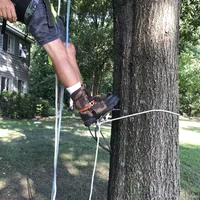
Here's my "stand" (foot platform) I welded up which locks by fulcrum on a tree.

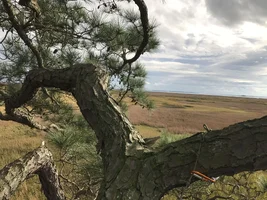
I'm actually a decent throw line chucker, though more often than not, I'm not in a manicured back yard. I can tell you hitting 30' standing in chest high grass on the edge of a marsh was no picnic yesterday. I ultimately settled for a lower TIP and alternate lanyarded to a higher location for my reward.
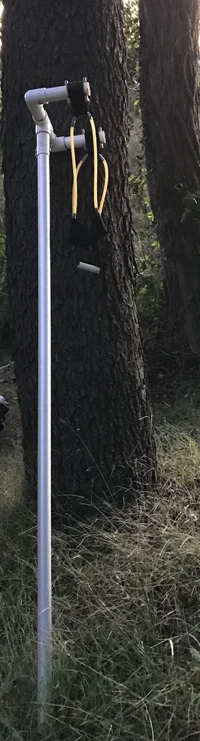
I have assembled an "assistant" for shooting holes in tight quarters but we're just getting acquainted.
So there ya go. UFTBYG (unfit to be your groundie).
Apologies in advance for how the photos fit in with text.


IMG_1662.webpIMG_1685.webpIMG_1662.webpIMG_1685.webpIMG_1916.webp
 

Attachments

  • IMG_1904.webp
    IMG_1904.webp
    168.9 KB · Views: 20
Screw all that bullshit. The object of becoming a climber is to be good at the whole package. Set a line with throwline each and everytime. You are new to this and practice will be good for you. No way am I even humping 30 feet. I will pump my footie up that. Single up double down if anything using a secret weapon. The thing is you have gotten into climbing at a great time. A couple hundos will have you blasting through trees in no time. Pull your pocket and get cracking. Screw all that bulky homemade rubbish. Get some proper gear.
 
  • Like
Reactions: evo
Thanks for the explanation. I see why you are considering chains. However, learning srt and setting a 50’ tie in should be a great benefit to you. You don’t have to climb 50’, but having the height in your tie in gives you a more comfortable resting angle at your preferred height. In production, I try to teach my team to not settle for the tie in just over their work, but to aim higher so they’re more comfortable and maneuverable at the working height. If hunting is the goal, it seems to me that eliminating hardware and complexity is important. I would have pre-installed throwlines and stick with srt, so to eliminate the need for a friction saver, and to keep you from having to thrust your way up right before you hope to bag something.

I like your commitment to learning new skills each year. Climbing is a great skill to have in the box.
 
Thanks for the explanation. I see why you are considering chains. However, learning srt and setting a 50’ tie in should be a great benefit to you. You don’t have to climb 50’, but having the height in your tie in gives you a more comfortable resting angle at your preferred height. In production, I try to teach my team to not settle for the tie in just over their work, but to aim higher so they’re more comfortable and maneuverable at the working height. If hunting is the goal, it seems to me that eliminating hardware and complexity is important. I would have pre-installed throwlines and stick with srt, so to eliminate the need for a friction saver, and to keep you from having to thrust your way up right before you hope to bag something.

I like your commitment to learning new skills each year. Climbing is a great skill to have in the box.
Crimsonking - I will be working on learning Srt.. Love to eliminate the friction saver, get the extra rope out of my face, progress 1:1.
Curious why I would have to "thrust my way up" Ddrt? I'm using ascenders Ddrt now.
I definitely know what you mean by setting a higher TIP for working a tree, but for standing on my "perch", closer to the TIP offers greater stability and back support, the sacrifice being flexibility. I could live with the high TIP but even attaching my perch to the tree is more challenging due to the added motion. I also often want to put the semi-permanent tip and perch on the side of the tree opposite the readily available tip limb.
The spar tip is ideal except for added cost of chain and quick links and need to climb to retrieve.
If I did the thread over, I would leave it at this:
"How would you create a safe, semi-permanent (4 months) TIP on a spar" and offer no further explanation for why.
Thanks
 
Not sure you read the whole thread. I'm looking to leave this in place for a while and use it for trying different techniques. A number of the replies have mentioned the floating tip for Ddrt. I will actually be trying more Srt.
If it's not a safety issue , I'll probably try what I had in the picture and check it carefully with binoculars before use.


I wouldn't.

If you want to leave an anchor, just choke two independent ropes (running bowline or whatever) with two fixed eyes (Figure 8 on a bight, bowline, whatnot) with two biners. Give yourself redundancy at least.
 
I wouldn't.

If you want to leave an anchor, just choke two independent ropes (running bowline or whatever) with two fixed eyes (Figure 8 on a bight, bowline, whatnot) with two biners. Give yourself redundancy at least.
I see what you're saying about redundancy. I think I'm headed for chain versus rope though. Rodent risk is real here.
 
@Aragorn Are you using a lanyard? I highly recommend so. Or you can use a monkey tail too.. This way you can have your climbing line high up, and then choke off where you would like, slack the climbing line and throw it behind a arm to keep it out of the way. Sounds like you need a good mentor to learn from.
 
Back
Top Bottom