
Navigation
Install the app
How to install the app on iOS
Follow along with the video below to see how to install our site as a web app on your home screen.
Note: This feature may not be available in some browsers.
More options
You are using an out of date browser. It may not display this or other websites correctly.
You should upgrade or use an alternative browser.
You should upgrade or use an alternative browser.
Tip on a spar
- Thread starter Aragorn
- Start date

evo
Been here much more than a while
- Location
- My Island, WA
Safe? Yes. But why? I would rather have the eyes separate so there’s more bite

CanadianStan
Branched out member
- Location
- Western Australia
What’s your goal for setting a TIP on a spar ?
Good question about "separate". I'd be leaving this in place with a throw line through it for on and off use and am concerned the setup would spread or wander down between uses. I could use a bungee to keep them in place but trying to keep it simple.Safe? Yes. But why? I would rather have the eyes separate so there’s more bite
One use is a practice setup. I have a tall pine around 100' with no limbs for 50+. I think I can slingshot a line up there. I would put this around 30' and leave it with throw line in place to try out assorted climbing equipment and ideas, and not have to haul as much rope each time.What’s your goal for setting a TIP on a spar ?
CanadianStan
Branched out member
- Location
- Western Australia
One use is a practice setup. I have a tall pine around 100' with no limbs for 50+. I think I can slingshot a line up there. I would put this around 30' and leave it with throw line in place to try out assorted climbing equipment and ideas, and not have to haul as much rope each time.
If you’re intent on creating a rope-based DIY friction saver, why not just install it on a union above the first few branches ?
Also keep in mind squirrels and other critters like to nibble on stuff for making nests. You may be better off just leaving a throw line dangling. When you want to test out DdRT, just use a floating TIP with a basal anchored line.
Never seen one 10' and this will be left in place a while.Why not get a bonafide retrievable friction saver?
Cheap, Proven, Awesome!
CanadianStan for the win!You may be better off just leaving a throw line dangling. When you want to test out DdRT, just use a floating TIP with a basal anchored line.
Squirrels- that's one of the reasons! I want to able to get a good look at it from the ground each time, which I think I can do at 30 with no limb blocking my view.If you’re intent on creating a rope-based DIY friction saver, why not just install it on a union above the first few branches ?
Also keep in mind squirrels and other critters like to nibble on stuff for making nests. You may be better off just leaving a throw line dangling. When you want to test out DdRT, just use a floating TIP with a basal anchored line.
You can make a friction saver to any length you want.Never seen one 10' and this will be left in place a while.
As Stan said the best method would be to simply leave a throw line in a tree, and when needed set a basal anchor with a floating tip for your Ddrt setup.
How much rope would be needed if the tree is 2' diameter, throw line limb 50', and floating tip at 30', Ddrt?You can make a friction saver to any length you want.
As Stan said the best method would be to simply leave a throw line in a tree, and when needed set a basal anchor with a floating tip for your Ddrt setup.
evo
Been here much more than a while
- Location
- My Island, WA
You could do it with:
100’ throwline
80’ of anchor rope (10’ for a base tie)
And 60’ climbing line
As for a friction saver:
24” x pi = just about 7’
I’ve used a rope lanyard with a adjustable ring when I need one for big wood
100’ throwline
80’ of anchor rope (10’ for a base tie)
And 60’ climbing line
As for a friction saver:
24” x pi = just about 7’
I’ve used a rope lanyard with a adjustable ring when I need one for big wood
I'm gonna need more rope!You could do it with:
100’ throwline
80’ of anchor rope (10’ for a base tie)
And 60’ climbing line
As for a friction saver:
24” x pi = just about 7’
I’ve used a rope lanyard with a adjustable ring when I need one for big wood
Those adjustable rings are nice.
Since the anchor rope would be a single rope termination, presumably a Yosemite bowline, what would you use for friction reduction? Hang a friction saver through it before pulling it over?
evo
Been here much more than a while
- Location
- My Island, WA
I always used a pair of locking (or screw lockers) opposite and apposed in a bowline on a bight. The old school solid bar petzl pear shaped HMS screw locks were what I used most often. They have a nice bilateral symmetryI'm gonna need more rope!
Those adjustable rings are nice.
Since the anchor rope would be a single rope termination, presumably a Yosemite bowline, what would you use for friction reduction? Hang a friction saver through it before pulling it over?
You could use naked rings, a secret weapon, a pulley, or any number of things.
TimBr
Official Well Known Greeter
- Location
- Northern Virginia
I'm gonna need more rope!
Those adjustable rings are nice.
Since the anchor rope would be a single rope termination, presumably a Yosemite bowline, what would you use for friction reduction? Hang a friction saver through it before pulling it over?
The video I'm about to provide a link to might not be the perfect answer to your question, because it still requires the full 100 feet of climbing rope for the base-tied system in order to set up the DdRT system that hangs off of it, but to me it is a really elegant and simple solution to your problem.
Daniel Holliday is the host of the Climbing Arborist website. I think he is just a brilliant guy, and I've sung his praises multiple times before. He's the only person on all of the internet who set out to deliberately make a comprehensive set of videos about climbing and working in the trees. On his own website he has the videos arranged by subject matter, so it makes it easy to focus on one area at a time, instead of having to grind through looking for an individual video that gets lost in a big pile of other topics that you don't want or need. His subject areas start at the most basic, of tying knots, and progress to climbing systems and rigging systems. All are worth watching.
Here is the link to the video that shows the most simple way to hang a DdRT system off of a single line, in my humble opinion.
http://www.climbingarborist.com/falsecrotch.php
Also, here is the link for the main page of his website.
http://www.climbingarborist.com/index.php
He also has a presence on YouTube, and I have already found at least one instance where he did have a video on YouTube that was not present on his own web site. So in spite of the fact that I prefer the organization of his own web site better, in some cases it might be worth looking on YouTube for other stuff. Here's the link to his YouTube home page.
https://www.youtube.com/channel/UC7jakWKUvZqiH7q7dNJau6w
I hope some of this is helpful. You can easily lose yourself in his videos for a few worthwhile hours, if you choose to. Best wishes.
Tim
Edit: I think he also has at least one video on how to do an effective base tie for the system, which you should also look for.
Last edited:
evo
Been here much more than a while
- Location
- My Island, WA
The video I'm about to provide a link to might not be the perfect answer to your question, because it still requires the full 100 feet of climbing rope for the base-tied system in order to set up the DdRT system that hangs off of it, but to me it is a really elegant and simple solution to your problem.
Daniel Holliday is the host of the Climbing Arborist website. I think he is just a brilliant guy, and I've sung his praises multiple times before. He's the only person on all of the internet who set out to deliberately make a comprehensive set of videos about climbing and working in the trees. On his own website he has the videos arranged by subject matter, so it makes it easy to focus on one area at a time, instead of having to grind through looking for an individual video that gets lost in a big pile of other topics that you don't want or need. His subject areas start at the most basic, of tying knots, and progress to climbing systems and rigging systems. All are worth watching.
Here is the link to the video that shows the most simple way to hang a DdRT system off of a single line, in my humble opinion.
http://www.climbingarborist.com/falsecrotch.php
Also, here is the link for the main page of his website.
http://www.climbingarborist.com/index.php
He also has a presence on YouTube, and I have already found at least one instance where he did have a video on YouTube that was not present on his own web site. So in spite of the fact that I prefer the organization of his own web site better, in some cases it might be worth looking on YouTube for other stuff. Here's the link to his YouTube home page.
https://www.youtube.com/channel/UC7jakWKUvZqiH7q7dNJau6w
I hope some of this is helpful. You can easily lose yourself in his videos for a few worthwhile hours, if you choose to. Best wishes.
Tim
Edit: I think he also has at least one video on how to do an effective base tie for the system, which you should also look for.
You can use a 50' false crotch rope to hang a Ddrt system 50' in a tree, you dont need 100' . This doesnt account for knots or base ties though.. Now if you want use a 50' canopy anchor but floating TIP at 30' you need 70'.
Just pull up the system with the throw line.
Admittedly its not the simplest nor best, but when you're workin with what cha got, it works well.
Why you'd want to set a floating 30' TIP on a 50' limb with nuttin but trunk below is beyond me.. Just SRT it... One 100' line, one 100' throwline and be done.. No use body humping up a spar any more..

chiselbit
Been here a while
Squirrels. Those little Bastards chew anything and everything. I’ve seen (more than once) where they’ve chewed through the insulated cover of electrical service lines. Down to the bare wires. I would never leave anything intended for life support in a tree overnight. If I really wanted a place to test out new methods and gear I’d install an appropriately rated eye lag, locking carabiner or delta link and a small pulley. Hang a throwline in it and pull my rope up when needed. Let those furry little f’ers break their teeth on the hardware when I’m not using it.
Not sure you read the whole thread. I'm looking to leave this in place for a while and use it for trying different techniques. A number of the replies have mentioned the floating tip for Ddrt. I will actually be trying more Srt.You can use a 50' false crotch rope to hang a Ddrt system 50' in a tree, you dont need 100' . This doesnt account for knots or base ties though.. Now if you want use a 50' canopy anchor but floating TIP at 30' you need 70'.
Just pull up the system with the throw line.
Admittedly its not the simplest nor best, but when you're workin with what cha got, it works well.
Why you'd want to set a floating 30' TIP on a 50' limb with nuttin but trunk below is beyond me.. Just SRT it... One 100' line, one 100' throwline and be done.. No use body humping up a spar any more..
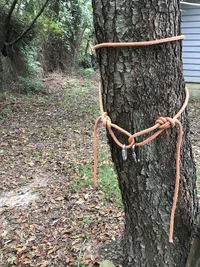
If it's not a safety issue , I'll probably try what I had in the picture and check it carefully with binoculars before use.
TimBr
Official Well Known Greeter
- Location
- Northern Virginia
Not sure you read the whole thread. I'm looking to leave this in place for a while and use it for trying different techniques. A number of the replies have mentioned the floating tip for Ddrt. I will actually be trying more Srt.
If it's not a safety issue , I'll probably try what I had in the picture and check it carefully with binoculars before use.
From everything I've ever read on the forums, it is a Cardinal sin to leave life safety rope in a tree overnight. It must be pulled out each and every time you finish climbing. The reason is the rodents that live in trees that love to chew on stuff. Over and over I've read tree guys say they would never trust a rope that had been left in a tree overnight. Having said all of that, I might do it if it was only for the purpose of work positioning, and I had one or two other ropes that I pulled out of the tree each time. If a squirrel did chew on it, I could still take a bad swing in this scenario, though. I'd inspect it closely before I put all of my weight on it in a dangerous fashion.
Edit: Read @chiselbit's post above; it is probably the best answer going. So hard they really can't hurt it.
New threads New posts
-
test
-

-
-

-
KBNest -Midline Attachable SRS Canopy Anchor.
- Started by TreeSteward
- Replies: 6
-

-

