Tie in to nifty lift

Over the years I've had machinery on two wheels more than once! Lifted outriggers on my grapple truck. Nosed over a front end loader Whew...lucky!

In all of those situations there was no breakage. My guess is that a tip over would happen before a mechanical failure. I hope to never test this though.

Enough of a butt pucker to put the load back down using the hydraulics.
 
Who has useful contacts with track/spider lift reps or manufacturers?
Certain ones make "arborists'" versions of their lift, I dont think it would be too crazy for is Arborists to communicate our need/want for a "tie in point" option on a lift.
Maybe some as simple as a low friction bollard to anchor to any desired style. Not sure really what THAT chart would look like, specifying max rope angles with different weights, and at different boom angles.
TCIA expo seems like the perfect way to show track lift reps how many arborists are interested in such an option
 
Don't know if it's technically correct to, but I tied to the boom of my hi ranger on a job where a large oak tree fell through the roof of a pole barn. I raised it over the center and used it largely for balance on the slippery roof (metal with leaves, sticks and dew) but I did also do a little climbing on it from. Mostly straight up and down when necessary and then swing the boom when I needed to climb elsewhere.

It worked for me with no other option for a good tie in.
 
Don't know if it's technically correct to, but I tied to the boom of my hi ranger on a job where a large oak tree fell through the roof of a pole barn. I raised it over the center and used it largely for balance on the slippery roof (metal with leaves, sticks and dew) but I did also do a little climbing on it from. Mostly straight up and down when necessary and then swing the boom when I needed to climb elsewhere.

It worked for me with no other option for a good tie in.

Got any photos of your hi ranger? I know, Google is my friend; I'll try to find some in that manner in the meantime. Thanks in advance.

Tim

P.S. Welcome to the TreeBuzz forum! I think you are going to like it here; lots of nice folks to learn from and share stories with.
 
Last edited:
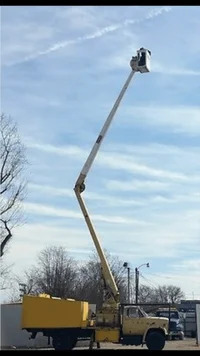
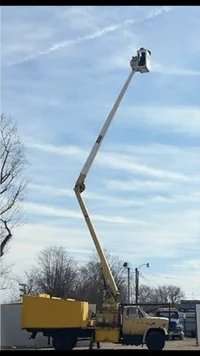
Nothing fancy. Just an old bucket truck.

But it gets the job done and I don't owe a payment on it.
 

Attachments

  • Screenshot_2016-09-02-17-11-34.webp
    Screenshot_2016-09-02-17-11-34.webp
    144.9 KB · Views: 35
  • Screenshot_2016-09-02-17-11-34.webp
    Screenshot_2016-09-02-17-11-34.webp
    144.9 KB · Views: 30
@Jehinten; Thanks so much. I appreciate your effort and your time.

It is an interesting question to me. If you tie off to a point high up on the boom, such that your weight is pulling almost straight down near the point where the basket is attatched, how is that any different than putting 500 pounds inside the basket? It seems to me like it would be safe enough.

Thanks again for posting the photos.

Tim
 
Last edited:
It has to do with force and angle - I don't know the math off the top of my head, but as you speed up on a line (like a fall, drop, or swing), it increase the energy at attachment point. 180 lbs can quickly become 500 lbs or more.

Put a throw bag on a short line and twirl it in a circle. You can feel the force increase in your hand as you need to hold tighter the faster it spins.

Same thing if you drop it from a decent height. You will need to be able to hold the weight as well as the energy from the fall


Sent from my iPhone using Tapatalk
 
It has to do with force and angle - I don't know the math off the top of my head, but as you speed up on a line (like a fall, drop, or swing), it increase the energy at attachment point. 180 lbs can quickly become 500 lbs or more.

Put a throw bag on a short line and twirl it in a circle. You can feel the force increase in your hand as you need to hold tighter the faster it spins.

Same thing if you drop it from a decent height. You will need to be able to hold the weight as well as the energy from the fall


Sent from my iPhone using Tapatalk

A related physics issue would be the 120° angle for double tie in climbing. Each line loads with 100% of the weight at that angle, and the percent increases dramatically as the climbing lines depart 120°, heading to horizontal. Since the climber could not handle that weight without support, it's likely that they'd be tied in to the tree, or free climbing with slack. Either situation would be a false idea of safety.

On another note, why don't people double tie into lifts? I saw a single-leashed dog jump from a pickup bed once and it makes me think that I'd like to be squarely in the bucket for the whole ride if something happens.
 
@colb; This is a good point. I have been working out of a basket lately, not arb related, and I have been trying to "tie in twice" when I can. I keep hearing the tree climber's mantra in my head about tie-ins that says "Two is one, and one is none." It's really true. I am pretty careful up there, so I hate to admit that I once found myself at height, and looked down to see both of my lanyards dangling. Probably only for a minute, basket sitting still, but I had no recollection of how I managed to unhook my lanyard without first connecting the second one.

I think the reason folks might not like using two lanyards is that it is generally a PITA. You face one way to use the lift controls, and when you get into a good position to work you have to spin around 180 degrees. Which to me means you have to swap the sides your lanyards are attached to, or else it just feels uncomfortable.

I do try to have two tie-ins, though, as often as I can, mostly just to try to protect myself from the mental error I spoke of earlier. It does make you feel really securely attached when you have two lanyards in use.

I guess it could also act as a reminder. If you're standing in the basket and you do not feel as though you are being tugged on and held in a bit of an unreasonably restricted manner, you probably don't have both lanyards connected. The restricted movement seems like a fair price to pay for the assurance of being tied in. It is just a lot of work to constantly implement the practice. But worth it, I'd say.

Tim
 
It has to do with force and angle - I don't know the math off the top of my head, but as you speed up on a line (like a fall, drop, or swing), it increase the energy at attachment point. 180 lbs can quickly become 500 lbs or more.

Put a throw bag on a short line and twirl it in a circle. You can feel the force increase in your hand as you need to hold tighter the faster it spins.

Same thing if you drop it from a decent height. You will need to be able to hold the weight as well as the energy from the fall


Sent from my iPhone using Tapatalk

Yeah, good points. I guess using it in a pinch the way @Jehinten did involves trying to get the line centered exactly where you want to be, and also moving as gently as humanly possible up and down the rope, in order to try to eliminate the generation of extra force on the tie-in point. Moving like a tree sloth, almost. Which is my normal mode of travel, anyway.

Tim
 

New threads New posts

Kask Stihl NORTHEASTERN Arborists Wesspur TreeStuff.com Teufelberger Westminster X-Rigging Teufelberger
Back
Top Bottom