The "right" way to prune

Around 2007 I reduced this lime tree (basswood in the US) it is in a courtyard in front of a small rural house.
It was what we call a Maiden (never been trimmed or worked on before)
branches were brushing over the roof and it was dominating the space.
So I reduced it overall, height, sides, shaping, topping, whatever you call it, no need to go to live growth on those trees.
These photos date from 2015 when I went back and re-did it, I was at the property last year and we talked about doing it again soon.

Allowing it to continue to get bigger was not an option, neither was taking it out. I am certain long after I retire someone else will be re-doing it periodically.

In short reduction can extend the life of trees.

Species and situation dependent of course.

Not a criticism or anything, as I said we all have our own way of doing things.

But for the sake of discussion in a situation like that typically my approach would’ve been to remove some of the lower branches to create more clearance over the roof, which in turn will also open the space up and not make the tree seem so overpowering for the yard size. Even a few cuts to raise the canopy can greatly transform a homeowner’s yard space in my experience.

One of my concerns with topping like that would be the new growth that is there isn’t as structurally sound as the original growth, its basically suckers if you will. I’ve worked in storm damage trees that had huge portions wrecked and the people kept the tree and new growth came back but it was all shoots. It was just a mess, and not very study for climbing either in certain sections.

I think of it like hedge care when people have a bigger sized tree that they want to “make smaller” because they think it’s too tall or whatever other reason. People wait until arborvitaes or hemlocks get so huge (20ft+) and overgrown and then they want to reduce them and transform them back into a perfectly manicured, tight and clean looking hedge that’s 8ft tall. It’s not very realistic if you don’t maintain them regularly from the start.

I can respect and appreciate the different points of view on the matter though.

And every case truly is different. What applies to one tree may not apply to another.
 
Last edited:
81DF1C3E-2C74-49C8-A07B-B1276557778A.jpegReductions can be just the thing! Even heavy ones on an over mature tree. I get it, like I said, no absolutes. Each tree, each client, calls for different approaches.

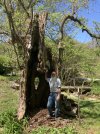
This willow (still uncertain species, probably a weeping form of S. alba) started to heave over into a silver maple adjacent when a dead mulberry crashed into the willow. We took it down from a height of about 65’ to this. Some very aggressive heading cuts, but the client wanted to keep the tree around as long as possible. And he already planted a replacement willow tree right next to it. We will see what happens!

(btw the hollow has been there, not quite as large as that, since he moved here in the 70s)

(Also, ps, this is the client, not me lol)

Among other things next week, there’s a mature red oak with a basal decay up in the woods above someone’s house. I have often seen such trees with such decay uproot in storms and I’m trying to save them from that headache, so I’ll probably take the central lead completely out of the tree, leaving about 75% of the canopy but hopefully reducing a lot or leverage. It’s kind of a hospice move, but it staves off removal or uprooting. We will see how it responds.

Mick (sorry I’d use your last name but I’m confused now as to how it’s spelled),

With something like that lime, how often does it need being prunes back?
How did it do with the initial pruning cuts as far as wounding?
Have you recommended starting a replacement tree or shrub for them to perhaps phase this tree out?

I guess I don’t find myself working on trees of that scale much. This area has a very mature canopy. And aside from view pruning, generally the clients don’t ask for much beyond general maintenance and health.

Just curious questions. Hopefully someone finds this post clear and meaningful.
 
Last edited:
Not a criticism or anything, as I said we all have our own way of doing things.

But for the sake of discussion in a situation like that typically my approach would’ve been to remove some of the lower branches to create more clearance over the roof, which in turn will also open the space up and not make the tree seem so overpowering for the yard size. Even a few cuts to raise the canopy can greatly transform a homeowner’s yard space in my experience.

One of my concerns with topping like that would be the new growth that is there isn’t as structurally sound as the original growth, its basically suckers if you will. I’ve worked in storm damage trees that had huge portions wrecked and the people kept the tree and new growth came back but it was all shoots. It was just a mess, and not very study for climbing either in certain sections.

I think of it like hedge care when people have a bigger sized tree that they want to “make smaller” because they think it’s too tall or whatever other reason. People wait until arborvitaes or hemlocks get so huge (20ft+) and overgrown and then they want to reduce them and transform them back into a perfectly manicured, tight and clean looking hedge that’s 8ft tall. It’s not very realistic if you don’t maintain them regularly from the start.
You don’t need to climb the new growth if you redo it on a regular cycle say 10 years. (to answer @Stumpsprouts question as well)

Anyway basswood/lime compartmentalises well and regrowth has excellent attachment and holding properties, there was next to no rot in the cuts I’d made 8 years before.
Again species is the key in discussing reductions.

I don’t really buy this mantra of replant a replacement nearby ready for the demise of the original.
1: The replacement will struggle to establish itself in such close proximity to the original and may well develop a poor form because of that.
2: It’ll be a right ball ache to take out the original when the time is right and it’s Sod’s Law you’ll damage the new one.
 
You don’t need to climb the new growth if you redo it on a regular cycle say 10 years. (to answer @Stumpsprouts question as well)

Anyway basswood/lime compartmentalises well and regrowth has excellent attachment and holding properties, there was next to no rot in the cuts I’d made 8 years before.

I don’t really buy this mantra of replant a replacement nearby ready for the demise of the original.
1: The replacement will struggle to establish itself in such close proximity to the original and may well develop a poor form because of that.
2: It’ll be a right ball ache to take out the original when the time is right and it’s Sod’s Law you’ll damage the new one.

I see what you’re saying.

Personally, I’ve never recommended plant a new one nearby, wait till it gets bigger and then take out the old one.

From the start I’ll suggest taking out the original and planting a new one that would be more manageable in size (if that’s what the issue is) and the clients aren’t open to any alternative solutions or they are leaning towards taking it out at some point anyway.
 
Homeowners pay mow companies top dollar whack stuff off their tree. Wouldn't it be nice as an arborist company to plant a tree. Than its our baby. And the next 30 years we are on that property shaping, fertilizing, treating. We would be its primary care provider/practitioner
 
Great point! Other side of that coin though, if you need to prune a tree over and over to maintain a target size, why not plant another sort?

I suppose because you only a short window of time when it’s at an ideal size. No tree stays at your ideal size.
20 years after you planted it to 40 years after you planted it, then it’s too big and by the dogma that seems to be prevalent in the US, it has to go.
Whereas regular trimming will keep it at or near its ideal amenity size for the client, thus lengthening its life to 70/80/100 years.

Species and context dépendant, like I always say.
 
I suppose because you only a short window of time when it’s at an ideal size. No tree stays at your ideal size.
20 years after you planted it to 40 years after you planted it, then it’s too big and by the dogma that seems to be prevalent in the US, it has to go.
Whereas regular trimming will keep it at or near its ideal amenity size for the client, thus lengthening its life to 70/80/100 years.

Species and context dépendant, like I always say.
That, and we still don’t have a wayback machine to go back and swap out a shade tree for a species with a smaller growth habit. I get called to prune 100x more than I get called to plant.
 
20 years after you planted it to 40 years after you planted it


YOu suggest a poll with your comment.

Realtors tell us that people move every seven years. That's no where near enough time to see any sort of tree problems. By the time the problems come to light the trees have gone through, what, 5-6-7, owners?

We deal with the present moment in the best way possible. and hope that we are able to go back to some of our trees once again.

How many have done work on the same tree again...once, twice...lucky to be three?!
 
We deal with the present moment in the best way possible. and hope that we are able to go back to some of our trees once again.

How many have done work on the same tree again...once, twice...lucky to be three?!
Thankfully for me Tom, most of the trees I prune, have been visited by me at least a half dozen times. (Doing nothing, is doing something if you choose to do it) Mostly, I only do what is absolutely necessary the first time and view the response over a year or two. I very rarely prune a mature tree or older entirely in one pruning.

In fact, I told early clients “if your not going to use me three times, I wouldn’t use me once. Somebody else will happily do it cheaper.” That has paid such dividends for my business, my knowledge of tree response to pruning, & my relationship with all my clients (trees & people).

I know that I am blessed in this way! I just want it out there that it is possible to build a successful tree business based on thoughtful pruning for a clientele that is out there.
 

New threads New posts

Kask Stihl NORTHEASTERN Arborists Wesspur TreeStuff.com Teufelberger Westminster X-Rigging Teufelberger
Back
Top Bottom