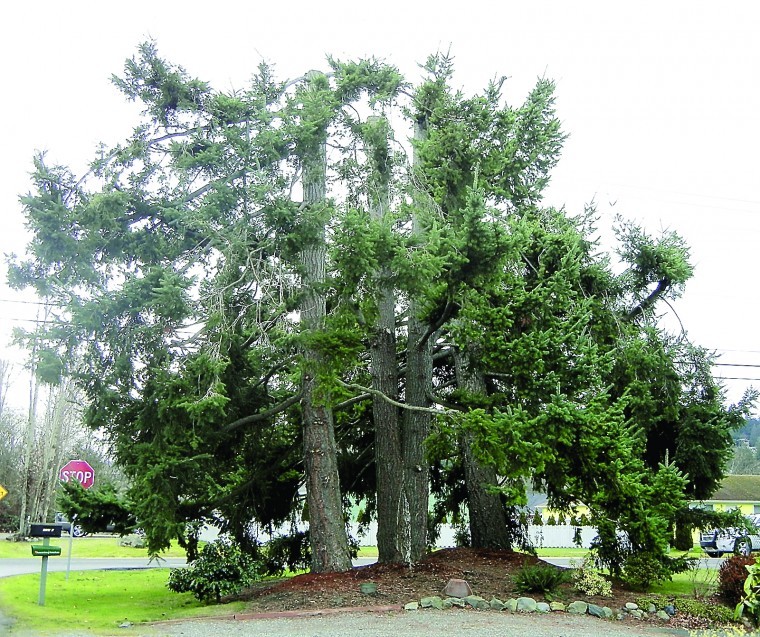
So, I've been thinking (which can make me some money). My thoughts can be boiled into two questions. The first has to deal with the burr oak picture that is attached. It is for a friend who deeply appreciates this tree. It is located directly next to a lot, where there is a park called "oak park". It's brother tree is in that park, and doesn't look as good as this one. What do you look for/do to make an oak look good. That is my first question.
My second question, what are your resources on pruning and the art of shaping trees? Like....how to make a life size bonsai???
Thanks.
View attachment 81986
The baseline consideration of pruning an emergent tree for aesthetic is residual risk (a technical tree risk assessment term). In this case, the overall lean of the tree appears to be away from the residence, and that may bear on lowering residual risk while expanding the opportunity to prioritize (to some degree) aesthetic pruning over the health issues associated with large pruning cuts. As with a risk assessment, risk is not assessed just for a "whole tree", but rather for the whole tree, the main leaders, the secondary branches, etc. Any pruning of an emergent tree for aesthetic should be subordinated to the level of risk that is deemed acceptable for each tree structure.
I'm going to say just a little about tree health in relation to aesthetic because others can say more about health - and say it better - than I. You can kill a tree by pruning it for aesthetic. The typical scenario (such as the one above) is that a client wishes to transition a tree that has never been maintained for aesthetic into an aesthetically maintained tree. In talking with your client, manage expectations to include tree death, disease, etc. The transition from unmaintained for aesthetic to maintained for aesthetic is usually fairly brutal. A good alternative is to plant a replacement tree, keep it under training for its whole life, and remove the other tree if/when appropriate.
There is a vast body of knowledge about aesthetic pruning and its best to get in there and start making your mistakes and successes. Posted before on treebuzz in another form are basic tree forms associated (but not limited to) bonsai:

en.m.wikipedia.org
Bonsai discussions - I believe - are applicable to the end goal of aesthetic appearance, but growth suppression drives the mechanics under the hood, and this is substantially different from the more vigorous growth encouragement, culling, and redirection in garden tree (a.k.a. niwaki) care. It is questionable to lump niwaki training with the training of emergent trees, but I believe it is useful to keep one foot on either side of the threshold. I do notice that - overall - there is a lot of conversation about bonsai on this thread, and it should probably be at least mentioned to a lesser degree than niwaki. It's 2022, we're professional arborists, let's level up.
In general, one places a niwaki in order to frame it from the interior of a residence by the architecture of the residence. This is because niwaki are resource intensive to install and maintain. A niwaki pine of 8' stature is about $10,000 to purchase, and often receives two visits per year, thus approximating the rule of thumb 10% cost ratio of installation to yearly maintenance. Prior to installing it, one generally modifies the architecture of the residence to promote the magnificence of the niwaki - e.g. lowering the level of the viewing window, removing 'Murica (no offense...) wood decks, installing hardscaping (stones, berms), defining the sense of refuge/outer boundary of the garden space, etc. The tree should then "fit" within the frame. In general, this means that the tree is not immediately adjacent to the house. This level of attention and care is expressed as Gyo (~medium level of care) or Shin (roughly formal/highest level of care), in the Japanese niwaki tradition. The tree in the OP does not fit this profile, so it is not a typical candidate for aesthetic pruning.
Rather, the tree is better viewed on *distant* approach to the residence. By the time one parks curbside, the tree cannot be practically viewed and all that money appreciated. Because it is outside the (lack of) garden boundary, the client and their guests partake in only a small percentage of appreciation for it as neighbors pass by, yet the client pays for all the maintenance. That dissonance does not encourage a repeat visit. The tree is therefore a candidate for So - rustic, low-level aesthetic care, or just ordinary reduction. Niwaki in their truest form should be like dragon eggs perched amongst mounds of treasure. They should create a sense of longing and desire for all that nature can be. That is where your client's money should go.
Often when I approach a tree for aesthetic pruning,, I try to distill the essence of the tree. I look at its normal growth habitat. I look for the most attractive take-no-prisoners line from the base to the top. Usually that line weaves/"has motion" without interruption by a straight section. The weave is hopefully larger at the bottom and gets smaller with height. Rarely, the tree is irregular and the "weave" is irregularity - no regular pattern should be allowed to persist. There are other patterns that await distillation, and everyone distills something different than everyone else. Sometimes it is necessary to make very large cuts to distill that line. The bigger a tree is, the less willing I am to make those cuts. The establishment of a main leader is not everything, but it constrains which secondary leaders can be kept or removed. This is an area of aesthetic pruning that is in convenient agreement with the basic precept of reduction pruning -subordinating to the main leader. I speculate that just as people can identify a sense of comfort in tree shapes and structures that offer refuge from predation, so perhaps they can identify comfort in empirically stronger structures... It seems to me that even in multileader styles, codominance is usually not aesthetically preferred. How nice! The OP tree has a line that goes from left to right (bottom to top) for the first ~20 feet then gets really busy. Typically, each union should have only two branches emanating from it. Typically, each elbow should have a single branch emanating from the outside side of it. There are sundry violations of those principles in that tree. It's a normal and busy shade tree, which is nice and fine. To correct those aesthetic issues you would need to make many large interior removal cuts, which wanders the mind back to tree health....
Aesthetic pruning is now a certificate-level pursuit:

www.aestheticprunersassociation.org
Any serious aesthetic pruner should consider being involved with this organization. Not saying you have to... I'm reading the Sakuteiki right now, which is another way to go about it...
Each of these topic areas - structure, health, and aesthetic - involve the three questions: Should I do it? To what extent? By what path?
My advice, having not been there, is to go inside, look out the highest-use windows (kitchen sink, living room) and create the conditions in that frame that precede the installation of 1-3 niwaki that can be maintained at Gyo/So level. If the frame needs work, tell them that as their arborist you recommend that they first pick up sledge hammers and make a hole in their wall.