Tapered Hinge With Backlean

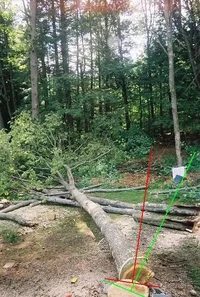
Chris, I would have placed my lines higher in the tree and put the hinge farther back due to all that weight hanging off the top of the tree.
You can see where all the weight is in the top of the tree looking at the above attachment, it's all off to one side.
Did you have someone winching the tree over while you wedged the far side of the hinge?
 

Attachments

  • 49419-chris.webp
    49419-chris.webp
    24.6 KB · Views: 84
[ QUOTE ]
If I were to do it again I would combine the tapered hinge with the Adjusted gun tech. that Tim Ard Describes.
...

I do feel that if I could have used the side tensioner line better, the Tapered hinge would have followed the notch straight into the lay.

[/ QUOTE ]
Hey, it's all good, right?!

You need to "adjust the gun" on a leaner anyway, which is why I'm confused why Tim apparently teaches it without the tapered hinge necessary to complete the scheme.

See the attached image. It would seem as though you gunned just to the left of the tree on the right. Due to the side lean, you'd have done better to try to "take out" that other tree just a bit. Near as I can tell the direction of the resultant back side of the hinge might should have been where the front side was directed. At least you didn't over compensate (can't say that's never happened to me...).

Doesn't look like the tapered hinge failed you too much.

Good job. The guy sure solved the deck problem for you!

[edit: I'm not trying to "say" anything about the notch depth in the attachment. I like where it was in that respect. I merely wanted the lines to be clearly shown as parallel to the apparent hinge faces.]
 

Attachments

  • 49421-hindsight.webp
    49421-hindsight.webp
    104.5 KB · Views: 87
Hey Kevin, yeah I thought about placing the lines higher up but I figured I had a good enough lead and pull on the winch that I didn't need to go higher. The groundie pulling it over for me said that there was not too much strain.

I was thinking about setting the notch deeper, but I had around 90% of the dia. so I was not concerned. Excellent holding wood all the way across. No rot.

Glen, you're right, I did gun just to the left of the tree for fear of over compensating and hitting the tree. Like you said, no big deal, everything worked out well and it was a fun job.

I too think that the tapered hinge tech. should be taught using the adjusted gun tech. combined with it. It just seems like the extra insurance that you get with both is worth it. How much you adjust the gun has more to do with the size of the tree and the amount of side lean. Like you say, it can be easy to over compensate.

Chris
 
It's important to work in unison between the person cutting and the person pulling.
The felling cut really gets slowed down to allow the winch to pull the tree.
If the tree gets cut too fast there's no way the winch can keep up.
The tapered hinge looks good.
 
Kevin, this tree had some backlean. The felling cut was already finished before we even started pulling.

The first thing I did after I had cut my notch was to take up some additional slack on the pull line and then set up my tapered hinge using a bore cut. By bore cutting I was able to set the hinge just the way I wanted it, 4" on the tension side, 1/2" on compression side.

With the side retainer line, there was no worry about my saw bar being pinched. After my hinge was set up, I proceeded to bore out towards the back leaving about a 2" holding strap. Then I set 2 wedges in the backcut, and released the strap. The tree did not set back or move forward until my groundie pulled it over.

Everything was under control, just the way I like it. I hardly ever use a conventional backcut, prefering to bore cut instead.

Chris
 
That was why it failed to fall to the intended lay.
If you start in on the back cut and then tension and continue repeating this process the tree can be pulled where you want it gradually.
If you cut and pull a leaning tree the tension will soon drop of the line and you have now lost control.
I cut,tension with a winch,wedge and repeat.
You can watch the tree and see where it's going and make any corrections before the hinge lets go.
The only time I use a bore cut is on a heavy head leaner just to remove stress because the tree is already leaning to the lay.
 
Kevin, I see what you're getting at, but I still need to think about that a little. What happens if you have a vertical tree with no forward or backward lean just the side lean?

Would you still use the conventional backcut instead of bore cutting it? Don't you think it would be better to set your tapered hinge the way you want it and not have to stand near the tree as it is falling trying to steer it by cutting more or less?

I really appreciate your insight (as well as everyone else's) and help. Like I said, it makes me think and to see other options is always cool.

Thanks
Chris
 
Chris, I'm glad you are open minded and don't take my comments as criticism because they aren't meant to be.
If you have lean of any kind you can and should be using wedges to lift the tree as you cut it.
Sometimes I'll stay with the tree and keep cutting but I can usually see what the tree wants to do and decide whether to stay or go.
I always go before the tree hits the ground.
Watch what's happening to the back cut and what your wedges are doing, take your time making the back cut and keep winching.
You'll be able to watch the tree move to where you want it while you continually set your wedges.
If it isn't doing what you want you still have plenty of holding wood to stop and make corrections.
 
Kevin, thanks for taking the time to explain your cutting procedures to me. I always try to keep an open mind to different techniques, especially when they can SAVE MY LIFE!

This may be off subject, but do you use any dutchman techniques up in Canada when dealing with side leaners? Everyone I talk with thinks they are too dangerous, but I still think they can be safely used if taught properly.

Thanks
Chris
 
I don't use the dutchman but I will add a second notch on the low side of the lean when I think it's required.
It removes a good section of the holding wood which allows the tree to turn.
 
Not to be contrary just for the sake of it...

Off the top of my head I think it's safe to say I'll always bore cut and form the hinge exactly the way I want it unless the stem is pretty plumb (i.e. a no-brainer). Especially on a critical fell.

I'm a bit leery about continued tensioning / progressive back cutting. If the guy in charge of the rope isn't particularly adept at it and/or communication gets fouled you could end up with a split.
 
Kevin, I remember now reading and seeing sketches that you did of the second notch tech. on a different post. Mark had some pics of that too I believe. That is very interesting. I've not had the chance to experiment with it yet.

One thing I did find this morning while looking through my library is the book THE CUTTING EDGE by the Ontario Forestry Safe Workplace Association (OFSWA). This is an excellent book, and on page 90 they have a diagram on falling side leaners which shows using a corning cut on the compression side to help with the lean. This looks like a dutchman tech. to me. So some books besides Jerry's and Dent's does teach the dutchman.

Glen, I too prefer to use the bore cut to set up my hinge. I just like the control it gives me better. I don't go overboard though and use it on every felling cut.

Chris
 
I didn't say that right. What I meant to say is that every time I think the hinge will be critical for placement or there's any head lean I'll bore cut. I guess it just seems that those two cases form the majority for me.

I've experiment with dutchmans, like when a tree needs to fall a certain direction but there's a fork in it exactly in that line and we don't want it to land that way and ruin the log. You can remove some of the face or stick something in it to get the tree to rotate a little on its way over. Never had any luck getting one to change its direction once it's started going.
 
Yes it has both.
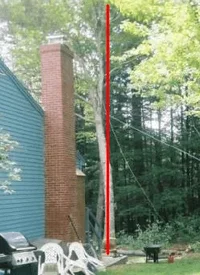
The tree leans down hill and off to the side with the building being under the lean.
I'll pull it and drop it on the gravel drive behind the building.
I'll use a 5:1MA with a FB and tension that with the winch then run the pull line through the PAW.
 

New threads New posts

Back
Top Bottom