Tapered Hinge With Backlean

[ QUOTE ]
And, I still think a tapered hinge is good insurance against breaking the holding wood, regardless of what Tim Ard says.

[/ QUOTE ]

I can't believe Tim or anyone else with any experience would even say that.

Leave the deck alone, tip tie the branches and enjoy the climb.
 
Hey Ekka, with all this discussion going on, now I'm not sure which technique I'm going to use. Yeah, I plan on getting video of the whole job.

First thing is to get that phone call from the property owner. He is planning on removing the whole deck first, having me do the tree removal, and then building a new deck. Nothing on the ground to protect.

Roger I too love discussions like this, and getting other people's opinions. I feel you can learn something no matter how small from everyone. I just hope the owner doesn't change his mind.

Kevin, I did not bid the job as a climb and takedown so I want to limit my climbing. I will climb it to set my lines and do a better visual inspection, rather than just using my throw line to set it.
 
Maybe he wants to build a new deck anyway, but if not there's no reason in the world to do any more demolition than removing that one quadrant of deck planks, hang maybe one 2×6 joist in the new opening, and replace the planks with full-length ones. Oh, and temporarily remove the one top rail.

If you're going to climb it anyway then you'd do well to tighten up the package a bit before felling it; so as to further protect the other trees in the felling zone. I've already described what I'd do, no reason whatsoever to even leave the ground. Nevertheless I enjoy the diversity of opinion here.

The general quality of discussion at this forum is among the best I've encountered.
 
maybe I missed somthing but what is the felling direction of the tree? My only concern was the fell would snag or snap some of the other tree limbs in fall. In all the ideas are great and yes this is a good discussion.
 
i think the outer reaches of the hinge do the work mostly. The distance betwen the compressed under lean and stretched portions is more just the leveraged reach/ multiplier, than worker itself.

A hinge is somehwat self adjusting to lay the tree into the gun as Glen says. The tensioned side countering the lean will pull harder to center, jsut as the compressed side under lean will slap harder than the other side, so the lean side will throw more towards center gun, all to self correct. But, all that has it's boundaries of useablity.

i definitely believe in the tapered hinge. Per the forward force, all hinges will be about the same strength, given the same pivot point, as they are made by the same load. How that fiber share is apportioned differently for tapered hinge is to place more pulling fiber in tensioned area by number, also a farther leveraged distance and also a better leveraged angle to the load; all in one move. Figuring more fiber in this area is support by numbers, longer distance/ fatness on that side; and also bringing more fiber inline behind the loading, for more of the support leverage potential to be realized.

The compressed area, can be very small and work about the same, it is squishing together; and is pivot. It is the tensioned area of stretched fiber pro-viding support; the compressed pivot just inherits the pulls from both support/ tensioned fiber pull, and the leveraged lean/load of the spar. In deed on split faces/ dutch /early close on lean side; as well as snap cut in tree, shows that the compressed pivot doesn't need to even be attatched, it is squishing together on own!

Serving to gunned apex of hinge i think is proper/ working to success mechanics. Overgunning to get the fall someplace short of gunned hinge is serving to where the mechanics fails to, IMLHO.

Climber's can test this all out at the most leveraged angle and travel; by keeping a horizontal branch, near horizontal on it's arc on hinge, we turn the whole felling model sideways to cross compare. Here, clearly fail to mechanics of over gunning not working very well, but tapered hinge rules. Along with dutching lean (low) side to push up and give support; after forcing hinge strength at first folding; like to fake it out, then change pivot point witht he new pivot when dutch closes.

Orrrrrrrrr soemthing like that /forum/images/graemlins/crazy.gif

 
One time I had a tree in a deck and the homeowner wanted to save money. I told him if he diidn't care about the deck I could just drop it but I would try to do the best that I could not to damage the deck. So I used to old tires and stuck a log in them and placed them on the fall side of the tree, I also place a tire between the log and the deck. When I droppet the tree it hit the log and rolled the direction of the fall and cleared the deck. NO DAMAGE the homeowner was impressed. I wish I had video.
 
i maid a slide once from firewood sized pieces during the takedown and some bigger in a massive pile in front of the tree/ felling zone. Then, through tree into it. There seemed to be enough movement and shifting, also throwing forward etc., that the deck had minimal damage.
 
I once had to fell a dead snag about 15 foot high and 18-24" diameter across a nice brick patio...I had used tires before and they absorbed the hit quite nicely. However, this time I decide for some reason (what was I thinking) to
slap an old piece of press board across the top of the tires
Oops! I hit my target dead center and the log bounced off like and olympic gymnast on a spring board. SHould have used Ekka's "Foam". Needless to say, that day I learned how to lay brick. SO much for that quick buck. I now use alternative methods. "Doh!" /forum/images/graemlins/icon315.gif
 
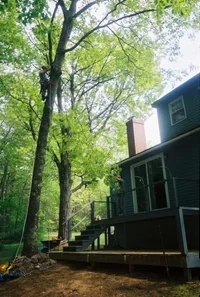
Well, I finally heard back from the owner and last Sat. I went to do the removal.

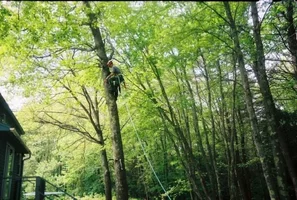
Here's a pic where I am setting the pull line.
 

Attachments

  • 49409-treelean6.webp
    49409-treelean6.webp
    70.2 KB · Views: 87
This one is where I am setting the side tensioning line.
Turns out that it was too far forward which minimized the holding ability of the tree.
 

Attachments

  • 49410-treelean5.webp
    49410-treelean5.webp
    91.9 KB · Views: 83
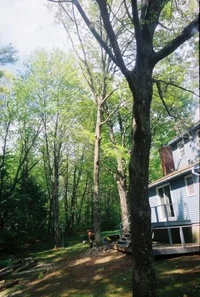
This one is where I am cutting the tree.

20"dbh. I used a 4" wide tapered hinge on the tension side and a 1/2" hinge on the compression side. Turned out not to be enough.
 

Attachments

  • 49411-treelean4.webp
    49411-treelean4.webp
    77.8 KB · Views: 83
This is a good pic of the side tensioner line with the forward drift, which did not help to hold the tree on the stump. I should have set a floating anchor perpendicular to the tree.
 

Attachments

  • 49414-treelean2.webp
    49414-treelean2.webp
    68 KB · Views: 88
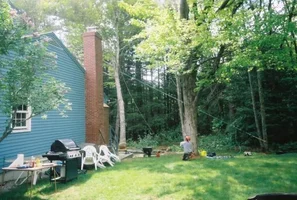
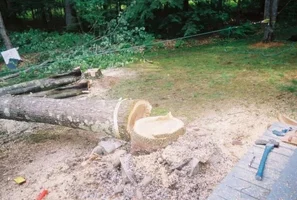
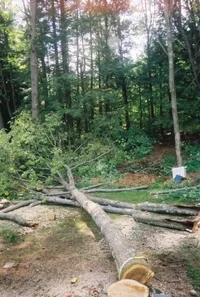
This pic shows the missed lay. No big deal since I had a full open space to experiment with the Tapered hinge.

If I were to do it again I would combine the tapered hinge with the Adjusted gun tech. that Tim Ard Describes.
 

Attachments

  • 49415-treelean1.webp
    49415-treelean1.webp
    80 KB · Views: 106
If you look closely at the last pic, you can see where the pull line was is going to. Look at the stump and you can see the tapered hinge.

I do feel that if I could have used the side tensioner line better, the Tapered hinge would have followed the notch straight into the lay.
 

New threads New posts

Back
Top Bottom