Tapered Hinge With Backlean

[ QUOTE ]
It should also be noted that the fibers of the hinge tend to break from the back. As the tree falls, fibers along the back of the hinge will break first. After the tree reaches a certain point in its fall, only the fibers at the front of the hinge are left to finish steering the tree. Therefore, making a hinge thin on one side will not accomplish any steering function.

This is a direct quote from the Tim Ard site. Hope this isn't a copyright violation!!!

[/ QUOTE ]

Nope, it's a fair use policy with recognition going to the author.

Anyway, I like it when there's a difference of opinion.

What we need is fact, so I think an experiment needs to be made. Anyone have some straight symetrical pines to fell? Just cut straight notches, one back cut to be parallel, the other to be tapered, video the fall and take pics of how they landed ... you'll soon see standing behind the tree on the ground that one will be out of line with the notch and the other wont (no wind or other factors).... that's assuming there's a difference.

I can personally state that from my experience there is a difference. And the hinge wood breaks from the back but it breaks when the notch has closed ... well and truly too late for a directional change.

The change or draw toward the thicker side of the hinge occurs a lot sooner and without being a physics PHD professor I would assume that once the tree has passed the 45 degree angle the hinge wood wouldnt do much more steering, it's the first 45 degrees thats important and the momentum or inertia is carried thru to the ground.

-----------------------

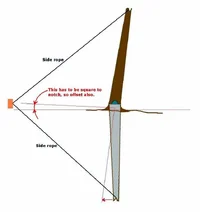
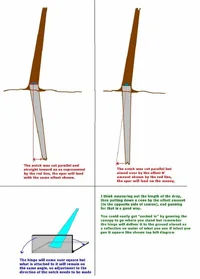
Also, you do have to gun to take into consideration the side lean or offset of the head. What you are sighting up psychologically when felling a symetrical tree usually is the canopy.

The key is that whatever the offset is; when the tree is laid out it will be the same on the ground (see diagram)
 

Attachments

  • 47979-leaner.webp
    47979-leaner.webp
    58.6 KB · Views: 105
[ QUOTE ]
I would assume that once the tree has passed the 45 degree angle the hinge wood wouldnt do much more steering

[/ QUOTE ]

But there is something else you can add to the stump to help direct the fall after the hinge fails.
Here's a hint ...
bns0159.jpg
 
Ekka, so you would agree with Tim Ard and use the adjusted gun technique over a tapered hinge? You just have to really make sure that you know how tall your tree is and how much side lean you also have.

You also have to take into account the slope of the ground that the tree is going to be felled to when you calculate the height of the tree. Any false measures can cause you to overshoot the tree and miss the lay badly.

I like your drawing and I agree the physics behind it does work. I wish I could set up an experiment to test both techniques.

Chris
 
Yeah

I was trying to post and stuff a few days ago but I couldn't do squat with the busted Buzz. My early comment of gun it true and fell it is <font color="red">wrong</font> .

Literally put a door hinge on your desk. Bluetac a ruler or something to it on an angle. Have it verticle but on a side lean then fold the hinge down to the desk ... notice how the ruler is still off to one side?

Now to get the ruler to land square you need to turn the hinge by the same amount as the lean. My tests were degree for degree. So in this case the notch will be 6 degrees offset to the opposite side of the lean to get the head into the sweet spot.

But there is a problem that may arise if using a side rope and you dont pay attention. On the attached diagram the rope which would obviously be on the LH side of the tree will become slack unless it is also offset by the same amount as the notch ... 6 degrees.
 

Attachments

  • 47988-leaner2.webp
    47988-leaner2.webp
    22.7 KB · Views: 103
Nice thinking Ekka! I like your controlled study with the door hinge and ruler. Makes alot of sense.

Yeah, I can see where the side retainer line could be a problem. Too far back could cause it to swing to far over and too far forward you loose the holding effect. It is also hard to sometimes find a suitable tree adjacent to the one that is being felled, though I suppose you could set a ground anchor if you needed.

You may not need the holding line on some trees though because of the full width hinge all the way across.

Chris
 
No doubt you've already noticed my PM reply, Chris.

I don't use a tapered hinge to steer a tree. It's there solely to provide the added hinge strength needed to keep the stem from falling to the side. Almost invariably the direction of the notch alone determines the direction of the fall.

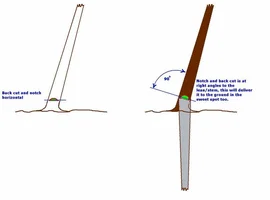
Another factor I don't recall being mentioned here (not re-reading the whole thread) is that the felling cuts can be made not strictly horizontally, but instead (more) perpendicular to the stem. (I would still use a tapered hinge.)

Ekka, fasten your "stem" perpendicular to the hinge pin but elevate one side of the pin to produce the lean. Now fold the hinge and see what happens. Similarly you could elevate one side of the hinge and fasten the "stem" to be strictly perpendicular to the table and see what happens.

I guess being a pencil-and-paper draftsman for my first "real" job (back in the day) helps me to readily visualize this type of stuff in the field.
 
[ QUOTE ]

Another factor I don't recall being mentioned here (not re-reading the whole thread) is that the felling cuts can be made not strictly horizontally, but instead (more) perpendicular to the stem. (I would still use a tapered hinge.)

Ekka, fasten your "stem" perpendicular to the hinge pin but elevate one side of the pin to produce the lean. Now fold the hinge and see what happens. Similarly you could elevate one side of the hinge and fasten the "stem" to be strictly perpendicular to the table and see what happens.


[/ QUOTE ]

Yeah i know but why was it drummed into us that the hinge must always be parallel to the ground. Also it will be a bit wierd coz when you sight it up you will be standing at exactly the offset amount plus have the angle to the ground level to confuse you ...

Coz imagine you're standing there, the tree hits the ground after falling 90 degrees hence the spar laid out straight but the brain will be thinking that the tree will end up exactle opposite if it goes the 180 degree fall .... but obviously it cant.
 

Attachments

  • 48035-lean3.webp
    48035-lean3.webp
    20.5 KB · Views: 69
Hi Glen, thanks again for your PM reply. I'll try to get some pictures of this tree for you guys to see.

I am glad that you can visualize these things in your mind and in the field. Sharing your ways of studying helps all of us. I am gonna try to think "Out of the Box" with some rigging ideas that I have for small experiments and I will pass it on when finished.

Yeah, I too remember reading in Jerry's and Dent's books about the hinge being made more perpendicular to the stem of the leaning tree. I have never tried this, but given the oppurtunity in a woods setting, sounds like a good experiment.

Chris
 
[ QUOTE ]
why was it drummed into us that the hinge must always be parallel to the ground

[/ QUOTE ]
I don't know. Sometimes parallel to the ground is not appropriate.

If the stem is plumb and you have one side of your notch cut higher than the other the stem will not go the direction you've sighted it. That's probably the main reason for the "horizontal" rule of thumb.

Any time I'll have a wedge in the back cut as anything other than an indicator that the cut is separating, I'll make the back cut perpendicular to the major axis of the grain at that point. It's not too difficult some times to effectively have a sloped back cut even when it's strictly horizontal, to poor/unsafe effect.

The rule of horizontal cuts (fore and aft) really pertain only to vertical stems, in my opinion.

It's really a bit of guess-work to over-gun a side leaner in order to have it fall to a precise location, no matter what you do. It's much surer to form the notch at a slight side angle matching the lean and gunned directly.
 
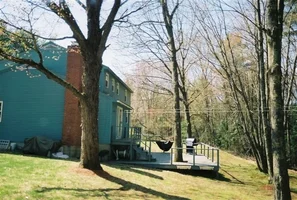
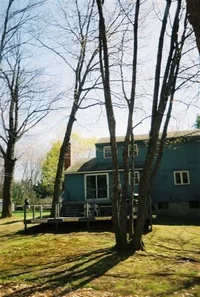
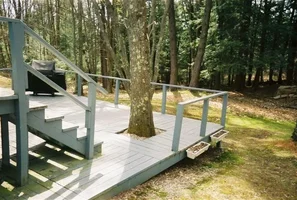
They're going to re-build the deck surface over the low-cut stump, right?

Which direction is the tree going to go? You could maybe get by simply removing the top rail, stacking a few pallets just off the deck surface just in case, about 4' up from the deck make a wide-enough notch so that the face never fully closes and leave the stem attached to the stump.

Toss a throw line through the major crotch and pull up your rope, then use your Maasdam rope hoist on the other end to pull that puppy over center.

Come back later to make the low stump cut after they've removed sufficient deck planking (or let them do that on their own for a few bucks less).

That's my preliminary size-up of the job anyway.
 
Well, you'd only gotten the first one up when I started that post so one of the questions was already answered by now.

You're welcome on the help; glad I could. Good job. The only thing I'd suggest further would be to put them all in a zip file, compose your descriptions in the post, and attach the one file. That way they will not open in a browser window and your descriptions can be referred-to simultaneously to viewing. (I'm special and have my system set up to not open them with the browser anyway :)

If you use paint, save in PNG for two reasons.
 
Gee, you are a lucky man getting that sweet job, I'd love to smack that down.

And I'd use foams and board, just like Glen's says remove the top rail only no worries.

Seeing all lays and pics was great.

I would go the parallel to the ground notch offset for the lean as per my earlier diagrams. Measure the tree out and put a cone where the offset is (opposite side of the lean), make sure the side rope is square to the notch, there's stacks of trees to set up for a side rope right on the money even if you have to use a floating crotch technique. But be careful not to have any get in the way and foul your rope on the way over .... some might do that. Gun that cone up and you are bang on the money.


Nice even back cut, thicker hinge than usual and pull her over (I'd use a 4wd). The backlean is bugger all, dont let it worry you unless you cut thru the hinge!

Any chance of video when you do it?

And yes, I use paint.
 
[ QUOTE ]
[ QUOTE ]

Another factor I don't recall being mentioned here (not re-reading the whole thread) is that the felling cuts can be made not strictly horizontally, but instead (more) perpendicular to the stem. (I would still use a tapered hinge.)

Ekka, fasten your "stem" perpendicular to the hinge pin but elevate one side of the pin to produce the lean. Now fold the hinge and see what happens. Similarly you could elevate one side of the hinge and fasten the "stem" to be strictly perpendicular to the table and see what happens.


[/ QUOTE ]

Yeah i know but why was it drummed into us that the hinge must always be parallel to the ground. Also it will be a bit wierd coz when you sight it up you will be standing at exactly the offset amount plus have the angle to the ground level to confuse you ...

Coz imagine you're standing there, the tree hits the ground after falling 90 degrees hence the spar laid out straight but the brain will be thinking that the tree will end up exactle opposite if it goes the 180 degree fall .... but obviously it cant.

[/ QUOTE ]

Interesting, guys. But a good reason for a horizontal hinge is that it gives more surface area for the all critical holding wood. In fact, sometimes I'll overcompensate the other way for just that reason.

And, I still think a tapered hinge is good insurance against breaking the holding wood, regardless of what Tim Ard says.

Great discussion, by the way!!
 

New threads New posts

Back
Top Bottom