Tapered Hinge With Backlean

chris_girard

Branched out member
Location
Gilmanton, N.H.
I've got a tree to remove and I'm looking for some opinions.

The tree is a maple around 75' in height, 18" DBH, 8' of weighted sidelean and 7' of weighted backlean.

My plan was to use a tapered hinge and a slightly adjusted gun to handle the sidelean. I've used both techniques with success. I like using the gunning tech. in a woods setting were I can use the full strength of the hinge. In a backyard setting though I prefer to use the tapered hinge for a more precise gun.

This tree will have a side retainer line and of course my pull-line for the backlean.

My quetion really is have any of you guys used the tapered hinge for backleaners? As the pull-line and my wedges bring the tree upwards, that hinge will be breaking. My concern with the tapered hinge is that it will weaken before the tree comes forward enough for it to work. Maybe the Adjusted Gun Tech. would be better?

Chris
 
I'm confused because you'll still need to adjust your gun when using a tapered hinge. And why would the tapered hinge necessarily be breaking any sooner? There should still be the same amount of fiber in the hinge, it's just that you're taking it away from the side it's not doing anything and transferring it to where it will. I've not had any problems with back-and-side leaners using a tapered hinge.

What is this "adjusted gun" method you're considering? Your description makes it sound like it's inherently imprecise.
 
I'm not sure what the big deal is if you have a side rope and pull rope?

Just cut an open enough gob that the notch doesn't close at verticle, back up with wedges and get the show on the road.

Make sure your side rope is at 90 degrees (not more) and tensioned. The side rope wont experience any shock load, gun your face true and leave a slight taper.

What strength is that side rope?
 
Like I said I am concerned with too much of the hinge wood in the back breaking as the tree is lifting up, thereby weakening the tapered hinge before letting it work.

I did say that I will have a retainer line but I need to look at that again, because I know that I do not have a good angle to hold it. If anything the line will be forward which won't help me that much.

The side rope is plenty strong. 5/8" stable braid.
 
Glens, you're right the tapered hinge in theory does transfer the strength to the tension side, but will close and break sooner on the compression side, due to the unequal tapered length.

The Adjusted Gunning tech. is the one taught by Tim Ard of The Game Of Logging. He says that if you have a tree with 5' of sidelean than you need to adjust you sighting line an additional 5' in the other direction. See the July 2004 TCIA mag.
 
I forgot to mention that with the adjusted gun you do not need a tapered hinge because you have the full thickness of the hinge working in your favor.

I just do not like sighting in a direction where the tree will not land. Hard to judge, you know what I mean?

Chris
 
I use throwline string with a weight on the end for a plumbline. Line the string up with the top and put a road cone to where the plumbline hits the ground. Pace or measure the distance, then go out to where you want the tree to land and measure the same distance and place a road cone there. I use the road cone as my sight. Silver maple does not have good fiber. Definitely use a side rope. The tree will have to go over somewhat quickly.
 
Chris, you won't have any problem pulling that over with a rope high in the tree.
I would set your corners to the lay,open face notch, leave a little higher hinge,cut a tapered hinge.
Cut and pull, cut and pull, it should come over easy.
Leave a decent hinge as needed and pull the tree into the lay.
You can use one rope around the tree, anchored on one end where you are pulling from and use a mechanical advantage on the other end with a rope brake.
A second line for safety is always cheap insurance.
 
[ QUOTE ]
the tapered hinge in theory does transfer the strength to the tension side, but will close and break sooner on the compression side, due to the unequal tapered length.

[/ QUOTE ]
Nothing should close any sooner on one side or the other. That's the point of making the hinge stronger on the "high" side.

[ QUOTE ]
The Adjusted Gunning tech. is the one taught by Tim Ard of The Game Of Logging. He says that if you have a tree with 5' of sidelean than you need to adjust you sighting line an additional 5' in the other direction. See the July 2004 TCIA mag.

[/ QUOTE ]
I don't get the magazine but now that you mention it, I think I recall something about it being discussed over at the other site not worthy of being mentioned. As I recall it was pretty much nonsensical. You always need to take the offset of the treetop into consideration and adjust for it accordingly. In your case, if you want the tree to land at a certain spot 75' away when it has 8' of side lean, you'll need to gun for 8' away from the side lean at that distance to hit it. Trust me; this stuff works very well. The only real problem I can recall was when I've over- or under-compensated and got exactly what I'd asked for.

You can also combine the forward and side pull lines by pulling to a vector between the two directions.

10% lean ain't much. It should be pretty straightforward.
 
i like tapered hinge in good wood. To me, a tapered hinge delivers where the mechanics wants it to, while overgunning delivers where wood fails at. So, to me; it depends on if the wood will hold or fail, which technique i choose. i also like dutching some on lean side for some stuff, with backleaner that can't be just a kerf step in lean side, because you don't want the close to happen(kerf makes it almost immediate close) before CG is forward of hinge, so must make a narrow face, then widen the control side, or use block on lean side.

Glen says neither side will close first (dis-allowing dutching lean side); that is true; but lean side will close firmer and thereby can start ripping earlier i think in right conditions. Especially with dutch in lean side only, then making it's own tapered hinge somewhat as it rips across from lean to control side. Or opening control/tension side. An early close on lean side only, can change pivot of works, to be closer w/ less angle to load; and farther w/better angle to tension. So is truly a double duty, compounding 'pivotal change' for the lean angle and length(to new pivot) of load is reduced; while the angle and length to support is increased after hinge strength is set at first folding.

i think a tapered hinge just works to improve 1 side(control/tension side) of that; in that it increases the support fiber amount, but also length to this tensioned fiber, and makes a better leveraged angle to said tensioned fiber. This is why the most stretched fibers agianst left lean might not be the extreme right back corner, but rather a little left; for those are the fibers that against that lean angle are farthest back and at best leveraged angle. So sometimes that is better than farther to right and back fibers, that have less leveraged angle. Nature choosing the most powerful strategy, and the forensics showing the positition of most stretched fiber postition in mute testimony to what went on.

i'd favour tapered hinge, wide across in best circumstances; let it steer imbalance; and all added effort be focussed on serving backlean forward; then running that force through multiplier of hinge/ tapered hinge to steer more powerfully than if pulling/pushing against lean directly.

i think the tree wants to go to center gun, and compression and tension on either side of the hinge self compensate somewhat to steer there. When we pull to right some degrees to help offset a lean to right; we are partially just replacing what the tensioned fiber in hinge would do anyway. For we are unloading the tension on the hinge, by replacing it with rope tension against same load/lean. Not a great gain; unless wood in hinge can't do this steering on own.

Orrrrr somethin'like that
/forum/images/graemlins/crazy.gif
 
I don't understand that one Ken.
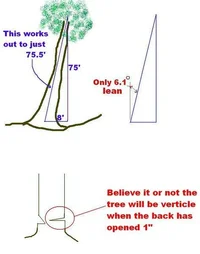
You could lift a tree vertical with a 1" wedge but are you saying the tree will straighten itself with a 1" felling kerf, or is it just the reaction showing how much a 1" lift has on a leaning tree?
 
[ QUOTE ]
Ken posted the diagram for me.

Since the glitch on the board I cannot post, it just crashes!!!

But when the backcut has opened up 1" + the thickness of the bar/cut the top will be centre again.

I made these trig calculations to eeze the cutters mind about the hingewood breaking theory.

Yes, a 1" lift over 75' does amount to 8' at the top, the lean is only 6 degrees.

Regards
Eric

[/ QUOTE ]
 
Ekka's way works if the CG is so high that 1" lift near the pivot of the hinge gives enough movement to CG to place forward of hinge. The higher the CG in relationship to how far back wedge lift is from hinge pivot, the more movement CG will get from the 1" lift. The hinge is central pivot for both load (CG) and support (wedge lift) to be calculated from.

Just like in forward lean; the amount of tension hold/support is it's leveraged distance and angle from compressed part of hinge as pivot vs. the distance/angle of CG as Load per same hinge pivot. Just a seesaw balance of load on one side and support on other; their amount of force X distance X angle multipliers from the pivot of compressed hinge portion. Thus, changing available compressed hinge portion is a 'pivotal change'; in that it takes leveraged distance angle multiplier from load and gives it to support at same time for compound effect, or vice/versa; takes it from support/tension and let's it favour load at same time; givng not a singular change but a compound one.
 
It should also be noted that the fibers of the hinge tend to break from the back. As the tree falls, fibers along the back of the hinge will break first. After the tree reaches a certain point in its fall, only the fibers at the front of the hinge are left to finish steering the tree. Therefore, making a hinge thin on one side will not accomplish any steering function.

This is a direct quote from the Tim Ard site. Hope this isn't a copyright violation!!!
 
TL, yeah I heard Tim say this too, but after watching the steering capabilities first hand, I KNOW that it really works.

Like I mentioned before, I like using the adjusted gunning tech. in a woods setting were I can use the full strength of the hinge. In a backyard setting though I prefer to use the tapered hinge for a more precise gun.

It has been a couple of weeks now since I went to look at this particular tree removal. I am waiting to hear back from the owner. I bid the job as a flop-over with no climbing other than to set my pull line, so my price is a lot lower than it could be.

I'll have plenty of pics too if I can figure out how to post them. I have some now, but I'm not sure how to post them. I did e-mail them to myself which automatically resized them, but I'm not sure what to do now to Attach them. Glen, any ideas?

Chris
 

New threads New posts

Back
Top Bottom