mark the 5/8 rope is expensive in 300' plus lengths and has to be ordered. wire is a block away from here and so versatile. a faller friend of mine has several 150' spools in the shop ready to go anytime.and there is a wire shop the same distance away that makes chokers . it also doesnt get damaged as easily if it gets smashed into the ground... i use 5/8 for lowering. but not yarding.

Navigation
Install the app
How to install the app on iOS
Follow along with the video below to see how to install our site as a web app on your home screen.
Note: This feature may not be available in some browsers.
More options
You are using an out of date browser. It may not display this or other websites correctly.
You should upgrade or use an alternative browser.
You should upgrade or use an alternative browser.
Tandem Tree felling plan critique requested
- Thread starter DLT
- Start date
- Location
- Netherlands
[ QUOTE ]
Hé Guys,
Lets not talk about tree one and two.
Is it just me looking at tree number three.
[/ QUOTE ]
/forum/images/graemlins/boohoo.gif that will be the end /forum/images/graemlins/goodnight.gif
first thing i thoughd about to.
Hé Guys,
Lets not talk about tree one and two.
Is it just me looking at tree number three.
[/ QUOTE ]
/forum/images/graemlins/boohoo.gif that will be the end /forum/images/graemlins/goodnight.gif
first thing i thoughd about to.

- Location
- Home of the New Jersey Devils
I understand. Yarding is a different technique for sure. I was just making sure that I stated that a 5/8" rope should be plenty for pulling it over.
- Location
- Home of the New Jersey Devils
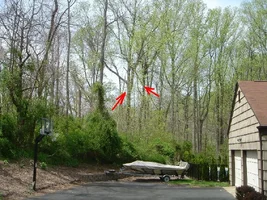
- Location
- Home of the New Jersey Devils

- Location
- Home of the New Jersey Devils

- Location
- Milford, New Hampshire
Mark,
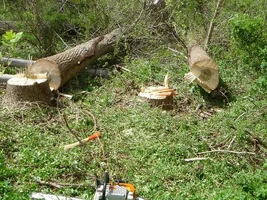
I see the fiber pull in your picture, but am not sure exactly what you mean by take advantage of the fiber pull.
In general, my strategy in critical situations is to get the longest hinge possible, which usually puts the hinge midway in the tree, and low to the ground to take advantage of the trunk flare.
The deadline for this job is May 1st, so check for a post later that week.
I see the fiber pull in your picture, but am not sure exactly what you mean by take advantage of the fiber pull.
In general, my strategy in critical situations is to get the longest hinge possible, which usually puts the hinge midway in the tree, and low to the ground to take advantage of the trunk flare.
The deadline for this job is May 1st, so check for a post later that week.
- Location
- Home of the New Jersey Devils
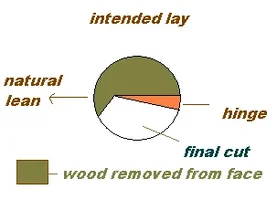
Well, I agree about having as much hinge as possible, but I would still try to keep it around 80% of the total dia. I am really talking about taking advantage of using the root flare if possible on the top side of the lean.

- Location
- Ontario, Canada
It makes sense to use the strength of the flare on the high side but once the holding wood is tripped the hinge is what counts.
What I do is notch the low side to remove the holding wood from that side of the tree if you need to turn it to the intended lay.
If its already leaning towards the lay then it doesn't matter.
What I do is notch the low side to remove the holding wood from that side of the tree if you need to turn it to the intended lay.
If its already leaning towards the lay then it doesn't matter.

chris_girard
Branched out member
- Location
- Gilmanton, N.H.
Kevin, so what you're saying is that you basically create a small dutchman on the low side to help swing the tree towards the lay.
Mark, I too will try to keep 80% of the dbh to take advantage of the full strength of the hinge though as I'm sure you know sometimes you can get away with less and sometimes you may need the full 100% depending on the situation.
Mark, I too will try to keep 80% of the dbh to take advantage of the full strength of the hinge though as I'm sure you know sometimes you can get away with less and sometimes you may need the full 100% depending on the situation.
- Location
- Ontario, Canada
I wouldn't say small, it depends on the tree.
Not a dutchman as we know it this is an actual notch to remove substantial holding wood on the low side on the same plane as the face cut.
Not a dutchman as we know it this is an actual notch to remove substantial holding wood on the low side on the same plane as the face cut.
chris_girard
Branched out member
- Location
- Gilmanton, N.H.
Kevin, would you also use a tapered hinge along with this notch removal on the low side or would you keep a full 10% dbh hinge for more strength?
Do you have any pics or a sketch that shows this setup?
Do you have any pics or a sketch that shows this setup?
- Location
- Ontario, Canada
If I was swinging it, a tapered hinge would be used to pull the tree.
I'll try and get a picture of it one of these days.
I'll try and get a picture of it one of these days.
- Location
- Milford, New Hampshire
[ QUOTE ]
why not try to take advantage of the fiber pull of the root flare?
[/ QUOTE ]
Mark,
1. I hate to be dense about this point, but I am still not clear on what advantage you refer to. Are you counting on the root flare fiber to maintain the integrity of the hinge longer that fiber further up the trunk will? Or are you using that fiber to "steer" the tree?
2. Is there any reason not to use 100% length in critical situations? If 80% will hold longer than 60%, 100% should hold longer than 80%
Chris, how far are you from Dublin NH? Care to watch?
Kevin, I had one training day with Soren awhile back where he demonstrated the Dutchman. Too high of a learning curve, any chances of failure for me personally to use. Plus, once the tree is moving, I want to be on my escape path, not cutting.
why not try to take advantage of the fiber pull of the root flare?
[/ QUOTE ]
Mark,
1. I hate to be dense about this point, but I am still not clear on what advantage you refer to. Are you counting on the root flare fiber to maintain the integrity of the hinge longer that fiber further up the trunk will? Or are you using that fiber to "steer" the tree?
2. Is there any reason not to use 100% length in critical situations? If 80% will hold longer than 60%, 100% should hold longer than 80%
Chris, how far are you from Dublin NH? Care to watch?
Kevin, I had one training day with Soren awhile back where he demonstrated the Dutchman. Too high of a learning curve, any chances of failure for me personally to use. Plus, once the tree is moving, I want to be on my escape path, not cutting.
- Location
- Ontario, Canada
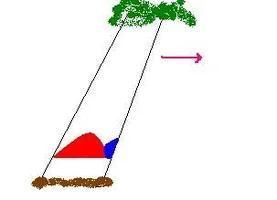
This isn't a dutchman.
It's two face cuts to turn a leaner.
See the attachment, take out the red towards the intended lay, take out the blue on the lean side and cut an angled hinge with the felling cut but don't get your bar pinched on the low side.
It's two face cuts to turn a leaner.
See the attachment, take out the red towards the intended lay, take out the blue on the lean side and cut an angled hinge with the felling cut but don't get your bar pinched on the low side.
Attachments
- Location
- Milford, New Hampshire
Kevin,
thanks for the explanation. I'll try on some leaners in the woods.
thanks for the explanation. I'll try on some leaners in the woods.
- Location
- Ontario, Canada

Roger_Barnett
Participating member
- Location
- Seattle, in the PNWet
DLT, there are many far more accomplished fallers on these forums than me. Some of us have used triangle hinge shapes to good advantage. Alos, if you can cut low near the root flare, there is often more fiber strength there. It can tend to tear instead of break which would be good.
Also, a holding line opposite the lean is often good as well, even though it means extra rigging.
Also, a holding line opposite the lean is often good as well, even though it means extra rigging.
- Location
- Home of the New Jersey Devils
I agree with Roger, DLT. I use the face cut low to the ground to help take advantage of the flare fiber. Any extra holding power is a good thing. In the job I just did I used a tag line that was pulled on about a 45* angle rather than with the intended fall line as per usual in a straight tree.

- Location
- Bloomington, Indiana
Mark;
I agree with your comments about using the fiber in the flare and about the tag line, but I have some questions about the last photo.
I take it that the tree was leaning to the right and that the wedges were used to help prevent fiber collapse on the right (down) side of the tree. Is this correct?
Also, it looks like fiber has pulled from the stump and stayed with the tree on the left side, and pulled from the tree and stayed with the stump on the right side. Any idea why? How did things look as the tree went over?
I agree with your comments about using the fiber in the flare and about the tag line, but I have some questions about the last photo.
I take it that the tree was leaning to the right and that the wedges were used to help prevent fiber collapse on the right (down) side of the tree. Is this correct?
Also, it looks like fiber has pulled from the stump and stayed with the tree on the left side, and pulled from the tree and stayed with the stump on the right side. Any idea why? How did things look as the tree went over?
New threads New posts
-
test
-

-

-
[CLOSED — AD WITHDRAWN] Experienced Tree Service Sales Representative — Sell in Your Own Town (Nationwide)
- Started by BlossomExteriors
- Replies: 14
-

-
 Lyme disease is a man-made military biological weapon developed on Plum Island
- Started by Daniel
- Replies: 7
-


