
Navigation
Install the app
How to install the app on iOS
Follow along with the video below to see how to install our site as a web app on your home screen.
Note: This feature may not be available in some browsers.
More options
You are using an out of date browser. It may not display this or other websites correctly.
You should upgrade or use an alternative browser.
You should upgrade or use an alternative browser.
SYMPLAST
- Thread starter twig
- Start date


guymayor
Branched out member
- Location
- East US, Earth
A useful concept , reminding us that
1. cambium is not the only living tissue capable of cell division, and
2. aplopast such as heartwood is not needed by the tree, so decay of heartwood is not a big biological deal.
O and a pedantic point; 'except' is used where 'accept' is intended. Sometimes spellchek ain't enuf!
1. cambium is not the only living tissue capable of cell division, and
2. aplopast such as heartwood is not needed by the tree, so decay of heartwood is not a big biological deal.
O and a pedantic point; 'except' is used where 'accept' is intended. Sometimes spellchek ain't enuf!
Last edited:
(GUY SAID-aplopast such as heartwood is not needed by the tree, so decay of heartwood is not a big biological deal)
not sure if i agree with that or not....??? The symplast is connected within the apoplast. Water is stored within the apoplast, that from my understanding the tree may use if needed. As far as heartwood decay goes if the tree is losing symplast (even within the dead heartwood)then it is losing energy in this case apoplast - stored water. thoughts????
not sure if i agree with that or not....??? The symplast is connected within the apoplast. Water is stored within the apoplast, that from my understanding the tree may use if needed. As far as heartwood decay goes if the tree is losing symplast (even within the dead heartwood)then it is losing energy in this case apoplast - stored water. thoughts????

KTSmith
Branched out member
- Location
- Maine, New Hampshire
But apoplast as in the functional (yet empty of symplast) vessels and tracheids is essential. There are lots of ways of looking at symplast/apoplast as essential parts of the living tree. They are the two distinct transport networks, both essential.
Of course, the symplast is also capable of energy storage and dynamic response, so more is involved than just transport. But that's one way to look at it.
As to #1, I'm writing a paper now that in part is about the callus (in the strict sense) that foms from dedifferentiated xylem parenchyma that forms a little pad of dividing cells, within which a new cambium develops. Lots of fun.
But sure, the vascular cambium produces the great bulk of cells in the life of a tree, followed by the cork cambium.
That "tree dictionary" site set up by John Keslick is useful. Most all of the text is a pastiche of writings of Alex Shigo, with a tiny bit of me and probably others as well. At least that's how I remember it. So as a pastiche, the intended context of the words was sometimes not as a dictionary definition, so don't expect them to be as complete as they might be if they were writted as coherent, single dictionary entries. That's not a criticism! Just be aware of what you are looking at.
Of course, the symplast is also capable of energy storage and dynamic response, so more is involved than just transport. But that's one way to look at it.
As to #1, I'm writing a paper now that in part is about the callus (in the strict sense) that foms from dedifferentiated xylem parenchyma that forms a little pad of dividing cells, within which a new cambium develops. Lots of fun.
But sure, the vascular cambium produces the great bulk of cells in the life of a tree, followed by the cork cambium.
That "tree dictionary" site set up by John Keslick is useful. Most all of the text is a pastiche of writings of Alex Shigo, with a tiny bit of me and probably others as well. At least that's how I remember it. So as a pastiche, the intended context of the words was sometimes not as a dictionary definition, so don't expect them to be as complete as they might be if they were writted as coherent, single dictionary entries. That's not a criticism! Just be aware of what you are looking at.
So would the decay of heartwood be detrimental to the tree? From my understanding as a tree ages it has less symplast and more apoplast. The apoplast would be made up of water, elements within its molecular structure. Can the tree utilize this if needed?
guymayor
Branched out member
- Location
- East US, Earth
"the callus (in the strict sense) that forms from dedifferentiated xylem parenchyma that forms a little pad of dividing cells, within which a new cambium develops."
Oooo can't wait to see that! Doesn't sound like trade mag material--which journal will it be in? Dedifferentiation sounds like a tantalising topic. Redifferentiation even more so! I dabbled in that in the attached, aided by Dr. Coder, but did not get too deep. Are those growing specks the 'pads' of which you speak? Black rubber covering is used to culture those--worked great for Dujesieffken on a de-barked tree, better than the clear wrap noted below.
{Cornelia smiled as she folded some plastic food wrap around a wedge of bread and put
it in a bag for us. “And Cornelia, can we borrow that roll of wrap, please?”
They looked at each other quizzically, shrugged, and followed me outside. “Well,
Codit, how are you going to test your suspicions about those specks being oil?” He was
way ahead of me; under the tree, he nicked a speck with his fingernail. Inner green shone
bright in the low winter light.
Cornelia gasped, her eyes wide with wonder. “It’s alive!” she cried. “But what does it mean?”
“It’s not oil, but a sort of stem cells for trees. It looks and feels like wax because of the
suberin in the walls of some parenchyma cells,” I told her. “As cells divide and differentiate,
miracles can happen. Some tropical trees grow new bark from parenchyma in
wood—who’s to say it can’t happen in Cornus florida? It’s a long shot, but we could try trimming
the damaged edges of these wounds, invigorating the roots by aerating and incorporating
compost, and covering the trunk with this plastic food wrap to keep the parenchyma tissue moist.}
"The symplast is connected within the apoplast." Umm, connected TO, perhaps, not much within. From my research on wood rays--done with a maul aimed at them as I split firewood--they tend to taper into nothing as they approach the core. Tomorrow I cut down a Liriodendron--maybe I'll do a little splitting and see what's inside. Water is stored within the apoplast, but water is not energy. I think water comes from the soil too. So i'll stand by: heartwood aka non-functional apoplast being grossly overrated, and the loss of it aka hollowing is a poor reason to whack a tree.
(The good old days of innuendo: She drew near me to gaze lovingly at the lush scenery, and eyed me appreciatively. “I also adore woody plants.” Her soft breath warmed my cheek. “How can I ever repay you?”)
Oooo can't wait to see that! Doesn't sound like trade mag material--which journal will it be in? Dedifferentiation sounds like a tantalising topic. Redifferentiation even more so! I dabbled in that in the attached, aided by Dr. Coder, but did not get too deep. Are those growing specks the 'pads' of which you speak? Black rubber covering is used to culture those--worked great for Dujesieffken on a de-barked tree, better than the clear wrap noted below.
{Cornelia smiled as she folded some plastic food wrap around a wedge of bread and put
it in a bag for us. “And Cornelia, can we borrow that roll of wrap, please?”
They looked at each other quizzically, shrugged, and followed me outside. “Well,
Codit, how are you going to test your suspicions about those specks being oil?” He was
way ahead of me; under the tree, he nicked a speck with his fingernail. Inner green shone
bright in the low winter light.
Cornelia gasped, her eyes wide with wonder. “It’s alive!” she cried. “But what does it mean?”
“It’s not oil, but a sort of stem cells for trees. It looks and feels like wax because of the
suberin in the walls of some parenchyma cells,” I told her. “As cells divide and differentiate,
miracles can happen. Some tropical trees grow new bark from parenchyma in
wood—who’s to say it can’t happen in Cornus florida? It’s a long shot, but we could try trimming
the damaged edges of these wounds, invigorating the roots by aerating and incorporating
compost, and covering the trunk with this plastic food wrap to keep the parenchyma tissue moist.}
"The symplast is connected within the apoplast." Umm, connected TO, perhaps, not much within. From my research on wood rays--done with a maul aimed at them as I split firewood--they tend to taper into nothing as they approach the core. Tomorrow I cut down a Liriodendron--maybe I'll do a little splitting and see what's inside. Water is stored within the apoplast, but water is not energy. I think water comes from the soil too.
So i'll stand by: heartwood aka non-functional apoplast being grossly overrated, and the loss of it aka hollowing is a poor reason to whack a tree.(The good old days of innuendo: She drew near me to gaze lovingly at the lush scenery, and eyed me appreciatively. “I also adore woody plants.” Her soft breath warmed my cheek. “How can I ever repay you?”)
Attachments
Last edited:
KTSmith
Branched out member
- Location
- Maine, New Hampshire
Maybe this isn't happening, but it sounds as if "heartwood" is being equated with "apoplast", which would be a big mistake and pretty scary. Maybe I'm over-reacting.
The symplast is the interconnected webwork of living protoplasts or "cell guts". The apoplast is the system of cell walls and open cell lumens (the insides of the vacant pipes).
By volume, the sapwood (yes, sapwood) is 80-90% apoplast. That 10-20% symplast does call the shots and is critically important. As I wrote above, one aspect of these is as transport systems. Sugar fixed in the leaves heads out to the rest of plant via the symplast. Nitrogen (and some other elements) moves through the symplast. Most calcium and magnesium and the great bulk of water moves in the apoplast, through the system of open pipes. In the excerpt from Keslick's Tree Dictionary, Shigo is speaking about water storage and flow in the sapwood apoplast, not heartwood. Water and other stuff in the heartwood is generally unavailable to the tree. Heartwood is plugged by tyloses and aspirated pits.
Yes, the little callus and wound response paper is in the fire scar series. I'm thinking Canadian Journal of Forest Research. I've had two this year (as coauthor) on wound anatomy in Annals of Botany. Just trying to get stuff out!
The symplast is the interconnected webwork of living protoplasts or "cell guts". The apoplast is the system of cell walls and open cell lumens (the insides of the vacant pipes).
By volume, the sapwood (yes, sapwood) is 80-90% apoplast. That 10-20% symplast does call the shots and is critically important. As I wrote above, one aspect of these is as transport systems. Sugar fixed in the leaves heads out to the rest of plant via the symplast. Nitrogen (and some other elements) moves through the symplast. Most calcium and magnesium and the great bulk of water moves in the apoplast, through the system of open pipes. In the excerpt from Keslick's Tree Dictionary, Shigo is speaking about water storage and flow in the sapwood apoplast, not heartwood. Water and other stuff in the heartwood is generally unavailable to the tree. Heartwood is plugged by tyloses and aspirated pits.
Yes, the little callus and wound response paper is in the fire scar series. I'm thinking Canadian Journal of Forest Research. I've had two this year (as coauthor) on wound anatomy in Annals of Botany. Just trying to get stuff out!
I would be interested in purchasing any of your publications KTSmith. Put up a link if you wish or i will just search and purchase that way. So in others words the heartwood is completely no use to the tree? Except for maybe pathogen protection ?.....via terpenes?(where tylosis exists?)
guymayor
Branched out member
- Location
- East US, Earth
Kevin, I agree. By saying "heartwood aka non-functional apoplast" I was trying to differentiate heartwood from functional apoplast. Sorry to have scared you! Or maybe I am still wrong if there is functional heartwood. I recall Alex saying something about electrical signals going across/through it, but that doesn't sound functional to me.
Looking fwd to the callus paper; the other 2 seem to have a more fiery focus, and there is this issue anyway: "The authors of Wood microanatomy of fire scars: tracheid and ray formation in Pseudotsuga menziesii, Larix occidentalis and Pinus ponderosa are on ResearchGate but haven't yet made the full-text available for download."
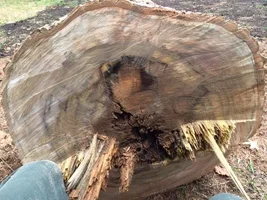
Re decaying heartwood, here's today's tree. Note the black shoestrings of Armillaria in the core. There were no wounds on the trunk or roots visible; the tree was killed after construction and soil compaction. Every time I hear "Decay is usually caused by wounding" it grates on my ears more and more. I doubt there is any data to support this, and I see so many colonizations by fungi that are unrelated to external damage. Could "Decay is usually caused by wounding" be a myth, especially in the case of heartrot?
Looking fwd to the callus paper; the other 2 seem to have a more fiery focus, and there is this issue anyway: "The authors of Wood microanatomy of fire scars: tracheid and ray formation in Pseudotsuga menziesii, Larix occidentalis and Pinus ponderosa are on ResearchGate but haven't yet made the full-text available for download."
Re decaying heartwood, here's today's tree. Note the black shoestrings of Armillaria in the core. There were no wounds on the trunk or roots visible; the tree was killed after construction and soil compaction. Every time I hear "Decay is usually caused by wounding" it grates on my ears more and more. I doubt there is any data to support this, and I see so many colonizations by fungi that are unrelated to external damage. Could "Decay is usually caused by wounding" be a myth, especially in the case of heartrot?
Attachments
Great question Guy!!!
KTSmith
Branched out member
- Location
- Maine, New Hampshire
Thanks Twig for your support. My stuff is all in free and in the public domain. Most of my more recent stuff is linked to: http://nrs.fs.fed.us/people/ktsmith. That link is also associated with my Treebuzz profile, reachable by clicking my avatar. However, that Forest Service site isn't opening at this moment, we have been having intermittently poor web access lately, which is crazy to me!
Thanks Guy, yes, that is one of the two papers to which I referred. Yes, the dendrochronology of fire scars and dendrochemistry/biogeochemistry pays for most of my time. As you've noted, arboriculture is a sideline for me. Of course, the FS does support that work by paying my salary while I'm doing arboricultural talks and consultation, but my original research on tree and fungus biology is supported elsewhere.
The paper you mention (Estelle Arbellay as senior author) is "in press" but hasn't been assigned to a specific issue or pages in the journal yet, so it's not in Researchgate or on my webpage. Estelle's second one in that series is also "in press" but I don't think the page proofs have yet been generated. All of that being said, those papers are more histometric and may not be so interesting to arborists. I'm pretty slack about Researchgate. They send me so many notices that I tune it out. Most folks just contact me directly, which is what I do when I want something from someone else!
As for the Armillaria photo...I'm not sure what the question is. I see evidence of all sorts of mechanical injury away from the plane of the section. I see multipe "fingers" of wound-initiated discoloration, for lack of a better term. You're right of course, fungi cause decay and not wounding. I'm pretty broad in what I consider wounding, maybe that's the ticket. Broken woody roots are wounds. Stubs from broken or shed branches are wounds. The necrotic lesion produced by Armillaria between root buttresses is a wound. That's what makes Armillaria a perthotroph, that it kills tissue ahead of its advance.
What's the tree species in the Armillaria picture? Most of the time when I see a "heartrot", the position of the decay column in or toward the center of the tree is an artifact. Decay usually starts in wounded sapwood (being broad in what might be considered a wound), whether the tree forms heartwood or not. The vascular cambium continues to add more wood (we hope)to the outside of the stem cylinder. So decay that started in the outer sapwood of 4-inch tree is now a central column in the 12-inch tree. Not because the center of a 12-inch tree became infected out of the blue but as a function of the geometry of stem increment and the time since wounding and initial infection!.
Thanks Guy, yes, that is one of the two papers to which I referred. Yes, the dendrochronology of fire scars and dendrochemistry/biogeochemistry pays for most of my time. As you've noted, arboriculture is a sideline for me. Of course, the FS does support that work by paying my salary while I'm doing arboricultural talks and consultation, but my original research on tree and fungus biology is supported elsewhere.
The paper you mention (Estelle Arbellay as senior author) is "in press" but hasn't been assigned to a specific issue or pages in the journal yet, so it's not in Researchgate or on my webpage. Estelle's second one in that series is also "in press" but I don't think the page proofs have yet been generated. All of that being said, those papers are more histometric and may not be so interesting to arborists. I'm pretty slack about Researchgate. They send me so many notices that I tune it out. Most folks just contact me directly, which is what I do when I want something from someone else!
As for the Armillaria photo...I'm not sure what the question is. I see evidence of all sorts of mechanical injury away from the plane of the section. I see multipe "fingers" of wound-initiated discoloration, for lack of a better term. You're right of course, fungi cause decay and not wounding. I'm pretty broad in what I consider wounding, maybe that's the ticket. Broken woody roots are wounds. Stubs from broken or shed branches are wounds. The necrotic lesion produced by Armillaria between root buttresses is a wound. That's what makes Armillaria a perthotroph, that it kills tissue ahead of its advance.
What's the tree species in the Armillaria picture? Most of the time when I see a "heartrot", the position of the decay column in or toward the center of the tree is an artifact. Decay usually starts in wounded sapwood (being broad in what might be considered a wound), whether the tree forms heartwood or not. The vascular cambium continues to add more wood (we hope)to the outside of the stem cylinder. So decay that started in the outer sapwood of 4-inch tree is now a central column in the 12-inch tree. Not because the center of a 12-inch tree became infected out of the blue but as a function of the geometry of stem increment and the time since wounding and initial infection!.
guymayor
Branched out member
- Location
- East US, Earth
Thanks Kevin. I just hit on Researchgate in an inept poke via Google Scholar. The stump was Liriodendron tulipifera as noted in post 6, buried in the love story but also indicated by the greenish hue. The smell is a dead giveaway, but that doesn't come through the screen so well. A very common species down here, having slid into the void left by chestnut blight. I should have been more clear about how broad our definition of 'wound' is. We're not talking about the tree self-wounding with included bark in sinuses, as buttresses develop, where tissues' piezoresistivity is reduced, due to that applied mechanical load.
This pressure would open the door for perthotrophy...ooo I love new words, perthotrophy, that is not an irresistible pull to visit Western Australia, but the ingress of fungal colonisation into pressurised tree tissue via secretion of enzymes. The juice is on the loose, squirting into innocent xylem. Not knowing what's in store, it takes in more, then Armillaria thrusts full bore, till there ain't no more, then it starts to snore...and the walls close in, hiding the sin, concealing within, the thick seals in the thin...
This pressure would open the door for perthotrophy...ooo I love new words, perthotrophy, that is not an irresistible pull to visit Western Australia, but the ingress of fungal colonisation into pressurised tree tissue via secretion of enzymes. The juice is on the loose, squirting into innocent xylem. Not knowing what's in store, it takes in more, then Armillaria thrusts full bore, till there ain't no more, then it starts to snore...and the walls close in, hiding the sin, concealing within, the thick seals in the thin...
New threads New posts
-
test
-
-
-

-
 Do you ever have the occasional customer service experience like this?
- Started by climbingmonkey24
- Replies: 21
-

-

