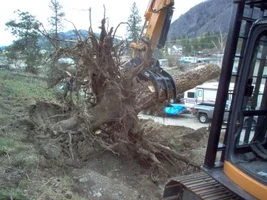
Its hard to say because it could be a taproot.. what kind of tree was it...is it a taprooting species? lets start with that. It also could be a grade change or even planted to deep because as we all know a tree will send roots out of a trunk if it is under the ground i have see it
It looks like the tree came out of a hillside. I wonder if a mud or earth slide could have changed the grade level. Just from the limited background of the photo, it doesn't look like a landscaped area. Further down the trunk it looks like a secondary, or perhaps original root plate.
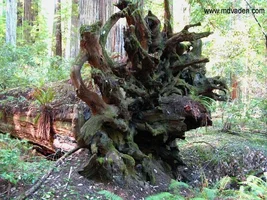
Here is a redwood I passed along Bull Creek Flats in Humboldt redwoods last year. See the previous trunk protruding beneath?
The bigger plate of roots are more recent.
It does not seem likely that just one flood did it. Apparently the 1964 floods of Bull Creek and the Eel River would have moved a lot of soil and sediment.
G. Beranek probably may have an idea about some basic changes in that area.
This redwoods looks to be triple the diameter that it was for its trunk below grade.
trees don't keep a taproot for much past the first few years. Whenever I've seen trees like these two pics there has been some sort of drastic grade change. Amazing that some trees can cope with a grade change.
Amazing photos, I think the original photo can be explained with a soil profile examination/description.
The soils in the photo appear to be quite gravelly and I am willing to bet that the lower root system is related to a layer of finer soil (clay?) that holds water. The lower root sytem likely becomes important in times of drought when the the upper root system cannot support the demand for water.
I have seen very similar situations in sandy soils of northeast North America where prairies are common and in desert areas.
Shag bark hickory along with pig nut hickory trees pretty much all have a tap root like that at least 12" diameter and smaller, have ripped a bunch out if fence rows and clearing lots and they all have a root system like that and were in hard clay ground most of the time