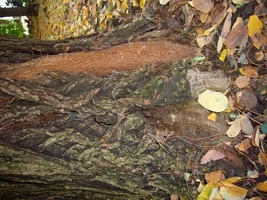
Strange locust tree problem... can it be saved?

"trees don't stop fungus by Codit"

Umm my hypothesis is: this statement is tautologically inconsistent, and downright oxymoronic.

Time to dust off your Shigo library. Or figure out what C+O+D+I+T add up to.
 
Last edited:
I'm sure that I can't resolve all of the issues above, but I can attempt to clarify a couple of things. I know that none of this will be new to Guy and Treevet, but it might help someone out there.
Compartmentalization is the system of inborn, constitutive protection and induced defenses that resists the loss of normal function and the spread of infection. Aspects of compartmentalization were noted by researchers in Europe and the US in the early 20th Century and later. In the 1960s, Alex Shigo published a series of mycology and plant pathology research papers that integrated his own observations with those made in previous generations. Through tree dissection and careful mapping of the fungal colonization of healthy and decayed wood, Shigo set out two general principles: 1. That trees actively responded to injury and infection through changes in tree anatomy, physiology, and chemistry and 2. That a succession of fungi preceded and resulted in decayed wood in living trees. In keeping with the-then current interest of plant biologists in compartmentation, he termed this collective system of tree biology as compartmentalization.
Shigo was given the opportunity to package this research in an expanded "technology transfer" effort in which he introduced CODIT as a model for forest managers to understand patterns of defects in trees. (Available for free (13 MB) at http://www.treesearch.fs.fed.us/pubs/5292). Note that language: CODIT was a model for non-scientists. The simplified presentation of "walls" helped to popularize the ideas...but in some ways weakened credibility with formal researchers, of which Shigo was one. Compartmentalization is a real system of structures and processes. CODIT is the comic book description. A very useful, but limited graphic approach. Many of our European friends treat CODIT and compartmentalization as identical, which is incorrect. I discuss that a little in: http://www.nrs.fs.fed.us/pubs/8529. I frequently lecture and write about compartmentalization. I almost never refer to CODIT except as mile-marker in the history of ideas.
A barrier zone (Wall 4) is anatomically distinct xylem produced after wounding. It is most often seen produced to the side of or above/below the actual wound. Check out that CODIT article above to see. Sure, it's more than one cell thick. Maybe more than a dozen cells thick, but rarely the width of a tree-ring. Some folks confuse woundwood (or callus, if you must) with barrier zones.
I expect I have no more readers at this point, so I will stop.
 
As always with your posts, I read every word. You are one of very few posters I read where I don't walk away saying "yeah, but..."
 
What, then, is the difference, for a working arborist, between compartmentalization and Compartmentalization of Damage in Trees, aka CODIT?
After 9 years of writing the character Codit's dialogue, my head may be screwed up about this.

"Some folks confuse woundwood (or callus, if you must) with barrier zones." The semantic splitting of predominantly chemical barrier zones away from perceptibly physical barriers in general may make sense in the classroom but it's confusing to tree owners and managers. In a way, it seems like TMI, or at least too much emphasis on an academic and to some audiences perhaps an arcane point.
It's all response growth.
It all closes wounds and limits damage.

Isn't that what it's all about?
 
"The challenge for tree care is to favor and support the biology that contributes to safe, healthy, and beautiful trees while understanding that all trees die and that all wood rots."

This abstract seems exaggerated. Are you *sure* that all wood rots?
Does petrified wood rot? Some wood burns. Some wood dissolves.

Can we state with scientific certainty that all trees die? Hard to understand why such exaggerations on the positive side would be annihilated by reviewers, but negative stuff just slides.
 
Thanks Guy, you're right, it's hard for me to prove that no trees live forever. I lean that way because of the absence of counter examples. There are plenty of indicators that death is pretty normal, even in the absence of hacks or even of certified arborist disease. Most natural forests are dynamic mosaics where life-threatening disturbances are frequent. Those disturbances set the stage for the next cohort or generation of trees. I'd be happy to be proven wrong. I take that back, I don't even need proof, just a sound argument with some evidence that immortality is reasonable to consider in a biological context. Evolution and genetic accommodation to a changing environment usually requires death of what was there before. I guess I'm not very sentimental today. I'll definitely grant you that many urban and community trees die prematurely because of human activity. But just as many wild and rural trees also die due to ecological processes like stand closure and natural thinning.

Also true that submerged or ponded wood can stay somewhat stable for a long-long time. I messed around with some dendrochronology work in Finnish Lapland, in bogs being harvested for peat fuel. The harvesters were just pitching these branches, and roots, and stems in great piles as they dug the peat. That multi-millennial pine and birch "subfossil" wood decayed pretty quickly once it was out of the muck. But sure, in anoxic environments, wood can stick around for a long time. Most of my active research in the last few years has been for dendrochronological markers of compartmentalization of fire injury. So my fire colleagues say no, not all wood rots, some of it burns. OK, true enough.

As for petrified wood, that of course is not wood. I'm looking at some beautiful petrified sections of my desk, crisp tree rings, good rays, what I interpret as compartmentalization boundaries, all fine anatomical features preserved in silicates of various composition. There is no lignin, cellulose, pectin, phenols whatever you might use to chemically identify or even suggest that something is wood.

I'm quite happy for the practicing arborist to use the CODIT model if it helps understanding. CODIT is a map at a particular scale or resolution. Compartmentalization is the actual landscape. If the arborist takes the initiative to really look closely and think about what she sees, she may find that the model walls don't really apply as well as they might. Then, knowing that CODIT is but a map to the landscape and not the landscape itself might be reassuring. It might be a cause to learn more. I don't claim to know what precisely the practicing arborist needs to know. Some want to know the minimum to get paid and I respect that. Some want to know because they are intrigued by this part of nature. I can share my perspective on the biology of the system and let the marketplace of ideas sort it out.

Central to the CODIT model are those 4 Walls. Seems like most folks just pay attention to Wall 4. But it is irritating to me that folks point to woundwood ribs or a closed wound and say "That's where the barrier zone is", and usually it is not. Wall 4 is tangential to the wound and above and below the wound, formed in the same year or the following year of injury. Wall 4 resists the outer spread of infection from reaching the vascular cambium. It is really not involved with wound closure. You can't see these walls from the outside. And on the inside, the barrier zone is the thickness of a piece of paper or construction paper. And yes, yes, this needs to be outside of the classroom, with fresh dissections, razor blades, and hand-lenses!

So that is far, far from simply a semantic argument. It is a misapplication of terms. So should that matter to the practicing arborist? That's not up to me to say. Most of the time, I'm just trying to keep the trees from being planted too deeply, the string trimmer away from thin-barked little trees, or getting wire-in-hose guy lines removed!

 
Thanks; that perspective helps relieve some of my confusion. I'll try to work up documentation for a sound argument with some evidence that immortality is reasonable to consider in a biological context.
 
From "The Nature of Tree Care" (Conversations with Alex Shigo...Jack Phillips)..."If a healthy tree is defined as one without active infections, then there is no such thing as a healthy tree".

"BIOLOGICAL SOUL ...Anthropomorphic language, despite the risks, can be productive. While trees do not possess the ability to communicate in a human sense, their vitality depends on communication. Trees connect information in ways to improve the chances for survival. Trees like all organisms, are a system of parts and processes designed for staying alive and continuing as a species. This system is based on receiving, communicating, and responding to new information.

The communication system is the network of living (parenchyma) cells connected by thin strands of living material called plasmodesmata. This network is called the symplast. The symplast is connected to the cell generator (cambium) and initiates and regulates biological processes.

Compartmentalization is the framework for defense in trees, and this process provides a dramatic illustration of communication in trees. Wounding experiments have shown that the symplast regulates the activities of the vascular cambium BY SENDING IT MESSAGES. When trees were wounded with drill bits and later dissected, it was observed that the cambium NEED NOT BE TOUCHED TO RESPOND. A barrier zone of specialized cells was formed by the cambium in response to injured cells elsewhere in the symplast.

These results are significant because they show that the cambium can receive messages from the symplast. This process has great survival value. If a tree is in trouble because of injury or infection, the cambium responds even if the problem has occurred elsewhere in the tree. This explains how barrier zones can form far in advance of injured tissue and demonstrates that survival in trees depends on the communication of new information."

This has always been my Wall 4 reckoning from the horse's mouth.

This incredible little book (pamphlet?) goes on to discourage one from considering trees only as individuals because "the biological soul of a tree is not simply a matter of internal processes. The life of a tree is ecological and communal. Trees grow and survive by forming relationships."

To cast in stone a tree's defense functions as CODIT is not how Alex wanted it portrayed (infection/wound....bangzap Codit...done) but as Kevin said, this is just entry level information and discourages further investigation.
 
Thanks; that perspective helps relieve some of my confusion. I'll try to work up documentation for a sound argument with some evidence that immortality is reasonable to consider in a biological context.

Good luck with that Sparky. Alex would have had fun with you in a seminar without you even knowing it.
 
Thanks old man. We had more of that fun than you can conceive. He reviewed the 2002 article on selective heading cuts, etc.

Are you running out of spitballs yet? And have you looked at the shingle oak on Belmont to SEE what good pruning is? Have you posted any of your work? Or are you just all talk and bible-thumping??
 
Response growth is a defense function, but enough with splitting hairs.

"The life of a tree is ecological and communal. Trees grow and survive by forming relationships."

This is the big picture.

IPM and tree care in general must be done with the ecosystem context in mind. We can manage that ecosystem by cleaning the wound and improving the soil (after getting the excess off the stem) to spur this gorgeous response growth that concerned the OP here.

This orange tissue is the best sign of vitality. Response growthlocust rib.webp makes interior decay less of a factor, and a reason to put the drill down!
 
Last edited:
>>>The toothpick-like sawdust strands you mentioned are from some type of boring insect larvae. You won't be able to find them because they're in the trunk. If they were doing major damage to the tree things would look a lot different than just a scar at the trunk base.>>>

This is an absolutely insidious suggestion! So now I have a mystery insect infestation to worry about, unable to see because they are hidden in the trunk, on top of the assumed mechanical wound and the fungus?

What insect, ants, or some other kind of larval borer? When I looked up white rot, it showed the same sort of toothpick strands under the just removed bark in this picture labeled "White-rot fungus photo by Sten Porse via Wikipedia under Creative Commons license.", below. Although I had brushed most of it out before the photo-

http://4.bp.blogspot.com/-NwlFF2ErXKU/U87gg_2BhDI/AAAAAAAAC6U/az5NLvFZs90/s1600/Hvidmuld.JPG

If there are bugs attacking also, this suggests some kind of pesticide should be used I would assume. I don't see anything but tiny ants, although we did have a huge crop of cicadas come out of the ground recently. I will add that since the bark was removed, the brown stuff is drying and coming off, leaving the white 'bone' looking wood which is remaining sound so far. Its no longer mushy. Surely thats a positive sign....
 
since the bark was removed, the brown stuff is drying and coming off, leaving the white 'bone' looking wood which is remaining sound so far. Its no longer mushy. Surely thats a positive sign....

:rock:

The borers are only in dead wood so killing them will not help the tree.
 
"Borers are only in dead wood huh :popcorn:? Well hopefully if they're ok in that respect it'd be real nice if they don't catch "Certified Arborist Disease" or worse yet "Board Certified Arborist Disease" of the worst one of all "Armchair Arborist Disease".
 
Jeff Pass - I would recommend to stop what you are doing to this tree. Please put the box store solutions down. There is a reason they sell this stuff. To make money. Some of the most respected members of the Arborist community are giving you advise for free.

So far we have obvious mechanical injury to the base of the tree. It appears to be over 1/3 of the trunk circumference.

We have fungal rot started probably associated with moisture retention under the damaged bark.

We have a positive response from the tree with a new root forming in the center of the defect.

We have a healthy upper canopy as described when comparing with other trees.

We have bottle butt forming as a response to decay/ injury.

We have a homeowner applying pesticides/fungicides to a tree with no knowledge of the side affects to tree/ canopy health.

We have a lean toward the neighbors home with the defect on the opposite side of the lean.

We have a limited budget.

I would recommend that you reduce this tree by 1/3 and keep it shorter than the other trees around it. This will minimize the effects of wind and lower its wind throw potential.

I would also recommend a guy wire to another tree if possible to pre-rig for a failure event.

Lastly, improve root health by applying composted cow manure or high quality topsoil to the root zone and expand a mulch bed as far a possible around the tree using clean mini-pine bark or other high quality organic mulch. Do not use cypress.

PS. Do not spray stuff on the tree. Nature is self correcting and we tend to screw it up with improperly applied chemical applications.

just my 2 cents.
 

New threads New posts

Back
Top Bottom