Stormy White Oak

chris_girard

Branched out member
Location
Gilmanton, N.H.
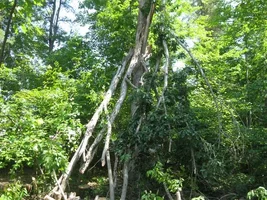
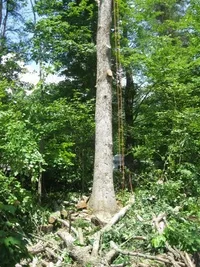
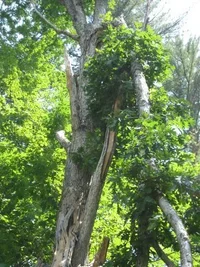
These pics are from a White Oak that was damaged in a storm here in NH a little while ago. The owners wanted all the damage cut out of the tree and left on the ground. This was once a beautiful tree on the edge of their woods line.

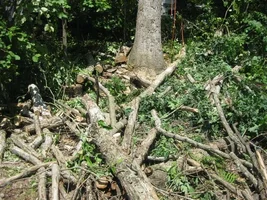
I started on the ground (knowing that I was soon be going to climb it) removing some of the tension wood from the leaders that were still connected to the tree, but soon realized that this was not going to work out, as the cuts were causing way too much movement of the limbs and that they could slide down on me at any moment…..not the best area to be cutting from. Yes, I was aware of the potential hazards, but wanted to get some wood out of the way first.

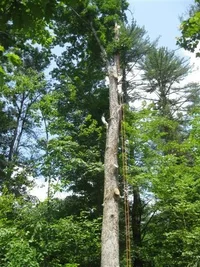
I decided that it was just best to get a high TIP, and descend down to the damage and limb it out from there.

Here’s one of the broken leaders that is hard to tell how strongly secured it still is
 

Attachments

  • 285981-hangingleader.webp
    285981-hangingleader.webp
    67.3 KB · Views: 277
Here, you can see how high my TIP is with most of the hangers and dead wood removed. I felt a whole lot safer cutting up there than on the ground for this one.
 

Attachments

  • 285983-TIP.webp
    285983-TIP.webp
    70.1 KB · Views: 224
It looks like the branches fractured but the branch collars held. Is that true? I couldn't see any collar tear-outs. If so, that shows the strength of the tree.

Working from the bottom up is like cutting palm skirts. Ouch!

Nice pile of firewood anyway!
 
[ QUOTE ]
It looks like the branches fractured but the branch collars held. Is that true? I couldn't see any collar tear-outs. If so, that shows the strength of the tree.

[/ QUOTE ]

That’s exactly right Tom. At least I was able to make some decent collar cuts if nothing else. That White Oak is sure strong wood.
 
[ QUOTE ]
[ QUOTE ]
It looks like the branches fractured but the branch collars held. Is that true? I couldn't see any collar tear-outs. If so, that shows the strength of the tree.

[/ QUOTE ]

That’s exactly right Tom. At least I was able to make some decent collar cuts if nothing else. That White Oak is sure strong wood.

[/ QUOTE ]

This is what I've heard some researchers call the CFZ or critical fracture zone. There is some formula like two or three times the diameter of the branch out from the collar where many failures occur statistically? I'll try to find a link for more info...

jp
grin.gif
 
[ QUOTE ]

This is what I've heard some researchers call the CFZ or critical fracture zone. There is some formula like two or three times the diameter of the branch out from the collar where many failures occur statistically? I'll try to find a link for more info...

[/ QUOTE ]

http://www.ecosync.com/tdworld/Branch%20Failure%20Investigation.pdf

Lead author was the primary provocateur for Biomechanics Week. Jon may not have seen it; he was too busy working there, while i was just along for the ride. ISA is selling the cd of that experience for like $8, highly recommended.

One take-home datum from John's work: 15% reduced from the end of a branch can increase stability by 50%. Something to keep in mind when those branches sprawl toward sunshine.
wink.gif
 
This morning I read the report. The most enjoyable take-away for me is that some of the art that an experienced climbing arborist practices is now being scientifically quantified. After cleaning up broken limbs a pattern is noticed. By using the observed failure in one branch and then looking at the next one which didn't fail the arbo can add 2+2=4.

I'm certainly not wishing for a storm event to prove that my subordination pruning works but when it comes I will be anxious to do some comparisons.
 
Then there is the question of large areas of heartwood freshly exposed--how could pruning paint be wrong to try to stop cracking and drying, which is the precursor to decay?

No, Chris, I ain't sendin ya back up for those big "white eyes". just sayin...
 
On Weds. a guy lost control of his Gator and smacked into a 6" live oak. A chunk of bark was torn off. The next morning when I was told about the accident I went and got the roll of saran wrap and covered the wound. Paint might have validity but I'd probably choose some sort of latex or maybe wax like my Dad used to use when we was turning wood to slow down the drying.
 
Absolutely, wrapping is proven effective at speeding growth of callus across wounds. For 6" trees it's straightforward; for 16" shaggy barked white oaks, sealant may be more practical.

Application on pruning wounds is for the same reason as on log ends--prevent drying out of exposed tissue. The challenge is to find something thin enough to stick and not bubble out, as Shigo noted with the old asphalt formulations, yet thick enough so that repeated reapplication is not needed.

Still working on that one...reapplication takes time, and the benefit/cost ratio can leave clients scratching heads.
 

New threads New posts

Back
Top Bottom