












Navigation
Install the app
How to install the app on iOS
Follow along with the video below to see how to install our site as a web app on your home screen.
Note: This feature may not be available in some browsers.
More options
You are using an out of date browser. It may not display this or other websites correctly.
You should upgrade or use an alternative browser.
You should upgrade or use an alternative browser.
Sticht Hitch
- Thread starter Brocky
- Start date


dspacio
Branched out member
- Location
- Narragansett Bay
It's innovative for someone who may only need to get up in a tree a handful of times a year, without laying out big money, and using lightweight gear. The redundancies are great for someone who isn't in the regular habit, just in case.He doesn’t use devices, other than carabiners, or an extra lanyard. It’s a safe enough system for beginners that only need to ascend to 20-30 feet.
With so much length in the hitch, it does seem like it could get tight and out of order if one was really climbing around on it.
It's innovative for someone who may only need to get up in a tree a handful of times a year, without laying out big money, and using lightweight gear. The redundancies are great for someone who isn't in the regular habit, just in case.
With so much length in the hitch, it does seem like it could get tight and out of order if one was really climbing around on it.

First time poster. Just wanted to chime in to say thank you @Brocky for creating Sticht Hitch.
I've been playing around with this and I think I've found the right combination.
The gears I use: KM3 10.5mm / Armor Prus 8mm / DMM 28mm ring / Stainless Shackle / and Hitch Climber
Descent on the hitch is smooth as butter and tends so easily that I don't even need a chest harness when footlocking (on a rock climbing harness, though).
Overall it's a great hitch for SRT when dialed in right, especially for a rec climber like myself.
Edit: The ring was 28mm not 26mm. And 8mm Ocean polly works as well.
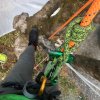
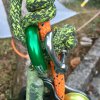
I've been playing around with this and I think I've found the right combination.
The gears I use: KM3 10.5mm / Armor Prus 8mm / DMM 28mm ring / Stainless Shackle / and Hitch Climber
Descent on the hitch is smooth as butter and tends so easily that I don't even need a chest harness when footlocking (on a rock climbing harness, though).
Overall it's a great hitch for SRT when dialed in right, especially for a rec climber like myself.
Edit: The ring was 28mm not 26mm. And 8mm Ocean polly works as well.
Last edited:
That's 30".@kany22 what length is that 8mm armor prus hitch cord?
Glad it’s working for you, slightly cheaper option to get into SRT.
Looks like the DMM ring might be too small, the top and bottom sections of cord are too close to each other, not allowing the twist to touch the rope. This causes a V rather than a U shape of the top and bottom pairs of cord sections which adds more unneeded friction. The shackle and pulley probably helps, but I find a pulley isn’t usually needed as it helps very little with the tending. You could try switching the ring and shackle to see if it improves things.
Looks like the DMM ring might be too small, the top and bottom sections of cord are too close to each other, not allowing the twist to touch the rope. This causes a V rather than a U shape of the top and bottom pairs of cord sections which adds more unneeded friction. The shackle and pulley probably helps, but I find a pulley isn’t usually needed as it helps very little with the tending. You could try switching the ring and shackle to see if it improves things.
Thank you for your insight. So far it seems to work well for me but there're still many things to try and learn obviously. I hope this hitch will be tested more widely and taught as the go-to hitch for SRT someday.Glad it’s working for you, slightly cheaper option to get into SRT.
Looks like the DMM ring might be too small, the top and bottom sections of cord are too close to each other, not allowing the twist to touch the rope. This causes a V rather than a U shape of the top and bottom pairs of cord sections which adds more unneeded friction. The shackle and pulley probably helps, but I find a pulley isn’t usually needed as it helps very little with the tending. You could try switching the ring and shackle to see if it improves things.
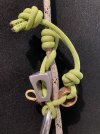
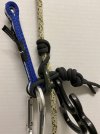 I thought someone had posted up a picture of using the Sticht in MRS with the rope attached to a tending ring, maybe deleted ? A similar method was used with fixed side pulleys back in the day. What was shown would work but the hitch is being tightened at the same time working against you. The front ring is the best place to attach a tender with the carabiner being the second.
Did you choose the black figure 8 on purpose on the back U twist rather than the brass pipe for some reasons?View attachment 80086I thought someone had posted up a picture of using the Sticht in MRS with the rope attached to a tending ring, maybe deleted ? A similar method was used with fixed side pulleys back in the day. What was shown would work but the hitch is being tightened at the same time working against you. The front ring is the best place to attach a tender with the carabiner being the second.
snunyabizness
New member
- Location
- portland, oregon
I wonder if there is a way to effectively use the dogbone from the hitch hiker device with the sticht and force a bend in the rope, or maybe a clamping effect
I'd try putting a dogbone between the twist and rope and finish off with stopper knots. If that makes sense.I wonder if there is a way to effectively use the dogbone from the hitch hiker device with the sticht and force a bend in the rope, or maybe a clamping effect
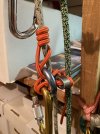 The bone between the twist and rope worked, but harder to release the hitch. There was just pinching, the slight bend with ring use makes a difference. However pulling the rope through the ring and putting the dogbone in front created too much friction, wouldn’t budge.
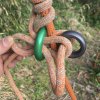
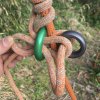
I, too, find adding a slight bend with two rings works the best with the ring on the back placed perpendicular to the front one. The twist makes the ring wobble, though, like some of you mentioned, so I put the back ring between a bight and let the tails through it.
The ring stays in place, and the hitch doesn't seem to bind, at least for me.
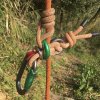
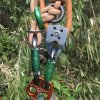
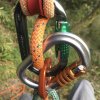
DMM 28mm ring / SMC rigging ring / 8mm epi / KM3 10.5mm / Pinto spacer / Stainless ring for tending
Sticht in action
The SMC rigging ring is perfect because of its flat surface, which works just like a pulley. I put a pinto spacer between the eyes to reduce the rope on rope friction when adding a carabiner rappel blake for longer descents.
It doesn't work well with 3:1, which I occasionally use, but I can always add a pulley, so not a big deal.
EDIT:
I should also add that the size of the front ring is key. It'll make space for the back ring to wobble if it's too big. The ideal inner diameter of the front ring would be around: Rope diameter + Hitch cord diameter x2 = 28 mm in my case.
That said, a few mm of the difference is not an issue. I've tried a 34mm, it works just as well.
The ring stays in place, and the hitch doesn't seem to bind, at least for me.
DMM 28mm ring / SMC rigging ring / 8mm epi / KM3 10.5mm / Pinto spacer / Stainless ring for tending
Sticht in action
The SMC rigging ring is perfect because of its flat surface, which works just like a pulley. I put a pinto spacer between the eyes to reduce the rope on rope friction when adding a carabiner rappel blake for longer descents.
It doesn't work well with 3:1, which I occasionally use, but I can always add a pulley, so not a big deal.
EDIT:
I should also add that the size of the front ring is key. It'll make space for the back ring to wobble if it's too big. The ideal inner diameter of the front ring would be around: Rope diameter + Hitch cord diameter x2 = 28 mm in my case.
That said, a few mm of the difference is not an issue. I've tried a 34mm, it works just as well.
Attachments

Last edited:
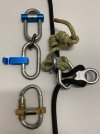 I see you like putting the twist inside the ring, I usually put the first crossing on top. The stopper being able to be wiggled while loaded shows that it doesn’t see much tension, making it possible to maybe only use one overhand.
 Replace the back ring for a figure 8 for adding friction and you can eliminate the break bar carabiner, which just about everyone says you’ll die if used. Commercially made break bars by CMI and one by me.
No, I mean I got rid of the twist altogether. The back ring is placed between bights and pinched with legs coming from the eye. The legs are then twisted before the stopper knot.I see you like putting the twist inside the ring, I usually put the first crossing on top. The stopper being able to be wiggled while loaded shows that it doesn’t see much tension, making it possible to maybe only use one overhand.
Replace the back ring for a figure 8 for adding friction and you can eliminate the break bar carabiner, which just about everyone says you’ll die if used. Commercially made break bars by CMI and one by me.
Hard to tell through pictures, though. I should probably make a video.
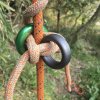

Thanks for the heads up about the carabiner blake. Didn't know it was a bad habit. Because of the wear it creates, I guess? I don't think I can make a blake bar myself and putting F8 kind of defeats the purpose of such a compact, lightweight system, so I'll look into using rollclip or something to reduce wear.
Last edited:
Thanks, I see what you mean, it might start binding with prolonged use, the twist, or a knot prevents the wraps from tightening up.
Forgot to be mention last post your use of the spacer to protect the eyes from wear, much better than the Petzl plastic sheave I tried in the past.
The fear of brake bars are not based on current gear, but unrated, probably weaker carabiners in the past. I don’t use them as I couldn’t get them to generate as much friction as I wanted.
Also tested the back ring compared to large and small bushings for the same use, the smaller ones seemed the best for less friction when tending. Otherwise about the same, except ring is hard to position directly on the rope.
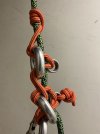
Putting two of the lower sections of the Sticht in series made releasing even easier, to the point there is a slight delay after compressing the wraps before moving. Picture below, iPhone got stubborn after last update, will only put picture at top, can’t write anything above, even in edit.
Forgot to be mention last post your use of the spacer to protect the eyes from wear, much better than the Petzl plastic sheave I tried in the past.
The fear of brake bars are not based on current gear, but unrated, probably weaker carabiners in the past. I don’t use them as I couldn’t get them to generate as much friction as I wanted.
Also tested the back ring compared to large and small bushings for the same use, the smaller ones seemed the best for less friction when tending. Otherwise about the same, except ring is hard to position directly on the rope.
Putting two of the lower sections of the Sticht in series made releasing even easier, to the point there is a slight delay after compressing the wraps before moving. Picture below, iPhone got stubborn after last update, will only put picture at top, can’t write anything above, even in edit.
Last edited:
It might. I haven't noticed it, but I'm a fairly light climber, so it'd be great if someone here could try it and report back. (Low and slow, of course!)Thanks, I see what you mean, it might start binding with prolonged use, the twist, or a knot prevents the wraps from tightening up.
Forgot to be mention last post your use of the spacer to protect the eyes from wear, much better than the Petzl plastic sheave I tried in the past.
The fear of brake bars are not based on current gear, but unrated, probably weaker carabiners in the past. I don’t use them as I couldn’t get them to generate as much friction as I wanted.
Also tested the back ring compared to large and small bushings for the same use, the smaller ones seemed the best for less friction when tending. Otherwise about the same, except ring is hard to position directly on the rope.
Putting two of the lower sections of the Sticht in series made releasing even easier, to the point there is a slight delay after compressing the wraps before moving. Picture below, iPhone got stubborn after last update, will only put picture at top, can’t write anything above, even in edit.
The twist, especially the upper one, seems to make hand tending harder for some reason, hence my alteration. It works like the side plates of a pulley, even for a bigger ring.
I'm sure you and others will come up with a simple, refined solution to add more metal on rope friction when descending while maintaining easy tending. Using a bigger back ring with a larger surface area was my intention, but it can be better. Just my 2 cents.












New threads New posts
-
test
-
-
-
-
 Light 14 or 16" narrow kerf bar for 200t or 201t
- Started by southsoundtree
- Replies: 9
-

-








