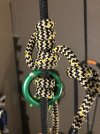
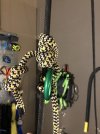
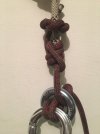
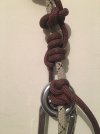
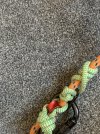
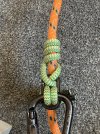
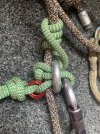
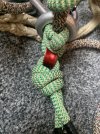
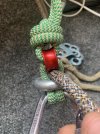
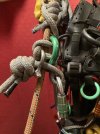
Sticht Hitch

I should probably just use the hitch climber and attach to the upper points. I don’t really use it for mrs because my climbing line is not spliced so this would be a good place for it. Have you used this hitch while on the job yet? Do you prefer it over any other srs techniques?
 
Have you used this hitch while on the job yet? Do you prefer it over any other srs techniques?
I have used the stitch hitch on the job. I tend to use my Hitch Hiker 2 as my go to system for both DdRT/MRS and SRT/SRS. I find it slightly easier to set up consistently and quickly.

However, I have it as my primary adjuster on my lanyard. Once set up it is smooth and consistent and allows use as a lanyard positioner and a choker tie off as a short secondary SRT. Really smooth tending in both situations once set up correctly (i.e. the length adjusted of the legs between the wraps and the crossover at the ring). You may need to message the wraps occasionally if it bites hard. There is a little sit back, but not much.

I also have a stitch hitch set up for my captain hook on the end of my long lanyard. Works effectively as a secondary tie off and for traversing between leads and trees.

I also keep a hitch cord and ring on my saddle for setting up a second system using the stitch hitch for both DdRT and SRT either on my tail or on a second line. Hard to beat having such a complete system with such little and light gear and at such little cost.
 
DA0A16D4-8D40-4C6A-9608-50112CD4C9AF.jpeg858226C5-A034-4B94-826B-0B8340FD9B95.jpegD1DFEE55-68E8-4E04-B970-F35777AF3F7E.jpeg
Works okay. Needs some improvement, posting in case someone wants to make it better. I have been using the normal stitch hitch as a lanyard adjuster with Yale safari and 8mm beeline. Very intuitive.
 
I played with the Blake’s for SRT awhile back, think I came up with something similar to yours, don’t know if it might start binding up with multiple cycles of loading and unloading.
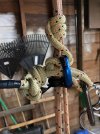
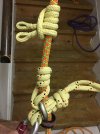
Ending with one eye seemed to make it twist around the rope when descending. Gave it a two eye finish to put a twist in the back. Needs better stopper than in pictures, had a long tail so made a twisted loop above hitch for compressing the wraps. Hand tends easily as pictured, could add a brass band at the twist, to bring the tail from eyes through it to get stopper away from moving rope. More playing needed, or to make it sound important, more research and development.
E3D3B251-D821-456B-B40B-A56A0545D50E.jpegE26E7149-A923-41D7-AE4D-4B0137158A93.jpeg
 
Been a while, sticht with XSRE and pinto spacer combo. Spacer works good as a tender, groove holds the rope well.
 

Attachments

  • 44642384-1815-4716-A516-FEC0F66B782B.jpeg
    44642384-1815-4716-A516-FEC0F66B782B.jpeg
    927.3 KB · Views: 162
  • 01CC3AEF-2C2E-4F51-A0B3-7FB3B5AF612D.jpeg
    01CC3AEF-2C2E-4F51-A0B3-7FB3B5AF612D.jpeg
    913.2 KB · Views: 155
  • 6BF88901-222A-4329-B833-8CD4D1260C32.jpeg
    6BF88901-222A-4329-B833-8CD4D1260C32.jpeg
    740.3 KB · Views: 158
The spacer looks like a good option, doesn’t have the deeper groove of a rigging ring! Are you finding that the single overhand is enough? When using a similar tender I can wiggle it when loaded.
 
The spacer looks like a good option, doesn’t have the deeper groove of a rigging ring! Are you finding that the single overhand is enough? When using a similar tender I can wiggle it when loaded.
I threaded each leg through the hole in the spacer before tying the over hand knot so I could tension it up, it does wiggle a bit but it stays where it needs to.
I thought the large contact area in the ring would add too much friction for it to be a nice tender.
 
When tightening the legs through the spacer first and then loading the hitch means there isn’t much pull on the overhand, I only tied it that way because of the length of the cord. The spacer works good as a tender because you can get good tension on the legs to lock it in place, it could lose some tension after climbing on it though.
 

Attachments

  • 8AD24554-F73F-482A-8A6C-2982E842417C.jpeg
    8AD24554-F73F-482A-8A6C-2982E842417C.jpeg
    761.2 KB · Views: 79
  • 292583A8-1627-4DFE-BCBB-974AEFB2DC79.jpeg
    292583A8-1627-4DFE-BCBB-974AEFB2DC79.jpeg
    636.1 KB · Views: 70
  • 20B85D25-0D3B-4DDC-9267-DA5E4358C7F8.jpeg
    20B85D25-0D3B-4DDC-9267-DA5E4358C7F8.jpeg
    483.1 KB · Views: 78
Love the sticht! Totally changed my life already. Here’s my preferred version so far. The shackle stays in place well, amazing tending. But honestly the basic version with only the single ring is pretty close to being on par with this as well. Such a great concept.
 

Attachments

  • 664D7748-4671-4534-89D8-C5DFA5AC3D45.jpeg
    664D7748-4671-4534-89D8-C5DFA5AC3D45.jpeg
    523.7 KB · Views: 101
What is this sorcery....
This is a hitch that easily releases and can be used to descend in control manner. As Lupin stated there is a basic form and other improvements increase performance by small increments. There is also a way to include the tender in the hitch, and a different way of making the hitch cord eyes by tying a stopper knot at the end of the hitch.
It’s a cheap way to get into SRT, it needs a method of descending quickly, like figure eight device, belay tube, or Munter, etc.
 
This is a hitch that easily releases and can be used to descend in control manner. As Lupin stated there is a basic form and other improvements increase performance by small increments. There is also a way to include the tender in the hitch, and a different way of making the hitch cord eyes by tying a stopper knot at the end of the hitch.
It’s a cheap way to get into SRT, it needs a method of descending quickly, like figure eight device, belay tube, or Munter, etc.
Ive been looking back on the conversation and it’s quite fascinating. Thanks for sharing! I’ll need to play around with this sometime.
 
Sticht is slowly replacing all my other climbing setups lol. The RIT is my current lanyard. I think the next step for that one is to find a slightly smaller ring. Seems to be an odd medium size on the tree websites for a ring at least. Larger chord is a lot easier to adjust, can do it aloft to remove sit back on the fly without untying the knot fully.

The thimble underneath for hand tending seems to be ideal for me. The 8mm viper is my 70 foot spar setup which replaced a hitchhiker. It also gets me in the habit of actually using a figure 8 so good development all around :b
 

Attachments

  • 46C640D8-CDD7-49F1-98FB-0814AE5B5E08.jpeg
    46C640D8-CDD7-49F1-98FB-0814AE5B5E08.jpeg
    562.6 KB · Views: 130
  • 75A65045-C77D-48E9-BDEC-141B6FDD43CA.jpeg
    75A65045-C77D-48E9-BDEC-141B6FDD43CA.jpeg
    480.6 KB · Views: 121
Last edited:
Seems to be an odd medium size on the tree websites for a ring at least.
Try looking for rappelling rings, I've seen a decent amount of size variation in them. I've been using a Camp ring (34mm ID, 54mm OD), it was ~$12. It works great with my 8mm beeline and 11mm kernmaster.

You cannot beat this hitch for SRT. It's cheap, it's easy to tie, and with the right cord, ring size, and stitch hitch variation it's infinitely configurable. Alone it is better than the rope wrench with all the hitches I've tried in my setup.

The rope wrench/stitch hitch combo is my favorite. You can use bulk cord by tying a stopper knot in the back (~4ft), it's effortless to tend, and I couldn't get it to bind. When I was testing it, I took some ~F0.1 to F0.25 falls on it or collapsed the hitch completely for free fall for ~1ft to 5ft and let it engage hard. Nothing made it lock up. It is near effortless to start descending again.
 
Last edited:
@Lupin_IV, if you go with a smaller ring it might force the twist up off the rope causing the two cord sections on the top and bottom of the twist to be more like a V rather than a U. The V shape will cause friction that’s not needed as the rope gets wedged into this V shape.

A separate suggestion would be to combine your two tending systems into just one.
 
@Lupin_IV, if you go with a smaller ring it might force the twist up off the rope causing the two cord sections on the top and bottom of the twist to be more like a V rather than a U. The V shape will cause friction that’s not needed as the rope gets wedged into this V shape.

A separate suggestion would be to combine your two tending systems into just one.
Smaller than the 24” isc? Or is that too small even?

I liked both the standard DMM size that comes with the TM and the blue pictured but thought they seemed ever so slightly floppy. Acceptable but felt like it could be improved.
 
The small ISC ring is about the smallest the 9mm will fit through, had to fiddle a little to get the second end through. Adjusting is harder the tighter the fit though.
546843DD-DAB5-4260-BADB-5AE90CF70D5E.jpeg
 
The small ISC ring is about the smallest the 9mm will fit through, had to fiddle a little to get the second end through. Adjusting is harder the tighter the fit though.
View attachment 76303
Right on. I’ve been using the small isc ring for 8mm and the blue 40mm for 9mm+. The camp ring sounds like the size I’m looking for to replace the blue ring for larger chord.
 
this seems to be the ticket for a pulley in prelim testing! Hand tending is completely effortless once you pass the 45 degree mark. Adds a little bit of length to the system but the gain seems worth it. I could never get the HC pulley to work, would rotate and really mess with descent and upward tending was weird. The ring drops right into the groove with the ct pulley (this all may have been discussed, excuse redundancy if it has). Only worry is the slight bend between the ring and where it enters the pulley for descent but seems ok. 100% on par with a rope runner IMO.
 
Last edited:

New threads New posts

Kask Stihl NORTHEASTERN Arborists Wesspur TreeStuff.com Teufelberger Westminster X-Rigging Teufelberger
Back
Top Bottom