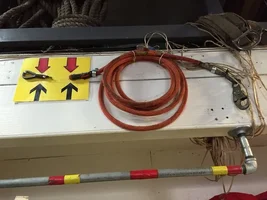
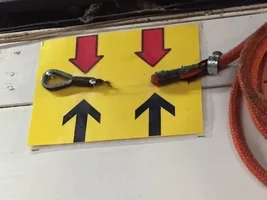
Steel core lanyard failure.

I don't know about that.
It looks like the two metal collars butt up against each other and the wire pulled out from both. Might give no warning at all even if it was clear heat shrink.

Tragic. Very sorry to hear about this.


While you might not be able to see the strands fraying perhaps, im confident the clear tubing would begin to collect rust residue as the strands corrode. After the tubing goes from nice and clear to being caked with rust that would be a good sign that the core is corroding severely. If not enough reason to retire immediately, then perhaps enough to warrant removing the covering and do a more thorough inspection.

-Steven
 
Some revelations have come from the ongoing investigation into the tragic death of a Vancouver area Arborist:
- The particular lanyard that failed had snaps that were not a swivel type - there is potential for flex fatigue. In this case, just after the crimp - but could also be between the thimble and the crimp.
- Black heatshrink over lanyard crimps prevents inspection of the described area of concern.

Another local Arborist cut off the heatshrink shortly after the information was spread to local companies from the investigation (which I will attach below). Please don't hesitate to share this information with your coworkers and colleagues. We are devastated by the loss of our dear friend.

Well, I contacted my friend in California and asked if he had pictures of the steel core lanyard/flipline that broke on his climber.

He just texted them to me.

Looks like the same STYLE of NON-swivel type.

This one made by US Rigging.

He said he told US Rigging and every tree person he knows about this problem.

I can give anyone involved with the investigation his contact information.

Posting here the two pictures he sent me.IMG_6412.webp IMG_6413.webp
It looks like he must have this displayed on his wall in his shop to remind workers to retire and inspect their lanyards.

This whole thing reminds me I gotta post about something that happened to me this summer, just in case it might save a life someday. I didn't want to hurt the manufacturers sales, I might do an article in TCIA mag and here and just not exactly name the products involved, I've been thinking on it a long time.

Also, back to the subject, I want to talk more on this steel core lanyard stuff and show my lanyards. Time to retire them.

Lanyard makers might need to make statements, to retire steel core lanyards after 2 years in wet climates and 4 years in dry climates. I'm not sure exactly on the years, I'm just making an example.

I have to run to a meeting now. more later
 
Though my steel-core lanyards have swivel snaps and have never been in the rain, the humidity levels here can be oppressive. The idea of clear tubing may be OK for some, but it still fails to provide any indication of what's happening to the steel core beneath the porous outer layer. After reading about this tragedy, and wondering about the condition of my steel-cores, I've decided to stop using steel-core lanyards for any type of life support. Rope lanyards don't rust, and the exterior surface is always visible for inspection.
 
Why use a rope cover? Wire rope on cranes are constantly in bad weather(rain, humidity, etc.) and they don't rust through(I know there are probably some examples out there that have due to extremely poor maintenance). I think the huge problem with these is simply that they can't dry out, the rope cover and shrink wrap hold in the moisture for longer than what the wire rope would experience in open air.
 
Well, I contacted my friend in California and asked if he had pictures of the steel core lanyard/flipline that broke on his climber.

He just texted them to me.

Looks like the same STYLE of NON-swivel type.

This one made by US Rigging.

He said he told US Rigging and every tree person he knows about this problem.

I can give anyone involved with the investigation his contact information.

Posting here the two pictures he sent me.View attachment 30906 View attachment 30907
It looks like he must have this displayed on his wall in his shop to remind workers to retire and inspect their lanyards.

This whole thing reminds me I gotta post about something that happened to me this summer, just in case it might save a life someday. I didn't want to hurt the manufacturers sales, I might do an article in TCIA mag and here and just not exactly name the products involved, I've been thinking on it a long time.

Also, back to the subject, I want to talk more on this steel core lanyard stuff and show my lanyards. Time to retire them.

Lanyard makers might need to make statements, to retire steel core lanyards after 2 years in wet climates and 4 years in dry climates. I'm not sure exactly on the years, I'm just making an example.

I have to run to a meeting now. more later
That lanyard does not look very old at all. Also it looks like the climber was clipped into the tail end of the flip line, probably in an attempt to distribute wear.
 
That lanyard does not look very old at all. Also it looks like the climber was clipped into the tail end of the flip line, probably in an attempt to distribute wear.
Good point the grab should be in front of that loop. That loop's just to hold the tail up. Unless it's a double ended lanyard.
 
That lanyard does not look very old at all. Also it looks like the climber was clipped into the tail end of the flip line, probably in an attempt to distribute wear.
They climb some huge Eucs. I asked him tonight, he said the tree was very large so the climber used the whole lanyard, used a biner attached to that eye. ( likely to another lanyard). after the break, he made sure he asked that both eyes are made to the same and can be used. He was told yes, both eyes are the same.
 
20150312_193259resize.webp
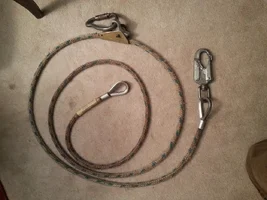
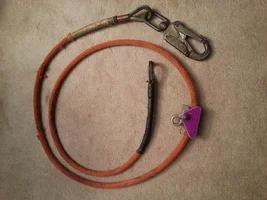
This is my personal steel core lanyard. Date says 2008. I thought I could use forever, as long as it looked good on the outside. Now I'll retire it. Going to pull test it to about 4,000 lbs (cause that's all my little rock exotica dynometer can handle), then I'll cut the swage ferrell off and inspect under that and under the rope.

This is the other cheaper one we have, was for a co-worker climber.
20150312_193501resize.webp
by the way, when clear shrink tubing gets older, you can't see through it anyway. Might be interesting under that black. Hope to have a shorter work day and do this tomorrow.
 
I threw away 2 steel cores we had in the trucks after this incident. I kept the 6 month old, hardly used Maxi-flip of course. We hardly ever use them anyway but the other ones are in the garbage.

_BEN
 
I also happened to have a Maryland Arborist Association meeting today, I brought this up. Two very large (well known) companies said they also heard about this death and the entire company threw ALL of their steel core lanyards away.
 
A new Maxiflip should be in my next Treestuff order. There are enough things on my mind While I am climbing, worrying about my lanyard should not be one of them.
 
View attachment 30917
This is my personal steel core lanyard. Date says 2008. I thought I could use forever, as long as it looked good on the outside. Now I'll retire it. Going to pull test it to about 4,000 lbs (cause that's all my little rock exotica dynometer can handle), then I'll cut the swage ferrell off and inspect under that and under the rope.

This is the other cheaper one we have, was for a co-worker climber.
View attachment 30918
by the way, when clear shrink tubing gets older, you can't see through it anyway. Might be interesting under that black. Hope to have a shorter work day and do this tomorrow.
The lower picture is what we run
 
View attachment 30917
This is my personal steel core lanyard. Date says 2008. I thought I could use forever, as long as it looked good on the outside. Now I'll retire it. Going to pull test it to about 4,000 lbs (cause that's all my little rock exotica dynometer can handle), then I'll cut the swage ferrell off and inspect under that and under the rope.

This is the other cheaper one we have, was for a co-worker climber.
View attachment 30918
by the way, when clear shrink tubing gets older, you can't see through it anyway. Might be interesting under that black. Hope to have a shorter work day and do this tomorrow.
How long do you think a clear plastic would stay transparent? If its 1 year that's a problem if it's 3-5 that could be a guide line for a new one
 
How long do you think a clear plastic would stay transparent? If its 1 year that's a problem if it's 3-5 that could be a guide line for a new one
I would imagine most clear would stay good for at least 3 years. Clear would help a person to see some of the cable. but where the rope covers the cable and the cable swage, that is the blind area you can never see. also likely contains fine dirt and dust under it and moisture.

I don't see a purpose for the shrink wrap at all anyway, except to make a nice appearance. perhaps it will slow down the process of a cable strand from sticking out and prinking someone; but maybe if it gets that old, it would be better to see and feel that.
 
I like the maxiflip but I don't see that it comes with a swivel snap.
Where are you looking? Maxi 5/8 is all I use now and I have a hard time finding them without swivel snaps.

By the way 'work hardening' is the bigger culprit. That doesn't take time it takes cycles to failure. Bend a piece of wire back and forth in the same place and it will break. Aluminium 5 or 8 cycles, mild steel like a coat hanger 15 to 20 cycles, strands of cable?
 
Yeah, I found it. I was mistaken. I ordered one yesterday. My current one was bought Nov 2014 but I can already see steel through the jacket. I also retired my 15 year old 12'-er. I have gone to maxi-flip in the hopes the jacket lasts longer as the alternative treestuff sells hasn't lasted for me. I have also decided to go back to the tri tech as my primary lanyard and will go with the cinch instead of a prussic and see how it works with sap. I have never really liked steel core but always had that false sense of security with it. My super custom double end tritech ce lanyard knock off I had made by treestuff was showing wear after a year and the sap made it a hassle to operate so I went back to steel core. I hope the trango fixes that issue for me.
 
I would imagine most clear would stay good for at least 3 years. Clear would help a person to see some of the cable. but where the rope covers the cable and the cable swage, that is the blind area you can never see. also likely contains fine dirt and dust under it and moisture.

I don't see a purpose for the shrink wrap at all anyway, except to make a nice appearance. perhaps it will slow down the process of a cable strand from sticking out and prinking someone; but maybe if it gets that old, it would be better to see and feel that.

Would the splice area not be the most common area of concern? Where the splice tails out or where the crimps are. I think the rope covers are still a good idea for micro grab/ prussic attachments, bark protection and for your hands it makes it nicer. But even 3-4" on each end would give more length to inspect.

Cable swag what are you referring to?
 
Sorry to hear about this.
I agree with xman, why cover it at all. It limits drying out. Or it attempts to seal, but then once it's cracked it can let water in and holds it in. And like x said, under the swage or wire crimp doesn't dry. So is this a problem of repetitions of bending or rust or both in combination? The repetitive bending could be improved by increasing the distance the cable is bare for. Not too much for workability reasons. But 3 inch instead of 1.5 maybe. Maybe totally unpractical. But When a short section bends there is tighter bending and reduced flexibility. Or a 3/16 nylon throw line like material as a core? Not that you want to look down and see your life on that. Maybe a steel core with different properties? More flexibility and less hard. Let the outer portion fend the saw? I'm not a scientist but that short distance for bending is an issue, no? Even though you'd expect it doesn't bend much?


Sent from my iPhone using Tapatalk
 

New threads New posts

Back
Top Bottom