SRT ELS

DSMc

Been here much more than a while
Location
Montana
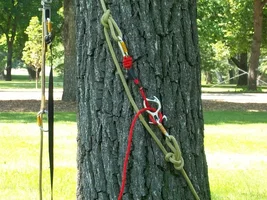
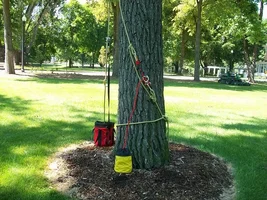
Thought I would post this here and let you all critique it. I hope the pictures are self-explanatory. You could substitute the Pirana with the belay device of your choice. But what I like about this is that 100 ft of 3/8" Kernmantle, rated for 5700 lbs, and the attachments fit in a small throw line bag.

This actually does not have to be attached each time you climb, just be readily available. It requires the climber to pretie two attachment loops prior to going aloft. The climbing line becomes its own anchor for rescue system.

This allows me to move quickly from tree to tree without dragging a tangle of gear with me.

Dave
 

Attachments

  • 185793-ELS.webp
    185793-ELS.webp
    174 KB · Views: 398
Emergency Lowering System??? ELS

It looks like the green rope in the system would have to be cut in order to lower the victim. If that's so I would have a good pair of paramedic shears or maybe handpruners tethered to the rope bag. Relying on someone using a knife is asking for both ropes to be cut.
 
Yes, Emergency Lowering System.

What I was trying to accomplish was a system that did not require complex, and time consuming, setup each and every time you worked SRT. The only thing additional that needs to be done here, is to tie two additional alpine butterflies on your anchored rope.

Because this is an EMERGENCY lowering system, one would expect it to be rarely, if ever, used. So the cutting of the rope seems like a reasonable alternative to a less secure but more complex arrangement that would require being tied every time.

An SRT anchored in this manner is secure with no worries of accidental disengagement.

Felcos are the preferred cutting tool.

Dave
 
DMSc,
I would have to say that if this is the system that you are trying to go for the only thing I would change is the butterfly knots. I would replace them with directional eights. always try using the a purpose knot for its purpose.

Question for you. I understand that you are trying to keep things smooth with regards to smooth being fast.Have you ever tried a mini port-a-wrap in replace of the eight. Then off to the side have a pre rigged 3:1 or 4:1 that can be snaped onto the port-a-wrap and to the line in seconds.
This would allow the rescue climber to not have to worry about cutting a line lowering themselfs back down.


Also have you ever gave the thought that if the line that the victim is on is not compramised to attach last stated rigging above to the victims line, climb up to the vic and only cut the hitch that they are climbing on, now the groundie can still lower the vic down and rescue climber can guide if needed. Does your company or crew drill on rescue or is it a hasty hope it wont be needed type thing ( not saying you or your company slacks in anyway)
.
 
Thanks for the thoughtful critique. You bring up some good points.

I'll start with your last thought first. My thoughts on the ELS is not to replace rescue training but to augment a rescue scenario and also to create ground rescue ability/possibility for many of the small companies that are working with just one primary climber. We fit into this category.

Whereas an ELS has its limitations, it is certainly a good system to have in place and could be of assistance in any rescue situation.

On the Port-a-Wrap. Yes I have used a dedicated port-a-wrap for quite awhile when using floating false crotch in doubled rope situations. For SRT I find it more cumbersome than this ELS package pictured.

I was trying to achieve a single rope ELS-friendly system that a climber would actually use and not slow them down due to being too complicated and/or time consuming to set up when a great attribute of SRT is simplicity.

I like the recommendation of the directional 8s. Might give that a try. I have been happy with the alpine butterflies due to their ability to withstand loading in the direction of use of the rope and their ease of untieing once loaded.


Dave
 
i believe an Alpine Butterfly is best/maximized when eye is pulled perpendicular to the line/not inline; and also with both legs loaded evenly(or deforms to compromise percentage tensile and untieability more), with the eye loaded same/less/if at all (as the legs). This then carries over to using same mechanic for mending or single/ multi bending (called Butterfly or Strait Bend) etc. That doesn't mean that it can't be used otherwise; just that it is more mechanically compromised than an inline 8,9 or 10. Should consider loadings, damage potentials, stiffness of line etc. to make best choice of speed (ButterFly) over power/remaining tensile(?).

i wouldn't go with cutting scenario, tool to be found and applied correctly. Just sling friction device to trunk and to then reeve lifeline thru directly, and lock off. In emergency take hard lock down to soft lock; then dial in lowering friction quantity. Also man or mechainc power for lift is good to have avail. in case gets hung up, passes out straddling something etc. This is when it is especially good to have friction device lower on anchor (assuming not horizontally applied); so can take longer pulls on a tensioning for faster rig tightening or load lifting etc.
 
Thanks for your time, Spyder. I can easily see that the in-line 8 is better configured for the direction of the pull. I will try it out. It just depends on how difficult it is to untie once loaded.

You say the Alpine butterfly is compromised strength-wise when pulled in this manner. Is this a realistic concern with the strength of our ropes, or just a note worth taking?

As far as choking off the lowering device to the base of the tree and the reeving through it and then locking off, this brings up a couple of problems I am trying to avoid.

The first being that if your climbing line is used for the rescued length you will constantly be dragging more line from each tree than is necessary in order to ensure a length of rope adequate for successful rescue.

Secondly many do not like the idea of a locked off lowering device supporting their climbing line that could be tampered with or inadvertently dislodged through tree working activities. I have used such a system and found it a bit of concern, due to the activities involved, such as slack in line, brush snagging the system. All things that could affect the lock off knot or misalign the system/components when weight is then reapplied. I find I like the security of my climbing line firmly tied.

Also remembering that a system like this may never be used. So I am quite alright that in an emergency I may lose 8 or 12 feet from the end of my climbing line. Because in all the time prior to that I will have streamlined my ability to transfer from tree to tree and still maintain a high security in a less gear-intensive way.

Dave
 
I understand the knots and everything and the need for a lowering system especially when using ground guys who do not climb. I am not really comfy with the idea of cutting ropes.
 
I think that the way I look at rescue is far diffrent then the way that alot of other climbers look at a rescue. The best way for me to discribe it is to look at it the same way as snipers in the military. The best sniper with the most experiance is never the one doing the shooting. He is the one that does the range finding and wind speed and globle postioning so on and so on. My point is that you can with little issues teach a groundie how to climb for the simple reason of rescue. In fack thats not a bad way to start new climbers in training.

The guy with the most time on a rope with the exception of the one in the tree who is not able to do much at that time, should be the one on the ground setting up the lowering. If this is possable (I know that it is not for alot of crews)then time of setting up rigging will be a non-issue do to you have a person that has done and probly can do it in his or sleep there for it. If you think about it the rescue climber only has to get to the vic attach into them and then eather have the one on the ground pic the vic's weight up off there line so you can take them on yours, or for the rescuer to cut there hitch.

Im sure my view on this is greatly diffrent then most of yous and want to make sure that you all know that I am in no way saying that what works for others is the wrong way.
 
I think rescue procedures and techniques will be as diverse as the work we do. What works outstandingly well for one company may be inappropriate for another. It is important to research and learn what will work in your situation.

There are several rescue scenarios where time is critical. The first one, and relatively common, are wasp/hornet attacks during SRT entry. Another is hemorraging that requires direct pressure by the climber to stop the flow. In both cases the climber needs to get out of there in a hurry. An ELS may be appropriate. If so, the faster it can be implemented the better for the victim.

Dave
 
[ QUOTE ]


I was trying to achieve a single rope ELS-friendly system that a climber would actually use and not slow them down due to being too complicated and/or time consuming to set up when a great attribute of SRT is simplicity.


[/ QUOTE ]


I came up with that too. Mine was simpler yet.
I had one alpine butterfly, and tied the other end of the ascent line to it. That other end becomes a lowering line. This is an ELS set up with a single rope. the running bowline has to be cut. As one end of the ascent line goes up the part you ascended on comes down and becomes lowering line.
I did this in a 2007 TCC Aerial Rescue and didn't score great. Then I heard some ITCC Master Challenge level climbers talk about it at a convention (about it being a solution for not having a 200' rope handy), and realized it was over the scoring judges heads.
My thinking was you don't have to own a lot of expensive fancy gear ( though it might work a little better) to be safe. Anybody could set this up. I don't have a 200' rope or a gri gri.
john
 
I think a large problem with the setup in the original post is the possibility that, in the event of an emergency lowering, the knot/biner combo could become snagged in a narrow crotch, preventing the climber from being lowered all the way to the ground. It is easy to see how it would happen, not easy to see how it might be rectified. It could add another dimension of difficulty to a rescue.

Why not just use a short length of rope choked around the base, install an f8 on the SRT line, tie the f8 onto the end of the choked line and lock it off. Cheap as cheap and as idiot proof and safe as it could be.
 
[ QUOTE ]
[ QUOTE ]


My thinking was you don't have to own a lot of expensive fancy gear ( though it might work a little better) to be safe. Anybody could set this up. I don't have a 200' rope or a gri gri.
john

[/ QUOTE ]

I meant...if you're gonna srt, and you don't have the other stuff handy, you could still throw in a couple old school knots for precautionary measure.
 
The f8 or any of the other belay systems choked off to the a base of a tree and used as an anchor is an excellent method. I think it is the most appropriate method if you are using an SRT access only system. These systems require a change over before descent can be accomplished. This is where the instantaneous ground lowering ability will really shine.

My thoughts on developing the ELS were that I am now using the Unicender in my single rope access system, which gives me quick access to descent without a changeover, reducing the odds of requiring a rescue on the entry.

I don't like dragging 1/3 more line than I'm going to be using to each tree when there is a lot of brush around. The ELS system allows me to use a stream-lined set up with a rescue unit compactly stored in its pouch away from the entanglements of the job. The possibilities of knot and carabiner entanglement should be considered but in most situations are easily addressed.

Remember branch structure affecting the ascending knot will be directing it away from the crotch, not towards the crotch as a descending unit would. Once the knot/carabiner combo hits the tie in point, things change dramatically. But at that point, the climber should have reached the ground.

Dave

P.S. Update: Tried the in-line 8's as suggested by others and they seem to work fine in this situation. They do not overly tighten, which was my big concern.
 
Another perk to having a system like this is that when working srt and going tree to tree or through numerous crotches and trees, it is sometimes necessary for the ground guy to feed you more line into the system in order to get down with out retracing your steps.

One can burn through 150 feet of rope real quick when going tree to tree or webbing up the tree. So its conveneient to have a system that is you dont need to grapple with a knots or wraps and you never become untied from the system. A system that you is easy to train the ground guys in.
 

New threads New posts

Back
Top Bottom