- Location
- Minneapolis
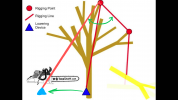
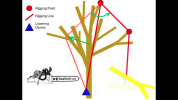
Yes - I was just trying to find the right way to ask it with some supplemental video of 'close enough' concepts.In that video, it's a little bit of a different trade-off he's looking at, with the limb walk and all; in the arrangement he's describing, he's actually directing the forces more into compressing the redirect limb (that is, more in-line with the limb) as he opens up the angle, and because he's opening up the angle, there is also a corresponding reduction in the force vector magnitude at that redirect limb as well. So, it's a win-win.
What your original post was referring to with what I imagine to be a classic basal anchor situation - straight vertical pole - is quite different; moving the anchor point away from the tree results in decreasing compression along the spar while increasing side-loading. That's not a trade-off I'd make because the spar will be stronger in compression along it's length, than being torqued by lateral force. At least, I can't think of a situation in which that isn't the case.
This is just relating to loading forces - there are other factors which might lead you to move a base anchor away from the tree being climbed. As a general guideline though: compression is good, torque/lateral-loading is bad.
Edit: I'm also just talking about a situation where you're climbing a straight spar on the rope directly below the primary support point, from which the rope departs and travels to it's terminal anchor point. Open or close angles to direct forces into compression.
Anyways, I like what you said here and I agree for the most part. I'm wondering if there's any good literature out there (similar to the angle / force vector charts) about side loading forces that I can reference to demonstrate my point to others. I don't THINK I've seen any such thing before..
Anyone know of anything like that? Currently have 5 tabs open about speedline forces, so I'd wager I stumble across something there when I get to it.