SRT Basal Anchor Forces - Should I Basal Anchor Across the Yard??

In that video, it's a little bit of a different trade-off he's looking at, with the limb walk and all; in the arrangement he's describing, he's actually directing the forces more into compressing the redirect limb (that is, more in-line with the limb) as he opens up the angle, and because he's opening up the angle, there is also a corresponding reduction in the force vector magnitude at that redirect limb as well. So, it's a win-win.

What your original post was referring to with what I imagine to be a classic basal anchor situation - straight vertical pole - is quite different; moving the anchor point away from the tree results in decreasing compression along the spar while increasing side-loading. That's not a trade-off I'd make because the spar will be stronger in compression along it's length, than being torqued by lateral force. At least, I can't think of a situation in which that isn't the case.

This is just relating to loading forces - there are other factors which might lead you to move a base anchor away from the tree being climbed. As a general guideline though: compression is good, torque/lateral-loading is bad.

Edit: I'm also just talking about a situation where you're climbing a straight spar on the rope directly below the primary support point, from which the rope departs and travels to it's terminal anchor point. Open or close angles to direct forces into compression.
Yes - I was just trying to find the right way to ask it with some supplemental video of 'close enough' concepts.

Anyways, I like what you said here and I agree for the most part. I'm wondering if there's any good literature out there (similar to the angle / force vector charts) about side loading forces that I can reference to demonstrate my point to others. I don't THINK I've seen any such thing before..

Anyone know of anything like that? Currently have 5 tabs open about speedline forces, so I'd wager I stumble across something there when I get to it.
 
Still not sure...but I think that in theory what it is would be to run the climbing line through multiple unions then tie it off in a loop. Lasso several unions and climb off this loop.

Read up on self-equalizing anchors used by rock climbers. See what happens if one of the anchors fails.

I'm reluctant to like this approach for anything but the most unusual solution. AND...this woiuld be secondary to a proper bomb-proof anchor and climbing system. A true double rope...two rope...set up.

This is a practice that would require so many annotations and footnotes if it were written into a training program. That alone is a disqualifier in my book...Occam's razor and all.
 
A base anchor, but set high in the canopy. Or, in other words, a canopy anchor that redirects higher over multiple smaller unions, with the idea being to spread the climber's load over the several smaller unions together. The friction combined with potentially more favorable load vectors at each union (compression), on paper at least, enables the safety factor obtained from climbing supported by any one of the unions alone.

Someone correct me if I've severely mucked the explanation/definition.
That's it.

Plus, it removes the base anchor from the hazards associated with the ground.

Plus, it retrieves like a canopy anchor.
 
Still not sure...but I think that in theory what it is would be to run the climbing line through multiple unions then tie it off in a loop. Lasso several unions and climb off this loop.
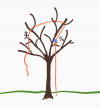
If you are referring to the canobase method, imagine knot blocking a ringed friction saver for climbing SRT. But the climbing side goes UP from the F/S, over multiple unions before it comes back down to the climber. And the F/S is choked on the upper portion of a stem instead of on a limb.

canobase.png
 
Last edited:
Believe me I've been confusing myself over this too!
Right, so think instead of moving the base anchor to a different tree, you create more open angles by moving the line outward through several unions on the opposite side of the target limb. Think of the spokes of a wheel.
 
A base anchor, but set high in the canopy. Or, in other words, a canopy anchor that redirects higher over multiple smaller unions, with the idea being to spread the climber's load over the several smaller unions together. The friction combined with potentially more favorable load vectors at each union (compression), on paper at least, enables* the safety factor obtained from climbing supported by any one of the unions alone.

Someone correct me if I've severely mucked the explanation/definition.

*Edit: increases

Canobase is a smart strategy when you want the distributed load qualities of a base anchor but you want to keep your life line away from ground and wood rigging operations.
-AJ
 
The issue of loads on the TIP has been a sticking point for me for a long time. . . . . . .

If a TIP is chosen and the climber decides that in order to use it the rigging needs change because it might fail I say the TIP is wrong. The TIP should stand on its own merits without the belt and suspender sort of thing.
Richard Hattier made a very good point in his TreeStuff rescue video years ago now - why not just first choose a more robust looking TIP or crotch, lower down and then progress up to the airy heights, so when you're up there, you can look out for havoc that nature hast wrought? Why go for the highest thing first? The sturdy lower union is your "survey station", before your final working TIP.

I'd like to see some testing/ failure research on branch unions in different tree species in an engineering test rig where they are loaded to failure, to see how much a branch collar can take if loaded in a manner that doesn't make a bending moment with the rope further out from the union. Maybe make an interesting TreeFund research project if all the variables were researched. Right now it seems we have 4" or wrist size or . . . For something so important, this should be quantified in an engineering materials study with hard numbers.
 
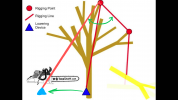
I was searching around the web for diagrams so I commandeered this one from TreeStuff. I think you (OP) are asking about opening the angle at the top to improve the force vector? And wondering if you should move the base anchor horizontally to do it, like this?
ink.png

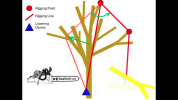
But what I was suggesting at first - and I think he's recommending it in the TreeStuff video - is just adding a redirect point to accomplish the same thing (except you're adding friction with the extra point).

ink (2).png
 
I was searching around the web for diagrams so I commandeered this one from TreeStuff. I think you (OP) are asking about opening the angle at the top to improve the force vector? And wondering if you should move the base anchor horizontally to do it, like this?
View attachment 73420

But what I was suggesting at first - and I think he's recommending it in the TreeStuff video - is just adding a redirect point to accomplish the same thing (except you're adding friction with the extra point).

View attachment 73421
Yeah pretty much exactly - sorry, which video is that exactly?

In short I think I got my answer from all yall in that...sure, you can move your basal away from the tree as long as it doesn't bring the resultant force angle away from the base of the tree / your TIP. It could make sense to do this depending on your redirect situation and it also could not, just depends.

Like someone said, too much going on here ultimately to recommend / teach to others, but useful to be aware of.

Thanks everyone for contributing - very good to brush up on some of the physics
 
... If a TIP is chosen and the climber decides that in order to use it the rigging needs change because it might fail I say the TIP is wrong. The TIP should stand on its own merits without the belt and suspender sort of thing.

We so rarely disagree that I can't help thinking that I am somehow misinterpreting the above statement.

The recognition of force vectors and how to make them work for us, is a fundamental component in tree work. It makes what we do safer. Even something as simple as limb walking is made possible because of our redirection of force to a different part of the tree instead of just relying on the strength of the branch we are on.

There is no doubt at all that a point of support within the tree that could not safely be loaded laterally, could easily do so in compression. To not utilize this knowledge in all that we do, would severely limit safety.
 
Last edited:
There is no doubt at all that a point of support within the tree that could not safely be loaded laterally, could easily do so in compression. To not utilize this knowledge in all that we do, would severely limit safety.
No disagreement.

The criteria for choosing a TIP is connected to loading. WE're all aware of the strength of wood in compression but not in a lateral load could flex or break. What is the climber demanding of the TIP? In the weak lateral load wood a main TIP down low that is bomber combined with a positioning TIP with a second rope might be the correct solution.

My issue is the thought process of synthesizing that bomber TIP using multiple unions in an attempt to get a self equalizing support. That is too dangerous to rig as a primary TIP.
 
This is the first time I heard of cano-basing as a named setup.

Not totally new to its use though. Good plan!

Gilman did some limb ripping but I'd have no clue how to find the work

ISA hosted a tree structure workshop one summer and they pulled apart some limbs using a big tow truck.
 
Richard Hattier made a very good point in his TreeStuff rescue video years ago now - why not just first choose a more robust looking TIP or crotch, lower down and then progress up to the airy heights, so when you're up there, you can look out for havoc that nature hast wrought? Why go for the highest thing first? The sturdy lower union is your "survey station", before your final working TIP.

I'd like to see some testing/ failure research on branch unions in different tree species in an engineering test rig where they are loaded to failure, to see how much a branch collar can take if loaded in a manner that doesn't make a bending moment with the rope further out from the union. Maybe make an interesting TreeFund research project if all the variables were researched. Right now it seems we have 4" or wrist size or . . . For something so important, this should be quantified in an engineering materials study with hard numbers.
Here is a start.
 

Attachments

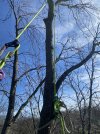
Always want to load into compression, so tie at the base of the tree your in to stay in compression. Here is a canabase which is pretty awesome allowing you to use smaller unions
 

Attachments

  • IMG_5399.JPEG
    IMG_5399.JPEG
    825.7 KB · Views: 40
Always want to load into compression, so tie at the base of the tree your in to stay in compression. Here is a canabase which is pretty awesome allowing you to use smaller unions

I'm a little puzzled how this setup allows for smaller unions. Not trying to be rude just trying to wrap my head around all of this. The stem pictured will be under greater compression due to the resultant force falling closer to the stem (as opposed to lateral force from a canopy anchor) however the load at the tip is increased and since there is less rope in the system than a regular basal anchor the system becomes much less dynamic in the event of a fall. I have used this setup many times, often as a secondary tie in. I didn't know it had a name.


*Looking at it again, having the anchor higher in the tree, as opposed to a basal anchor, would probably reduce the torque applied at the TIP so that may be an advantage.
 
Last edited:
I had a perfect use for tying off away from the tree recently. Removing a leader on a multistem pine, working entirely on that side of the tree. Base anchoring to another tree 15' away from the working side, as high as I could reach, kept the rope clean out of the action, and created that compression vector force.

I was indeed tied on a questionable point, it was a ~4" branch, looked stout, but dead, so having the rope pulling in toward the trunk a bit, rather than straight down, also helped me feel confident. There weren't other suitable branches I could throw to in the area, so I rolled with it, with extreme caution and no sudden moves on ascent. I run a double end lanyard, so I can tie in twice with that while working, not relying on the ascent line TIP for any shock.

I agree with @DSMc . it's not about trying to do the impossible, but stacking the odds in our favor.
 
Last edited:
I'm a little puzzled how this setup allows for smaller unions. Not trying to be rude just trying to wrap my head around all of this. The stem pictured will be under greater compression due to the resultant force falling closer to the stem (as opposed to lateral force from a canopy anchor) however the load at the tip is increased and since there is less rope in the system than a regular basal anchor the system becomes much less dynamic in the event of a fall. I have used this setup many times, often as a secondary tie in. I didn't know it had a name.


*Looking at it again, having the anchor higher in the tree, as opposed to a basal anchor, would probably reduce the torque applied at the TIP so that may be an advantage.
Exactly! I was very hesitant at first as it was different and new but after a good discussion with peers it makes sense. I still don’t go smaller than wrist parent stems but i do feel a lot better about them. It’s not my go to as of now but it has made the dormant oak pruning way easier on the angles.
 

New threads New posts

Kask Stihl NORTHEASTERN Arborists Wesspur TreeStuff.com Teufelberger Westminster X-Rigging Teufelberger
Back
Top Bottom