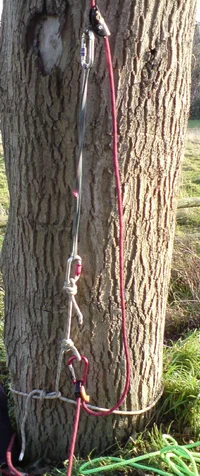
SRT Anchor

I have found in a lot of situations, I will have my anchor on another tree far away as opposed to the trunk of the same tree your climbing. this lowers rope angle at the TIP and it also gets the rope somewhat out of the way in the tree. Of course every situation is different. the downside is the rope weight can make your slack wierd.


I tend to go with the trunk wraps and and bowline option because it is the least gear intensive and works just as well as the other options.
 
mark,

depending on the length the casualty has to travel to the ground and the weight of the geezer does this not mean there is going to be alot of friction on the munters and it will be reflected of the metal work to the lowering line. i just thought itmay be a issue due to the way the munters works, if im talking rubbish then say but i thought the munters created alot of heat i think i am wrong but just want to check.
 
[ QUOTE ]
Why dont you guys just tie a running bowline to the bottom of the tree? Or choke it on an isolated limb at the top of the tree?

[/ QUOTE ]

Doing that wouldn't allow you to lower the person that is ascending to the top of the tree if they were to get into a situation that they need to be lowered right away. It's more of a safety thing.
 
My trunk wrap anchor incorporates a full wrap, or two, around the tree before the rope is snubbed off with a friction hitch configuration. By using the trunk for friction there isn't a need for a special belay tool or another sling choked at the base.

When I've tested this with people who have no rope experience they have all been able to figure out how to 'lower' me in case of an emergency.

Even skilled rope workers can have a difficult time do as good a lower using a munter, Gri-Gri or other tool. With plenty of friction on the trunk the rescuer pays out rope or walks the rope back around the trunk until just the right amount of friction is attained. This is just like lowering logs/limbs without a friction device/bollard.
 
just tie an alpine butterfly above your running bowline. If you need to be lowered your groundy just clips his/her climbing system into this, cuts below the alpine(or undoes the bowline) and lowers you down.
 
[ QUOTE ]
My trunk wrap anchor incorporates a full wrap, or two, around the tree before the rope is snubbed off with a friction hitch configuration. By using the trunk for friction there isn't a need for a special belay tool or another sling choked at the base.

When I've tested this with people who have no rope experience they have all been able to figure out how to 'lower' me in case of an emergency.

Even skilled rope workers can have a difficult time do as good a lower using a munter, Gri-Gri or other tool. With plenty of friction on the trunk the rescuer pays out rope or walks the rope back around the trunk until just the right amount of friction is attained. This is just like lowering logs/limbs without a friction device/bollard.

[/ QUOTE ]

Tom, you know I love you BUT...trunk wraps are very species and situationally dependent. THIS is why we developed lowering devices. We found it was easier to learn and control friction on a device rather than the trunk.

Some of the smaller belay systems can be tricky for the uninitiated, whereas I have not found anyone who knew how to tie a knot that could not undertand the useage of a Port-A-Wrap.

And whereas minimal setups are fun and may be appropriate in situations like rec climbing, arborists tend to pull up to the work site in trucks to carry lots of tools to handle whatever situation we run into with the best tool for the job.

My two cents.

Dave
 
I was messing about with dummies and fall factors the other day (slow day at the office and I had to get away from the computer....) and put this simple set up together

Running bowline around the trunck with an alpipe butterfly up to a barrel knot (can be fig8). Then an anchor sling to a fall arrester, with a big loop of rope (only a small one in the pic to save space) to a descender that is attached to the alpine butterfly.

The idea is that if a fall occurs (TIP failure, climbing above your anchor, etc) the fall arrester takes the shock out of the fall. After a fall or for speedy lowering the groundie pulls the slack through the descender, cuts the inexpensive sling allowing the fall arrester to be released and lower away......

The main reason I used a fall arrester rather than a prussik is that it is a known quantity - designed to do this job on a rope and experience shock loads. There are a few descenders around (I'D ti name one) that lock under quite small shock loads - hence the fall arrester to act as a buffer.

To go really gear intensive you can also include a small inch worm system to save the sling - but that invoves more training for your rescuer....
 

Attachments

  • 173573-treeanchor.webp
    173573-treeanchor.webp
    419 KB · Views: 161
[ QUOTE ]
I was messing about with dummies and fall factors the other day (slow day at the office and I had to get away from the computer....) and put this simple set up together

Running bowline around the trunck with an alpipe butterfly up to a barrel knot (can be fig8). Then an anchor sling to a fall arrester, with a big loop of rope (only a small one in the pic to save space) to a descender that is attached to the alpine butterfly.

The idea is that if a fall occurs (TIP failure, climbing above your anchor, etc) the fall arrester takes the shock out of the fall. After a fall or for speedy lowering the groundie pulls the slack through the descender, cuts the inexpensive sling allowing the fall arrester to be released and lower away......

The main reason I used a fall arrester rather than a prussik is that it is a known quantity - designed to do this job on a rope and experience shock loads. There are a few descenders around (I'D ti name one) that lock under quite small shock loads - hence the fall arrester to act as a buffer.

To go really gear intensive you can also include a small inch worm system to save the sling - but that invoves more training for your rescuer....

[/ QUOTE ]

very cool all mechanical setup...i would need hands on to understand it fully however
 
[ QUOTE ]
The idea is that if a fall occurs (TIP failure, climbing above your anchor, etc) the fall arrester takes the shock out of the fall. After a fall or for speedy lowering the groundie pulls the slack through the descender, cuts the inexpensive sling allowing the fall arrester to be released and lower away......


[/ QUOTE ]

The fall arrestor shown; does that function like a Screamer/energy absorber? If so, at what load does it begin to function/deploy? I believe most units engage at ~three or four kN. Given that the lead leg of an SRT rope run through a tree crotch will experience more load than the fall leg... and given that typical ascenders will shred mantle at ~4 to 6kN... would it be more appropriate to install the energy absorber into the climber's end of things, rather than on the fall side of the rope? Also, regarding cutting the webbing attachment: cutting should be considered only as a last resort. Especially when other effective methods exist that don't involve the need to cut anything, IN MY OPINION.
 
I agree with the cutting away comment - we always teach it as a last resort. As I said at the bottom of my post, you can have an inchworm setup that will take the weight off to let you remove the fall arrester and lower on the descender. I mentioned the cutting the webbing as it is the simplest version of rescue to teach a non climber or someone not familiar with setting up or using hauling systems.
smile.gif
The idea is to be able to set it up and run through its use with a new starter or non climber so that they are competant to use it before you climb. For the cost of a sling you can ascend to 1 foot off the ground and supervise them rescuing you to ensure competancy. The same can be done with setting up the hauling system, it takes a little more time though.

The fall arrester allows slippage at 4kN - usually just before a croll shreads the sheath.

As you point out the ideal is to have the energy absorbsion with the climber - but the only way to have the fall arrester/energy absorber attached to the climber is to either use a second back up line for anchor failure or use one of those fall arresters as a chest ascender. If you include a fall arrester above the climber on the same system it will begin to deploy/slip but the chest asender will bite before it can do its job. It's a tricky one to do but thats what makes climbing trees so much fun!
 
One thing to consider about fall arresters or screamers is are they actually going to deploy and would that be a good thing. When dealing with trees and srt keep in mind that the rope is most likely going through multiple unions and back to the ground, this will have alot of rope in the system. The achor it's self is going to flex and absorb energy even more if it is through multiple unions. Plus you may not want it to deploy depending on your surroundings. Are there limbs directly underneath you? Are you close to the ground? It would be silly if a screamer worked and you ended up fally hard on a limb 3' below you.
 

New threads New posts

Back
Top Bottom