macrocarpa
Branched out member
- Location
- Midwest

Follow along with the video below to see how to install our site as a web app on your home screen.
Note: This feature may not be available in some browsers.
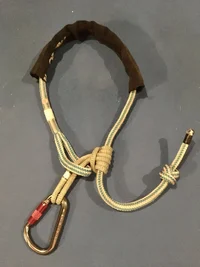
Why does the end of the split tail look so much smaller than the main rope ?See any problems with using split tails from the blakes hitch days as an adjustable friction saver?
Why does the end of the split tail look so much smaller than the main rope ? Because the spliced end is wider
What is that stopper knot ? Figure 8
Make sure the split tail loop is not stressing directly on the prussic eye splices ? i.e. maybe longer prussic cord ? ? ? Yes I will fiddle with the positioning - thanks!
That makes sense to me thanks! I was basing it on this -I use a split tail for a friction saver, I see no problem with it. You’re probably fine like that but it’d have a nicer bend radius with two biners or a biner and a ring or quickie or delta link or small pulley on either the prusik or eye. It’d be retrievable if you use that pear/HMS biner along with something smaller that can be jammed with a knot or retrieval ball.
I can take a pic of mine later tonight if what I wrote isn’t making sense.
What's wrong with the split tail loop touching the eye splices of the prussic?Why does the end of the split tail look so much smaller than the main rope ?
What is that stopper knot ?
Make sure the split tail loop is not stressing directly on the prussic eye splices ? i.e. maybe longer prussic cord ? ? ?
Taylor Hamel is just excellent.That makes sense to me thanks! I was basing it on this -
I was taught that stressing in spliced areas was to be avoided.What's wrong with the split tail loop touching the eye splices of the prussic?
I ask because in another thread we are talking about choking eye splices, the threads were " fate lanyard prototype" and cinching lanyards. Reed wortley waurthaug and AJ moss both say choking eye splices even with hardware is fine...and I believe hey would lie about their break tests.
Now this guy is choking rope on rope...I can't see what's wrong with it but I mentioned in that discussion with them that it seems everybody in our industry doesn't feel the same about choking splices ... Maybe we'll have to start a new thread on the topic.
What your thoughts on choking splices Greg?

Ya that's what I had always thought too but Reed looked at me like I was crazy
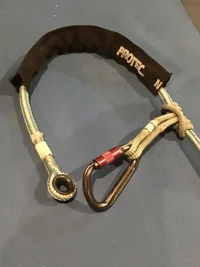
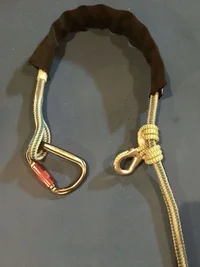
So the moving rope goes thru the carabiner & the thimble ?Maybe this configuration is better with the spliced O. Just trying to repurpose old gear.
Yep, scratch that one. I like using a tight eye. It wont fit through.(a tight eye end will probably not pass thru ?)
Yep, scratch that one. I like using a tight eye. It wont fit through.
In that configuration,, I don't believe, the thimble has to be rated; it is the cordage that needs to be rated. The thimble is only there to improve the bend radius; and abrasion resistance, for the cordage.Im assuming this thimble is not rated for life support but cant find any solid info to clarify?