Speedline Anchor

MikePowers321

Carpal tunnel level member
Location
Leeds, Ny
I was thinking, and of coarse this may have been visited before on the buzz, but if you don't have a solid anchor (truck/tree) point for a speedline, has anyone ever used metal fence stakes pounded deeply into the ground? I would think it would be for relatively light branches. But any ideas on this?
 
I've done it for fairly small branches. Those t-stakes work quite well. Just play with the angle you drive them as it depends on your soil composition.
 
Mike those earth anchors Treestuff sells are legit for that. Do them opposing the pull on 45 into ground if possible . Even the short ones hold some good weights. I'm sure your idea with fence post would work well , even double em up.
 
Combination Picket Holdfast

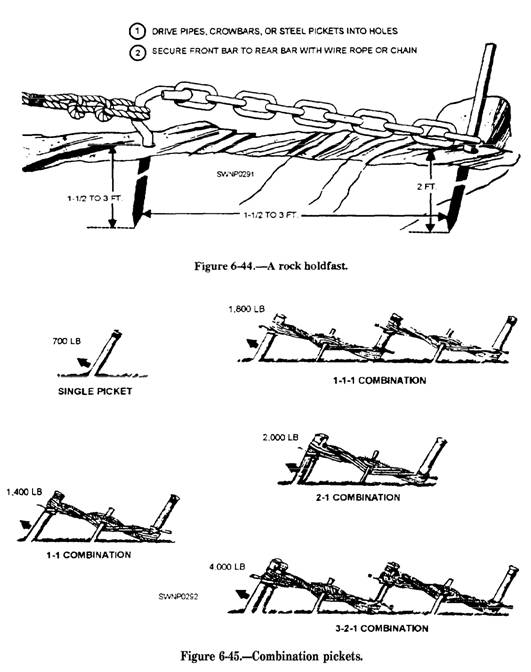
A combination picket holdfast consists of two or more pickets. Figure 6-45 gives you an idea of how to

image285.jpg


arrange pickets in constructing a 1-1-1 and a 3-2-1 combination picket holdfast.

In constructing the 1-1-1 combination (fig. 6-46), drive three single pickets about 3 feet into the ground, 3 to 6 feet apart, and in line with the guy. For a 3-2-1 combination, drive a group of three pickets into the ground, lashing them together before you secure the guy to them. The group of two lashed pickets follows the first group, 3 to 6 feet apart, and is followed by a single picket. The 1-1-1 combination can stand a pull of about 1,800 pounds, while the 3-2-1 combination can stand as much as 4,000 pounds.

The pickets grouped and lashed together, PLUS the use of small stuff secured onto every pair of pickets, are what make the combination picket holdfasts much stronger than the single holdfasts.

The reason for grouping and lashing the first cluster of pickets together is to reinforce the point where the pull is the greatest. The way small stuff links each picket to the next is what divides the force of pull, so the first picket does not have to withstand all of the strain. Using 12- to 15-thread small stuff, clove hitch it to the top of the first picket. Then take about four to six turns around the first and second pickets, going from the bottom of the second to the top of the first picket. Repeat this with more small stuff from the second to the third picket, and so on, until the last picket has been secured. After this, pass a stake between the turns of small stuff, between EACH pair of pickets, and then make the small stuff taut by twisting it with the stake. Now, drive the stake into the ground.

If you are going to use a picket holdfast for several days, it is best to use galvanized guy wire in place of the small stuff. Rain will not affect galvanized guy wire, but it will cause small stuff to shrink. If the small stuff is already taut, it could break from overstrain.

 
We use it in tech rescue all the time. Pickett systems for opposing forces or same side opposing forces in overturned vehicles and such. 1:1:1 is plenty for most applications. 3/4" rebar about 4' long is perfect. The windlass rod is thinner and shorter and 25' of semi crappy rope is perfect. You can probably do this with stuff in your shop. I would consider a post puller though.
 
Depending on what your soil is like I would go with the earth anchor as well. Once they are screwed in about two feet they are pretty solid. You may need to cut them off below ground level with an angle grinder though.
 
I have used cross line anchors with success. A figure 8 as the speedline's termination on the cross line makes it infinitely adjustable. Also allows you to stack you brush.

Of course you are vectoring loading, but just work it into you rigging plan

The two necessary anchor points have been everything from earth anchors to trucks, to big ass tombstones. Even a motor home once in a campground.

Tony
 
You may need to cut them off below ground level with an angle grinder though.

Use a ten foot long piece of galvanized or black iron plumbing pipe, 1" size, the heavy walled stuff. It will cost you between 15 and 40 dollars (varies a lot, catch 'em on sale) and two people can screw them in and out of the ground easily. Stick it through the eye of the 5/8" 4-foot ground anchors to the halfway point, and get a person on each end. Then, you can reuse the anchors over and over again. You just walk around in a circle, works like a champ. We do this every year during a ham radio event called Field Day, to put up 30' towers in a hurry. From that, I got the idea to use them for speedline anchors... but, obviously, lots of people figured that one out.
 
I have used cross line anchors with success. A figure 8 as the speedline's termination on the cross line makes it infinitely adjustable. Also allows you to stack you brush.

Of course you are vectoring loading, but just work it into you rigging plan

The two necessary anchor points have been everything from earth anchors to trucks, to big ass tombstones. Even a motor home once in a campground.

Tony
I like this technique especially if I have other trees and can raise the anchor point nice and high if desirable and they're usually a bit more stable than tombstones ,but that's awesome you used someone's tomb for something cool not many people can say they've done that.
 
actually the Pickett anchor pics were from a virginia department of fire programs presentation. MYbe they got them from the army

In about '86 I was in a surplus store when I was visiting my folks in Phoenix. I bought the hard copy there. Years later when the Internet was up and running I found a website that had the Army Rigging Manual free to download.

One great resource!

One of many sources:

https://rdl.train.army.mil/catalog-...9130-6BCEE7BBC5A9-1343151324082/tm3_34x86.pdf
 
In the past I have tied a rope between 2 anchor points and thrown a prussic on it. Essentially it is a floating anchor anywhere between the 2 main points. Also ground anchors work in some situations. Cool stuff from steve:D
 
We use it in tech rescue all the time. Pickett systems for opposing forces or same side opposing forces in overturned vehicles and such. 1:1:1 is plenty for most applications. 3/4" rebar about 4' long is perfect. The windlass rod is thinner and shorter and 25' of semi crappy rope is perfect. You can probably do this with stuff in your shop. I would consider a post puller though.

Or weld a large ring or cross bar on top to help pull it out
 
Makes me wonder about those anchor things that the off road guys use attached to thier winches to pull themselves out when they get stuck in bad spots. Anyone know what I'm talking about or what those things are called? I seen one recently on some show about an off road challenge or something haha.
 

New threads New posts

Back
Top Bottom