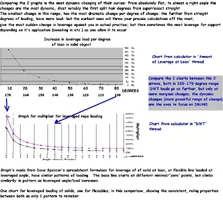
i think that Like Dave Spencer said:
I don't think it is possible to use a calculator or laptop in the real world to "predict" accurate results. Once loaded, everything changes due to flex in the trees, stretch in the rope, and errors in the log weight estimate. I'm sure results could vary by 20% easy. This should just be used as a guidline. I would bet that taking measurments from a static load would be accurate within 4% but by then it is too late.
It seems like a waste of time to use a computer instead of looking at the system and saying "hey, we are passing 90deg of angle, we better start taking smaller pieces because of the amplified forces."
i believe that is after talking to the late Peter Donzelli, so reflecting on his views also.
In the
DWT Thread 's calculator/spreadsheet as well as the
Leveverage at Lean 's thread; there is a common point; that the fewest degrees change off straight/straight gives the most dynamic, immediate fluctations in leverqging load, support and calcualtions. i beleive this is the range we most look to use this stuff.
i think it is okay to classroom the stuff through, scrutinize it, understand it, find it's dynamic and stable points; get a feel for the patterns, to make informed decisions.
In the field, besides what Dave mentions, aren't we guessing at the load, no rot in 100% vertical supports, guessing at pretightening tension, speed of hinging, C.o.B. etc. Where all we can do is learn the deep common principals; at what points the smallest scrutinizations yield the largest impact of support, develop habits that take no more time than other motions- but set that part of the system closer to maximum support/minimum loading multipliers etc.
So i think that a lot of it is an informed guess/gamble in the field; with so many estmated variables. That lessons can be learned by putting pieces of a system under a microscope in the 'classroom'; that might give a 'feel'/respect for forces, setting things agianst themselves and each other and balances etc.; that without the view of the microscope, might take many years to soak in by noticing their pattern correctly, if at all. i think the numbers give us this pattern, and means to break them down into components of a system, to more knowingly trace the flow and multiplying of load and support, in definable components.
Ta always beat the house; when i'm placing my bets, on what can be done, with a line and a saw. When i should back of a bit, when i can take more; when it is set aginst itself so bad it can't work; then so when we have set it against itself, and have strong supports-so you can gracefully really take more. IMLHO