I guess a tension ratio of 1.2 means 83% efficient. Real rope on a real pulley runs 1.2 ratio.
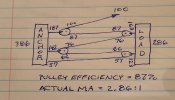
2nd diagram, 4:1 system should put 400 lbs onto load
With a tension ratio of 1.2 the numbers go 100, 83 (87), 68 (76), 57 (66), 47 (57)
100 + 83 + 68 + 57 + 47 = 359 lbs at anchor
83 + 68 + 57 + 47 = 255 lbs onto load
1.2x1.2x1.2x1.2 = 2.07
100 / 47 = 2.13 i.e. nuked by 4 turns around pulleys
A planned 4:1 became a 2.5:1 doh! And that's with a favourable 1.2 pulley, smaller diameter portable kit type pulleys would be worse.
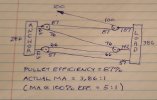
first diagram, 5:1 system should put 500 lbs onto load
reverse the roles of the numbers, you get 359 lbs onto the load
A planned 5:1 became a 3.6:1 doh!
Very discouraging.
And the tension ratio for a biner on an alpine butterfly or probably also for rope on rope for serious gear minimalists is 2.0. So the numbers would go 100, 50, 25, 12.5, 6.25 lbs
50 + 25 + 12.5 + 6.25 = 93.75 lbs from putting 100lbs into a 4:1 system!!! 2nd diagram
for first diagram 100 + 50 + 25 + 12.5 + 6.25 = 193.75 lbs from putting 100 lbs into a 5:1 system!!!
Moral of that story always use pulleys, not biners on a bight.
Thanks for the illustrations

edit - Dan, easy way for mechanical advantage - count how many strands of rope leave the moving body, easy to see 4 and 5 in the diagrams. doesn't matter if from a pulley or fixed, rope is pulling