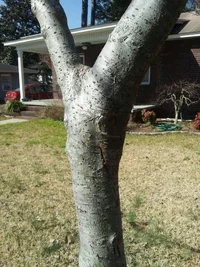
Slits

Another...
386920-rps20140314_172850.jpg
 

Attachments

  • 386920-rps20140314_172850.webp
    386920-rps20140314_172850.webp
    136.2 KB · Views: 18
Yes sir, I understand the lenticels. But I've watched this tree on pretty much a daily basis and there was never a fresh injury showing. I would have said the same thing had I seen it on a client's tree. However in this case, they just appeared sans injury.
 
The transverse or "horizontal" ones here are lenticels and constitutive." Awesome adjective! The axial or "vertical" ones are induced by normal bark separation. Maybe 'mechanical' means any physical force, like phloem burgeoning out faster than the outer layers, forcing them to tear slightly.

That's my current theory on TL's tree. I agree with RS that the dotted lines (I smell a title there) on the elms I saw at UTexas may be 'ray cells gone wild". These presumably pass gas, so could they also be considered lenticels?
 
To me, mechanical means mechanical. I'd think it was from the outside in rather than the inside out, but a dissection would resolve it. Sort of like speculating on the number of teeth in a horse's mouth...might as well just count 'em. I realize that dissection is likely not an option here. Fortunately for me, I go back to the central question: "how important is it to know" whatever it is we are talking about. If understanding the process is more important than the individual stem, then go for it! If not, life can remain a mystery...which can be nice as well.

Rays and lenticels are quite distinct, I'm not sure of "ray cells gone wild", although they can indeed explode in size as they enter the phloem.

Yeah, constitutive versus induced is a key distinction in evaluating structure and function!
 
[ QUOTE ]
Sort of like speculating on the number of teeth in a horse's mouth...might as well just count 'em.

[/ QUOTE ]

Yeah but who really wants to be the little kid that gets whipped and thrown out into the dark street?

Sorry, I can't really contribute to the discussion so I will leave now.
 
if you go by wikipedia
A lenticel is a porous tissue consisting of cells with large intercellular spaces in the periderm of the secondarily thickened organs and the bark of woody stems ...

or
Merriam‑Webster
Dec 7, 2012 - a loose aggregation of cells which penetrates the surface (as of a stem) of a woody plant and through which gases are exchanged between the ...

If ray cells rapidly growing emerged at a lenticel...is that what we're looking at in the original post?

re dissection, I have 3 elms out front; will look for a characteristic branch to sacrifice.

Whipped? o cmon...
 
Rays extend through the phloem to the cork cambium (if present). Rays don't extend to lenticels which are to the outside of the cork cambium. Indeed, respired CO2 and essential O2 from the atmosphere do exchange through lenticels, but the rays are interior to that and not directly and physically connected. Probably a picture in Esau's plant anatomy text, but I don't have that within reach from my home desk.
 
Kevin, we've seen cases of parenchyma in rays dividing and growing outward.

Could the expansion break through?

So if the lenticels are outside the cork cambium, what pathway does this gas flow follow in and out of the tree?
 
Definitely, ray parenchyma can divide after mechanical injury and localized death of the cambium. Often, that's where the callus pad originates that becomes the source of of new vascular cambium. This is well-described in standard texts.
In my own histology, I haven't seen involvement of proliferated cells associated with rays reach lenticels. I do not recall encountering published accounts of that either.
Actually, that is not surprising. Lenticels are in the phellem or cork. Phellem is derived from divsions of the phellogen (cork cambium). Most of those cells destined to be cork are pretty thick-walled and suberized. However, there are patches of thin-walled, less suberized (unsuberized?) parenchyma produced. Those patches become lenticels. As phellem matures, the living cells die. The thick-walled corky cells persist. The thin-walled cells break down, leaving air spaces. That's where the lenticels come from.

That's about as far as I can roll this. I'm thinking that no one else is interested in this thread by this point. I'll email you a paper, not so much on the 1st year anatomy above but on some of the consequences (Lenzian, K.J. 2006. J. Exp. Bot 57:2535-2546). I'm not attaching it because of copyright policies, but I'd email it to anyone else still interested!

Of course, I could be mistaken here. Standard texts can be incorrect as well, but I'm sort of curious why this is such an important point.
 
Thanks Kevin for that review; I'd forgotten much of that process. It's important only in trying to figure out the original feature, the suspicious slits. Those trees are in a shaded and poorly drained area as I recall, so lenticels and aeration were high on the list of theories.

This reminds me of the washboard-type rippling feature on beech bark that i once tried to suss out. Frank Telewski skied down that rabbit hole with me on that one, and at the end it came to the same conclusion; ya gotta cut it open to really know.

i'll be getting a new blade for my table saw and keep my eyes open when in U. parvifolia for sacrificial samples, and we'll see wassup down in there, some day.
 
[ QUOTE ]
TL, those look like cat scratches.

[/ QUOTE ]
I know they do. And there are plenty of cats around.

But no joke, my yard is my stress release. It's where I go to decompress and get over a tough day. And I baby my trees. If there's an injury I know about it. Ask anybody in the neighborhood and they'll tell you the same.

Anyway, not a big deal. It's a little disheartening to try to back someone's research with evidence and then have it shot down, that's all. But I'm over it. For now on it's ears open and mouth shut.
 
I got cats, foxes, coons, possums in the yard. That 'scratch' is normal bark separation. imo.

Thin skins?--still can't see where all this shooting and whipping took place. This is the internet, guys; all theories are fair game. Hold on loosely, but don't let go!
 
No disrespect intended or received from my end! I apologize if I was a bit abrupt! We are all learning every day, or could be learning every day. Sometimes no matter how hard we study and examine and think on a question, a useful answer does not come and the mystery continues. That's my world, anyway!
 
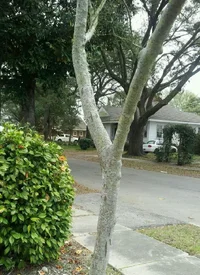
Not trying to beat a dead horse here but maybe this pic illustrates more clearly that these are not cat scratches but a natural reaction of some sort that the Ulmus parvifolia are going through.
387853-rps20140325_183753.jpg
 

Attachments

  • 387853-rps20140325_183753.webp
    387853-rps20140325_183753.webp
    225 KB · Views: 10
Eggs Ackley, as R. Crumb would say. Normal maturation, not physical damage. Adolescence looks awkward.

Looks like some directional pruning on the roots might be in order soon.
 

New threads New posts

Back
Top Bottom