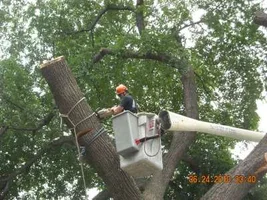
slings for hanging pullys and blocks

5/8th Tenex loopies for hanging blocks. The WLL doesn't have to be a lot higher than the anchor at the ground. Gotta remember the biological entity that the block is hanging from.

Too large of gear for the tree to handle could result in a tree failure. Discresion in a learned thing. When in doubt, cut what the tree, gear ang your experience will handle!

3/8th Dynema (Amsteel) is a great alternative when gear weight is an issue!
 
[ QUOTE ]
5/8th Tenex loopies for hanging blocks. The WLL doesn't have to be a lot higher than the anchor at the ground. Gotta remember the biological entity that the block is hanging from.

Too large of gear for the tree to handle could result in a tree failure. Discresion in a learned thing. When in doubt, cut what the tree, gear ang your experience will handle!

3/8th Dynema (Amsteel) is a great alternative when gear weight is an issue!

[/ QUOTE ]

Tree strength issues aside, if your block attachment is not 2x the strength of the attachment for your lowering device, you don't have a well balanced rigging system. Your block attachment becomes the weak link.

3/8 Amsteel is rated at 19,600#(which is 1960# wll), taking that into account, the advice given seems to be at odds with itself.
 
[ QUOTE ]
3/8 Amsteel is rated at 19,600#(which is 1960# wll), taking that into account, the advice given seems to be at odds with itself.

[/ QUOTE ]

The word you are looking for is 'contradictory.'
 
The WEAK link is the inability to know the weight of the load! OR knowing what your limb or crotch will handle.

The Amsteel proves you can potentially have much larger loads than the trees can handle, in a much smaller package.

Most don't seem to get it. The WEAK link in any system are the UNKNOWNS!

Feel free to put together a BALANCED rigging package (as far as gear is concerned). That is the best option. STILL if you are unaware of the weight of the load, and the trees ability to support it, it is poke and hope!

Banjo, I know a guy JUST like you!
 
Your rigging line should be the weakest component of the system. Not either of your anchor points.

Why would you want your block anchor point to be 2x stronger than your lowering device attachment? That makes no sense at all.

A GRCS uses a 40000 lb truck strap for anchoring, even though the GRCS is rated for 2000lb wll the anchor point itself is far stronger.


3/4" tenex sling for block placement, 3/4" tenex whoopie for friction device attachment, and a 5/8 or 3/4" double braid rigging line= equals a system where the line is the weakest link. As it should be.
 
My understanding is that the block and what is securing it to the tree are having 2x the weight of the piece that is being lowered pulling on it. Say your lowering a 200lb piece of wood. You need to pull with 200lbs of force to keep the log suspended. That = 400 lbs exerted on the block and sling. Therefore the sling holding the block should have 2x the working load of the lowering rope. Or at least be a good bit stronger. Is this correct?
 
[ QUOTE ]
My understanding is that the block and what is securing it to the tree are having 2x the weight of the piece that is being lowered pulling on it. Say your lowering a 200lb piece of wood. You need to pull with 200lbs of force to keep the log suspended. That = 400 lbs exerted on the block and sling. Therefore the sling holding the block should have 2x the working load of the lowering rope. Or at least be a good bit stronger. Is this correct?

[/ QUOTE ]

That is correct. It is even double that if the block is set from the ground over a crotch with a line installed in it as in a false crotch system. My $.02 worth is that regardless of the balance or imbalance of the system, I would not want my block or my lowering device to fail before the line would. This includes the devices themselves and or the lines or slings that secure them. I agree with treedimensional that a rigging system that can handle more than the tree is easy to put together. Some discretion is needed.
 
I think your 5/8 eye sling will work perfect 9 outa 10 times i have some that are made of 1/2" and 6' long love them up in the tree also i have webb slings off my hip i use alot but your 5/8 rope will be fine just keep an eye on them for wear and know there limit and play within it if u come across something to big don't use it rethink your plan but i personally like them
 
I'm in agreement that balance makes sense in rigging system, I agree that the block connection needs to support ~2X what the load line will see. I also agree that we are rapidly approaching the point where rigging gear will exceed the strength of most trees... for practical rigging purposes anyway.

Here's what I'm not clear on, how do you choose what will be the weak link? For instance Tophopper says it should be the load line and that makes sense... perceptually. But what are the physical reasons? Why the loadline and not one of the lowering anchors?

I'm not saying that's wrong, I'm just wondering how you pick a weak link.

To me, the weak link is what you wind up with. Another way of saying it is, I'm gonna build a system with NO weak links, I don't plan on ANY of it coming even close to breaking. The weak link is what it is... but it's still waaay stronger than the load I'm gonna hit it with.

That's the philosophy anyway, doesn't always work like that, and I'm not claiming any high ground here. I was pretty tense about a pine tree I was using yesterday a that kept on bending and bending and a 2 year old 9/16" was getting more of a workout than I wanted... multiple points were closer to failure than I wanted.

I just think it's an interesting exercise to decide WHAT should fail first when failure basically amounts to disaster.
 
A breaking rope is bad. A tensioned block breaking free flying at the climber, or lowering device flying up at the climber seems worse. A block attached to a broken tree top flying down at the climber seems worst.
 
Blinky, I hear ya! SST too! So back to the fundamentals. Rule 1: (at least for me) is that NO ONE will be under the LOAD or in its PATH in the event of a failure. Rule 2: A climber is less mobile (due to 2 tie-in points when cutting) so the rigged piece (or failed gear) should move away from the climber.

To summarize: it is NOT cool to bust up a clients stuff, BUT in the event of a rigging component failure, I would choose to have stuff busted up than to kill a climber OR a ground person.

For me, I would rather have the sling/block come off the tree than the rope coming back up at me a mach chicken!!!!

I wonder how many people have seen a 9/16, 5/8 or 3/4 inch modern rope break. My test bench guy broke a 1 1/2" rope on the bench. It ended up in a melted blob and blew the end off the bench!

*This of course in an extreme situation* REMEMBER Discretion it what will keep you ALIVE!
 
[ QUOTE ]
But what are the physical reasons? Why the loadline and not one of the lowering anchors?

I'm not saying that's wrong, I'm just wondering how you pick a weak link.

[/ QUOTE ]

I think it is a general consensus of those who have experienced the various failures that the load line is, at least in a small degree, less lethal.

I have had a one inch load line (old 3 strand, not the modern double braid) fail, wrap over my back and try to yank me out of the tree. Not the most fun I have had, but I am still here. I have also experienced blocks and lowering devices being catapulted through space at blinding speeds. That's a sight that will definitely make you pause and reflect. Lots of dangerous forces there.


[ QUOTE ]
The weak link is what it is... but it's still waaay stronger than the load I'm gonna hit it with.

[/ QUOTE ]

Head of the nail struck with this comment. Too many lose sight of this. It is far too easy to produce tree failure with our modern, super strong equipment. You must use caution and judgment to prevent this worst case scenario.

Dave
 
so im guessing i should just use a 3/4 sling for my blocks from now on. since i use my 5/8s line alot and the sling should be stronger then the line. i just ordered a new 3/4 whoopie sling for my porty wraper. i do a bit of coconuts removals too and a 3/4 sling will probably speed up production for me becuase i can drop bigger pieces.
 
Check out the tenex loopie for your blocks. Because of the way they choke they have a higher WL than the whoopie. The whoopie is more versatile however because of the fixed eye. You can more easily hang and adjust pullies with the whoopie. You have to experiment to learn what works best for you keeping WL's in mind at all times. Again, learn to splice tenex and you can make customized stuff inexpensively. Double braid is good too but is harder to splice and not for making adjustable slings.
 
[ QUOTE ]
so im guessing i should just use a 3/4 sling for my blocks from now on. since i use my 5/8s line alot and the sling should be stronger then the line. i just ordered a new 3/4 whoopie sling for my porty wraper. i do a bit of coconuts removals too and a 3/4 sling will probably speed up production for me becuase i can drop bigger pieces.

[/ QUOTE ]

Be sure that your block can handle the size sling as well. If you were to use a larger sling that the block is designed for, you may get side pressure on the cheek plates from the anchor sling.

Your block sling being more than 2x's your rope's swl is right.
 
Good point. 5/8 block, 5/8 sling. You said your block was 5/8 so try the 5/8 loopie sling which has a WL of 2500lbs. Perfect match for 9/16 stable braid or 5/8 tree master. Both about 1250/1300 WL.
 
5/8 Stable Braid -SWL 1630 lbs
3/4 Tenex Sling- SWL 2200 lbs
2 Ton Block -WLL 4000 lbs

238602-7-7-10080-400.jpg


every bit of 1600 lbs.
 

Attachments

  • 238602-7-7-10080-400.webp
    238602-7-7-10080-400.webp
    43.2 KB · Views: 58

New threads New posts

Back
Top Bottom