Skylining micro-chipper into forested work site...ideas.

Some ramblings.

The reeve line is basically a double whip so the line sees 1/2 chipper = 225 lbs. During lift pulley drag only adds .4x225 = 90 lbs more tension, lowers tension by 90 during lower. so its low stress

If you tension up the carry line reasonable, adding load is like sweating a tree-pull line sideways and a practical advantage is about 5x, so 450 lbs is going to at least 5x or 2500 lbs. If you redundant a second carry line it'll just add the pretension, net load will get divvied up to make 2500

the traverse line uphill is 450 lbs x sine hill/rope angle plus pulley drag so its a smaller portion of 450 lbs

to tighten or to catenary - if you trad highline tension tight the numbers get big. if you go easy on the tension the rope sags and forms a basket tending to roll the load to center span - then you're fighting uphill traverse load, but is it perhaps even lower than the pretension would be?

A possibility instead is backstay the two spars and do a 2 rope M rig, just increment the two lines to move the load. grcs at each tree base, line up to rigging pulley and down/attach to chipper/rigging plate/slings etc. however no support redundancy - that's a judgement call. net tension on the ropes might be even half sized depending on amount of sag

too much time on my hands

A little sidethought creeping in - if something fails and the chipper splats - not the same as brush or a log splatting. Occurred because of rescue guys examples being so redundant
 
Last edited:
Remember the 120 degree rule, as highlines add some fuck off forces on the anchor trees. Keeping the load as close to the ground is best, and one challenge is getting the lines high enough.

Another option vrs the reeves is a two winch system but they must be braking winches. 1A and 2B The near gin hang two blocks and place one winch line per block.
The tail tree has only one block (2B).

Now for the carriage rig either a straight pick or a double whip with 1A. This has a rider block mid span on the belly of 2B. The bitter end of 2B pulls on this rider block where its terminated.

Winch 1A pays out slack when winch 2B takes in. This raises the load and also moves it to the trail at a height determined by the rate 1A lets slack out.

It gets jerky and dynamic but allows for the operator to fly the load at a desired height across undulating ground.

Con: a reeve static sky line can have the anchors on trees further out than the gin and tail somewhat acting as guylines.
Pro: one less line an a more basic carrage.

If going with a reeve I personally like the CMI rigging trolly and a pair of rock exotica swivel pulleys. The lighter Dmm only accepts 1/2 inch lines and has an oddly low WLL.
For the load attachment i prefer the largest block (dmm) with the tunnel axle and this is where i put the back and forth control lines (limits twisting). The weight helps dropping a belly but frequently needs a manual tag line to make sure it drops when unloaded (one way brush hauling loads).

Let me know if this makes sense, I can draw something up if you like.
 
The M rig only needs two blocks and two grcs, but doesn't have suspension redundancy. Does away with reeve cart/pulleys and traverse line(s) and pulleys. all methods need backstays.

More gear definitely makes more elegant and better. But burns setup and takedown time. Also a factor many loads vs one off load (slow/fast/easy load movement).

What say the experienced highline folks to sloppy highline tension, does it just degenerate into a mess or it works (despite the basket effect) but just looks bad?


Maybe a diagram with 1A 2B (or not to be:)) to confirm it was understood correctly
 
This is native forest with trees overhanging the one lane road.

We could drag brush, skid brush piles, or high line brush.

This microchipper will be a versatile tool for a specific niche.

On this job, I can probably roll the chipper in. I found a route. Only native ferns getting roughed up a bit.

I specialize in tough access jobs and low-impact, so it is a matter of building capacity to do various work in various ways.


Cranes are great tools, but they need a bunch of space.
8 years or more ago, a 50t was $1300+ minimum port-to-port.
Makes sense. My crane operator has a 4hr minimum port to port at $750 for a 50t. It makes it worth calling him in for trees that can be done within an hour for zero ground impact.
 
Forest management of a root- disease pocket of very tall doug-firs upwind of a shop and 2 large declining cedars. (hazard tree mitigation, invasive species removal, replanting with non-susceptible species, fuel reduction).

Neighbors on one or both sides have narrow undeveloped strips of land the homeowners want to buy, but haven't been able to convince the neighbors. One side is too small to build a sensible house on. They bought the raw strip for 500k during the bubble that broke in 2008. Now worth 150k. Maybe their root- disease trees will persuade them to sell.


These trees were supposed to be logged with the rest as prep for the shop being built, but the one homeowner started hugging trees mid-logging (small scale logging that I turned over to someone I know who does small scale logging).

They've had several trees tip, and some are fading.

We've be making them short enough to not be in reach of the new 40x60' shop.
 
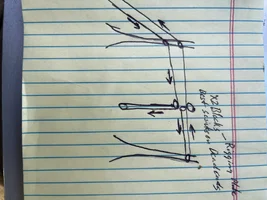
Here is the sketch of the ‘dynamic’ high line. Obviously deflection is needed and when moving the load away, the top winch needs to overcome the braking from the other increasing forces.
If the bottom line is held tight the load will raise.

Bringing the load back in to the winches is basically the same in reverse. This system works best with limited gear. The double whip isn’t necessary if the load is light.
Best used when wanting to keep the load low to the terrain. Uses less gear but certainly takes coordination
 

Attachments

  • image.webp
    image.webp
    197.2 KB · Views: 9

New threads New posts

Kask Stihl NORTHEASTERN Arborists Wesspur TreeStuff.com Teufelberger Westminster X-Rigging Teufelberger
Back
Top Bottom