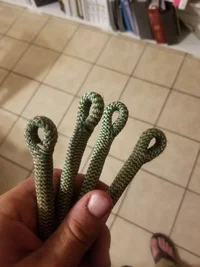
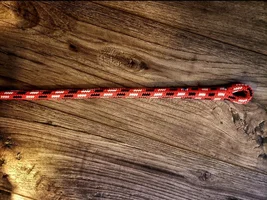
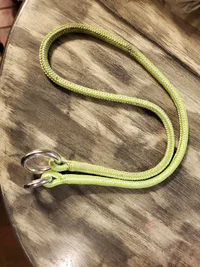
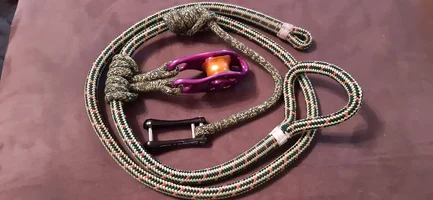
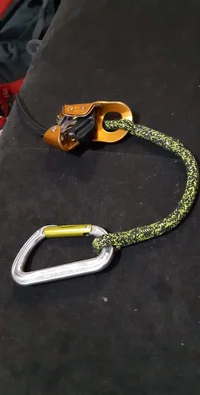
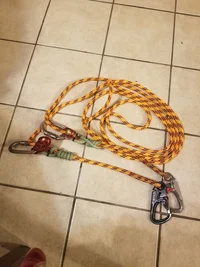
I think a mass producer would make large pockets to accommodate a large variety of objects. Your point of faster production might have something to do with it too. I also make mine as small as possible, customised to the block I intend the sling for.
My bad, i should have specified.. what i mean is the large pockets on Safebloc, THT, Beast rings etc.. they are indeed large hardware, but in the cases I'm referencing, it's as if you could almost fit these things through longways.
On the bare slings, the large pockets make would sense though from an "unknown usage" perspective..
I've developed a habit of using my single ring ultras as utility slings since they are usually in a bag close by the work. Choke them around a tree and clip a pulley to a loop to redirect a pull line or to clip the rope puller to.
I like small pockets.
Bonner mentioned at some point that the ultraslings are the most time consuming spliced products that they make, so fewer splices and less rope needed to meet a certain length both seem like good reasons.
I have never tried a commercially produced ultra. Do the ones for smaller rings have pretty small loops?
I'm glad you mentioned the Bonner posts. This leads to another question that's been bothering me. At one point he mentions the importance of having each leg equalized.. this makes sense to me as well as not inducing twists as well.. but my question is, how are they going about it, are they actually counting pics per section? Or just eyeballing/measuring & adjusting the first brummel of each series?
I've done it both ways & have noticed you can't just mark equal lengths. I'm usually one pick shorter or longer than the opposite side when counting from that sides last tuck. This will usually get them dead on for me. For a 5/8's single Med X ring, I'm usually 13 then 14 on the other side when counting picks.
I'm just curious how y'all are going about it. My newer methods is definitely way more time consuming, but kills the second guessing in the back of my head.
I don't think I've ever bought one, actually. The ones I've seen usually had fairly large pockets no matter what was spliced onto it.
I haven't either, i can't justify the cost even though i know there's probably a better methodical process being used. 249 retail for a safebloc & about 30ft of spliced tenex is just... Idk.. alot! Lol.
(This isn't a question directly to you Jeff, but if you know.... by all means..)
Speaking of Tenex-Tec & Safebloc..
I've thrown this out there without much luck before, but, where did the idea of Trex not being ok for Safebloc/Notch Triple Thimble come from? Is there some actual data or recorded accounts that suggests not to use it?
I ask as i still see people (ppl who make an actual living splicing) still using Trex on these items without any sort of concern being voiced..