Show off them splices

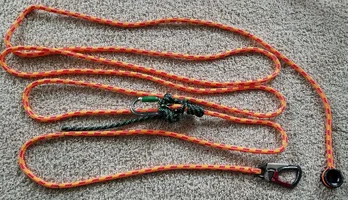
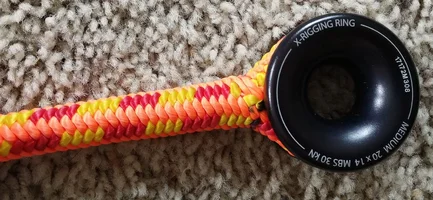
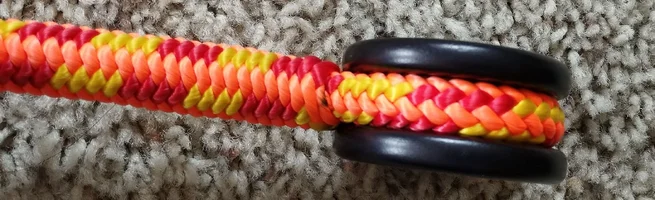
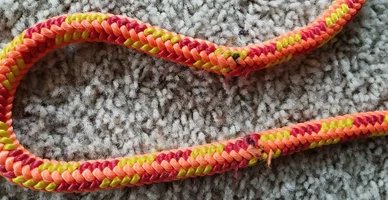
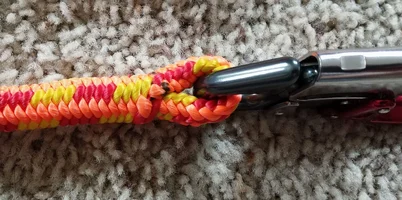
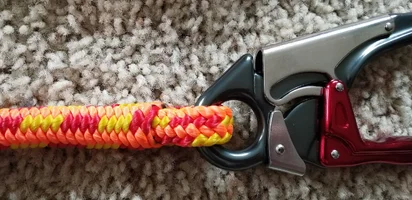
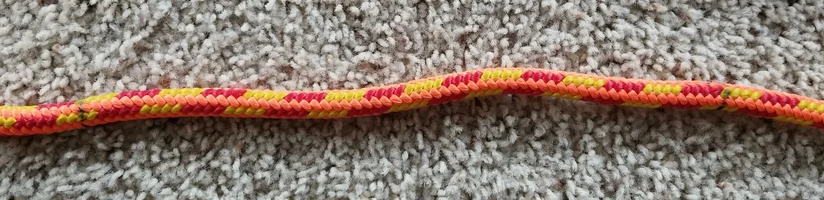
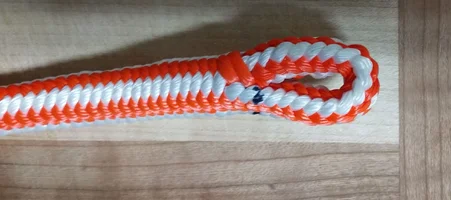
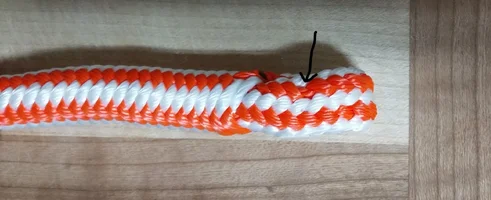
Had about 30' of Yale XTC Fire from a treestuff rope bag, turned it into a lanyard this morning (and yesterday evening and the evening before...) I've only got improvised tools, and had never done 16 strand before, so it was pretty tricky at first... but the second splice went a lot faster than the first. Some good techniques in this video and this thread. I did the side with the ring first (credit to @Tuebor for the ring-on-tail-end-of-lanyard idea), but the tools I used to spread the cover strands to extract the core weren't sufficiently rounded, so I broke some cover strands and kind of made a mess. I found a more rounded thin rod to use on the snap end, so that went better. Still need to lockstitch both ends -- it seems like there's a variety of methods and locations to do this, so I'm doing a bit of research.

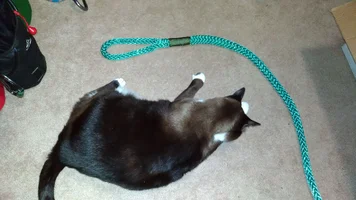
Finished product:
IMG_20180421_122558.webp
Tail end (note the messed up cover fibers in the crossover area):
IMG_20180421_122629.webp IMG_20180421_122632.webp IMG_20180421_122644.webp
Snap end:
IMG_20180421_122611.webp IMG_20180421_122613.webp IMG_20180421_122622.webp
 
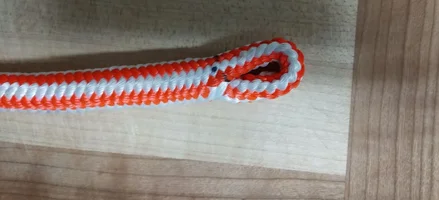
Send help, I might have a problem... third 16-strand splice of the day. 60' piece of Braided Safety Blue Hi-Vee, also from a rope bag -- spliced a tight eye on one end to make a shorty climbing line. I made a better wire fid, and this one was the smoothest of the three, although there's one issue. One of the cover strands (orange strand, halfway up the eye in the second photo) is pulled noticeably tighter than the others, leaving one side of the eye slightly bunched up. How much of a problem is this? I'm planning to go tie it to a tree tomorrow and hang on the eye a bit to see if it equalizes itself before I lockstitch it. Should I be worried about that strand taking a disproportionate amount of the load in the long term?

IMG_20180421_205900.webp IMG_20180421_205912.webp InkedIMG_20180421_205907_LI.webp
 
For the tight strand, just slide something under it and gently lift it until it matches the rest. The carburetor adjustment screwdriver from Sthil, with edges rounded off, is a good size for this.
 
Hey ladies and gents,

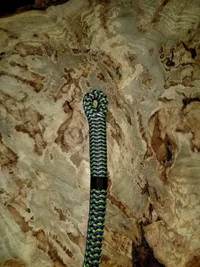
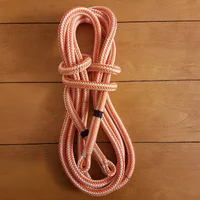
Completed my first 16 strand tight eye splice in hi vee to use as a 12 foot lanyard. Gotta say smooth sailing until the crossover final bury. Took a real solid anchor and a lot of effort to bring it home.
Antibiotic cream for blisters....$10
Appointment with acupuncturist for tendonitis.... $50
The feeling you get when you are hanging off of your first life safety rope that you spliced....priceless20180429_225040.webp
 
Hey ladies and gents,

Completed my first 16 strand tight eye splice in hi vee to use as a 12 foot lanyard. Gotta say smooth sailing until the crossover final bury. Took a real solid anchor and a lot of effort to bring it home.
Antibiotic cream for blisters....$10
Appointment with acupuncturist for tendonitis.... $50
The feeling you get when you are hanging off of your first life safety rope that you spliced....pricelessView attachment 51295

Do you have a wooden mallet or a rubber one to beat the hell out of the tight area and loosen it up? I've got a ghetto piece of apple wood that looks like a hammer I used to use to beat the splice loose again.
 
Thanks for the tip...I was just putting a fid in the eye and working the throat like mad. Will try the mallet on the next one. I find splicing similar to lays potatoe chips...bet you can't just do 1. #addicting
 
5/8 tenex eye splice. I used waxed poly for the lock stitch and 550 cord for the wiping. I really like the 550 cord.
 

Attachments

  • 15266895521892253134148926029732.webp
    15266895521892253134148926029732.webp
    379.7 KB · Views: 20
With all the rain keeping me out of the trees I am getting some splicing done. The blue moon and tachyon splices are so tight I don't think lock stitching is necessary. I don't think they are going to slip at all, I can hardly bend them.What do you guys think?
 
I would think above, so that, that part of the core is included. I also stitch then whip, but do the stitches next to the throat with a speedy stitcher type tool. Probably no advantage, but I like the look of the whipping right next to the eye.
 
I also like the look of the whipping next to the eye, but these are so tight I would have a very hard time to pass a needle through it. I am probably going to whip these below the core extraction point. When the splices are this tight I get the sensation of the needle ripping through strands instead of sliding through. I try to do my whipping as high up as I can without getting that ripping feeling in the needle.
 
Maybe check the tip of your needle for burrs, or maybe it needs to be rounded more. If the tip is correct, there isn't going to being tearing ,or shredding of fibers. Having a handle makes it easier than having to force the needle through with pliers. You just have to be careful to watch that the needle doesn't bow while you're struggling. I use a 1/4" drill chuck on a handle. Similar to the speedy stitcher, but has adjustability for different needle diameters.
 
I have read that some splicers use a ball tip needle instead of the standard needles. I think that would help. I have new sail makers needles and they work great if the rope is not stiff as iron. I don't pull on them with pliers because I don't want to make any burrs. I have used the speedy stitcher with brand new needles and it does the same thing if the rope is too stiff. What kind of needles do you guys use? Any idea where to get the ball tipped speedy stitcher needles?
 

New threads New posts

Kask Stihl NORTHEASTERN Arborists Wesspur TreeStuff.com Teufelberger Westminster X-Rigging Teufelberger
Back
Top Bottom