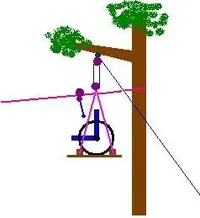
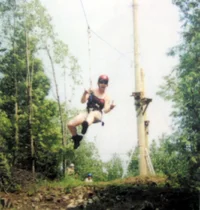
Howdy. I'm part of a non-profit group that does recreational tree climbing with kids that have disabilities. We've been doing it for a couple of years, and we're trying to expand the experiences that we can offer disabled climbers. To that end, we're working on the details of setting up a zip line between 2 trees. We often use a double pulley system to get the kids out of their wheelchairs.
Our thought was we'd use that to get them in the air, raise them to the level of the zip line, transfer them onto the zip (and use a tag line), then they ride the zip line down toward the other tree - almost to ground level, where they are clipped into another double pulley system, then lowered back into their wheelchair.
I've had some email conversations with TheTreeSpyder after looking through some of his pages about different rigging concepts and examples. There was a discussion about 5 years ago about speedlines that included a bunch of force calculations. ( Speedline forces ) Unfortunately, the accompanying diagrams are lost to cyberspace. Anyway, he suggested I post here for some further help.
One of the things we're trying to do is figure out the forces involved, so that we can determine how best to rig it (especially in regards to angle of the ropes) and even what kind of rope to use. We currently use 1/2" arborist rope(XTC), but we figure we'll have to change that for this application. I've seen the tables that list the amazing increases in force on the rope as the angle of pull gets closer and closer to 180 degrees, but I'm having a hard time visualizing how to figure that out in a zip line setup. Obviously, we don't want to rig it in a way that creates forces that might damage (or break - Yikes!) the rope.
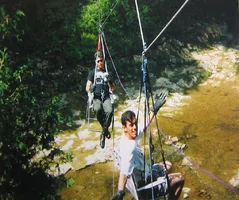
We have a couple of print resources that discuss the setup of a zip line, but it is more geared toward people in the rock climbing industry.
Does anyone have any diagrams or additional thoughts about forces involved in setting up a zipline?
Thanks for any help,
Patrick
www.arborquest.org
Sorry for the long post!
Our thought was we'd use that to get them in the air, raise them to the level of the zip line, transfer them onto the zip (and use a tag line), then they ride the zip line down toward the other tree - almost to ground level, where they are clipped into another double pulley system, then lowered back into their wheelchair.
I've had some email conversations with TheTreeSpyder after looking through some of his pages about different rigging concepts and examples. There was a discussion about 5 years ago about speedlines that included a bunch of force calculations. ( Speedline forces ) Unfortunately, the accompanying diagrams are lost to cyberspace. Anyway, he suggested I post here for some further help.
One of the things we're trying to do is figure out the forces involved, so that we can determine how best to rig it (especially in regards to angle of the ropes) and even what kind of rope to use. We currently use 1/2" arborist rope(XTC), but we figure we'll have to change that for this application. I've seen the tables that list the amazing increases in force on the rope as the angle of pull gets closer and closer to 180 degrees, but I'm having a hard time visualizing how to figure that out in a zip line setup. Obviously, we don't want to rig it in a way that creates forces that might damage (or break - Yikes!) the rope.
We have a couple of print resources that discuss the setup of a zip line, but it is more geared toward people in the rock climbing industry.
Does anyone have any diagrams or additional thoughts about forces involved in setting up a zipline?
Thanks for any help,
Patrick
www.arborquest.org
Sorry for the long post!